G7 Guitar Chord
G7 is the G dominant seventh chord. It has four notes: G, B, D and F. The open shape uses three fingers, no barre, and every string is strummed. G7 leads so strongly to C that you will find it in most songs written in that key.

Three fingers spread across the first three frets with three open strings in the middle. Strum everything.
How to play G7, step by step
- Index finger: 1st fret, high E string
- Middle finger: 2nd fret, A string
- Ring finger: 3rd fret, low E string
- Strum all six strings.
The F on the high E string is the note that turns G into G7. Practice moving between C and G7: the two chords partner in an enormous number of songs.
More ways to play G7
There are 4 common G7 shapes in total: the standard one at the top of the page, plus these, easiest first. You only ever need one. Tap any card to hear it.

Punchier and more even than the open shape, with no strings ringing loose.

Clean and mid focused, without the low G thump of the other shapes.

The highest and tightest G7 here, thin on bass but very articulate.
Songs that use the G7 chord
- Learn this song(opens a new tab on our partner site)
Imagine
John Lennon
- Learn this song(opens a new tab on our partner site)
Me & Bobby McGee
Janis Joplin
Yesterday
The Beatles
Capo 5
Learn this song(opens a new tab on our partner site)- Learn this song(opens a new tab on our partner site)
How Sweet It Is (To Be Loved By You)
James Taylor
- Learn this song(opens a new tab on our partner site)
Crazy
Patsy Cline
- Learn this song(opens a new tab on our partner site)
Ruby Tuesday
The Rolling Stones
If strings go dull or buzz
- High E string buzzes
- The index finger is stretched away from the other two, so it tends to land lazily. Bring it right behind the 1st fret and press with the very tip.
- Open strings sound choked
- The ring finger on the low E often bumps the A string, and a flat middle finger can catch the open D. Arch both so the middle of the chord can breathe.
- The stretch feels too wide
- Tilt the hand slightly toward the nut so the index reaches the 1st fret without pulling the ring finger off the 3rd. The shape loosens up within days.
What makes it a G7
G · B · D · F 1 3 5 ♭7
G7 is a G major triad (G, B, D) plus a minor seventh (F). The F and the B sit at the most unstable distance two notes can have, and they collapse inward onto the E and C of a C chord. That is why G7 is the V7 of C major and C minor, and since C is among the most common keys in popular music, G7 is often the first dominant seventh a player ever needs. When a song feels like it is asking a question, G7 to C is frequently the answer.
G vs G7
G major rings a G on the 3rd fret of the high E string; G7 lowers that top note to an F on the 1st fret. Everything below stays the same, but that single change tips the whole chord toward C. Keep G when the chord is a resting place. Reach for G7 in the last bar before a C chord, where its pull does the work for you.
G7 in major keys
Every note of G7 sits inside these keys. See how it works alongside the other chords in each one.
G7 chord questions
What is the difference between G and G7?
The top note. G major has a G on the high E string at the 3rd fret; G7 lowers it to F at the 1st fret. That F makes the chord pull toward C.
Is G7 easy to play?
Yes. Three fingers, no barre, all six strings strummed. The only challenge is the stretch between the 1st and 3rd frets, which fades with practice.
Why does G7 sound unfinished?
The F and B inside it form the most tense interval in music. Your ear expects them to resolve into a C chord, so G7 on its own feels like a held breath.
Do you strum all six strings in G7?
Yes. Every string is part of the open shape, from the G bass note on the low E to the F on top.
What songs use G7?
Hound Dog and Route 66 use G7 in their blues changes, Sunday Morning cycles it in a ii V I, and Fly Me to the Moon runs it inside a jazz turnaround.
Chords to learn next
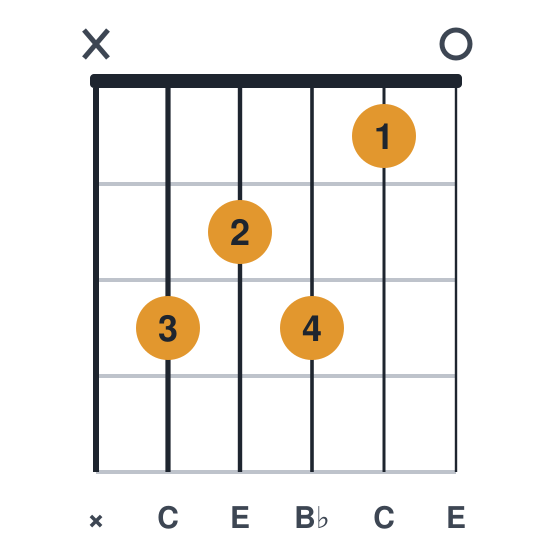
- C7G7 resolves to C
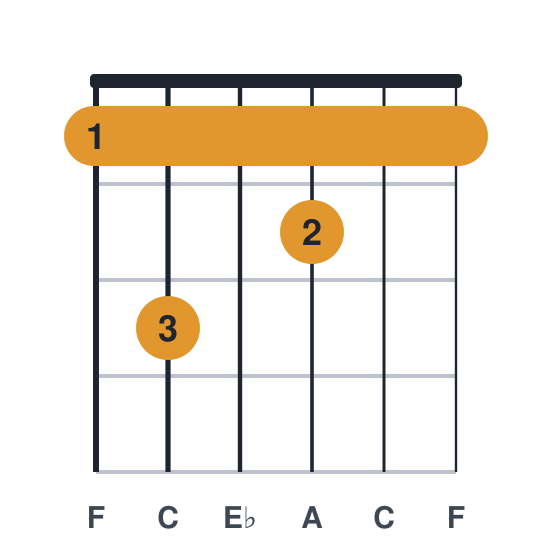
- F7the IV chord next to G7 in blues in C
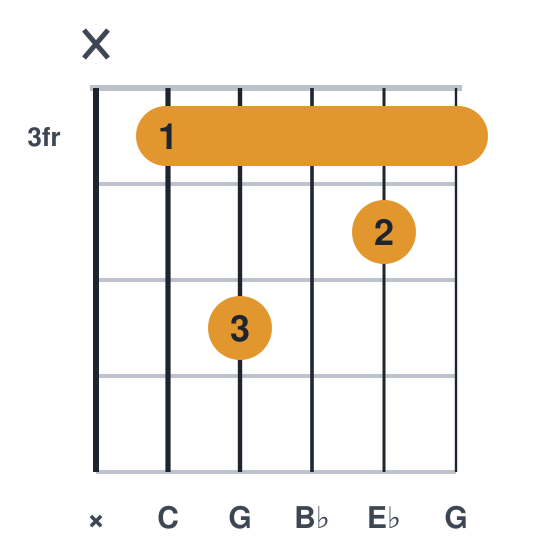
- Cm7G7 is the V chord of C minor
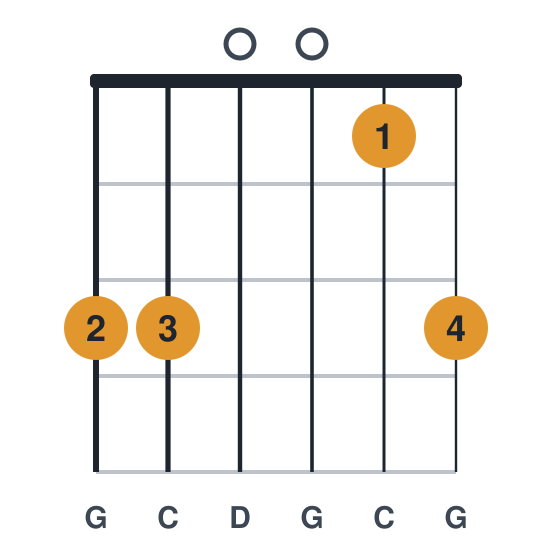
- Gsus4the suspended color players hang on before resolving


Other G chords
G7 guitar chord chart (320001) from melodician.com