Dm Guitar Chord
Dm is the D minor chord. It has three notes: D, F and A. The open shape is compact: three fingers on the top three strings plus the open D string, with both low strings skipped. Most players learn it soon after D major, since the two shapes are one note apart.

Three fingers in a small triangle on the top three strings, with the open D as the root. The two lowest strings stay out.
How to play Dm, step by step
- Index finger: 1st fret, high E string
- Middle finger: 2nd fret, G string
- Ring finger: 3rd fret, B string
- Leave the D string open. Strum from the D string down, skipping the two lowest strings.
The awkward part is usually the ring finger reaching the 3rd fret while the index stays back at the 1st. Place the ring finger first and build the shape around it.
More ways to play Dm
There are 4 common Dm shapes in total: the standard one at the top of the page, plus these, easiest first. You only ever need one. Tap any card to hear it.

Fuller and rounder than the open Dm, with a real bass note under the chord.

In between the others: thicker than the open Dm, lighter than the barres.

Deep at the bottom but high on the neck, so the top strings come out tight and punchy.
Songs that use the Dm chord
- Learn this song(opens a new tab on our partner site)
Stay
Rihanna
- Learn this song(opens a new tab on our partner site)
Blackbird
The Beatles
- Learn this song(opens a new tab on our partner site)
You Can't Always Get What You Want
The Rolling Stones
Norwegian Wood (This Bird Has Flown)
The Beatles
Capo 2
Learn this song(opens a new tab on our partner site)- Learn this song(opens a new tab on our partner site)
Burnin' For You
Blue Oyster Cult
- Learn this song(opens a new tab on our partner site)
How Sweet It Is (To Be Loved By You)
James Taylor
If a string buzzes or disappears
- High E buzzes or dies
- The index holds the F at the 1st fret, the very note that makes Dm minor. Press with the tip, right behind the fret wire, and keep the finger from sliding back.
- Open D string gets muted
- The middle finger on the G string can lean back and touch the D. Arch it upward so the open root has room to ring.
- Low strings rumble into the chord
- Start the strum from the D string. If you keep hitting the low E and A, rest the pick on the A string before each strum, or brush them with the fretting thumb.
What makes it a Dm
D · F · A 1 ♭3 5
Dm is a minor triad: D, a minor third F, and a fifth A. It is the relative minor of F major, sharing all of its notes. Its most common job is the ii chord in the key of C, where the Dm to G to C move, a ii V I, is one of the oldest progressions in music. In the key of F it serves as the vi chord.
Dm vs D
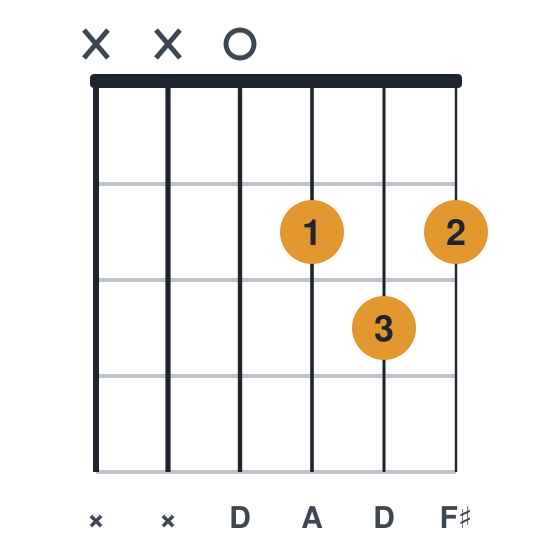
D major has an F♯ where Dm has an F. On the fretboard that is one fret on the high E string: 2nd fret for D, 1st for Dm. That string is also the highest note of both shapes, so the difference is easy to hear. Sliding the index between the two frets while holding the rest of the shape is a good ear exercise, but in a song, play the one the chart calls for.
Dm in major keys
Every note of Dm sits inside these keys. See how it works alongside the other chords in each one.
Dm chord questions
Is Dm hard for beginners?
Not really. There is no barre, but the three fingers sit close together and the index needs a small reach back to the 1st fret. Most players get it clean within a few weeks.
Why do you skip the low E and A strings?
The low E is not a note of Dm, so it clashes. The open A is a chord note and does no real harm, but the standard voicing starts on the open D root for a cleaner bass.
What is the difference between Dm and D?
One note: F in Dm, F♯ in D major. On guitar it is the high E string, 1st fret instead of 2nd.
What songs use Dm?
Californication, Losing My Religion, Ain't No Sunshine and Sultans of Swing all feature it, the last one built around Dm as the home chord.
Is Dm the same as Dm7?
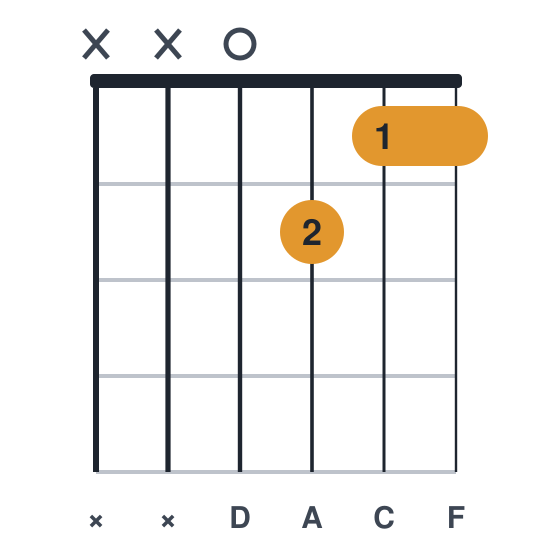
No. Dm7 adds a fourth note, C, to the three notes of Dm, which softens the sound. The two are close cousins and often swap in pop and jazz.
Chords to learn next
- Dthe major version of Dm
- Dm7adds a seventh for a softer Dm
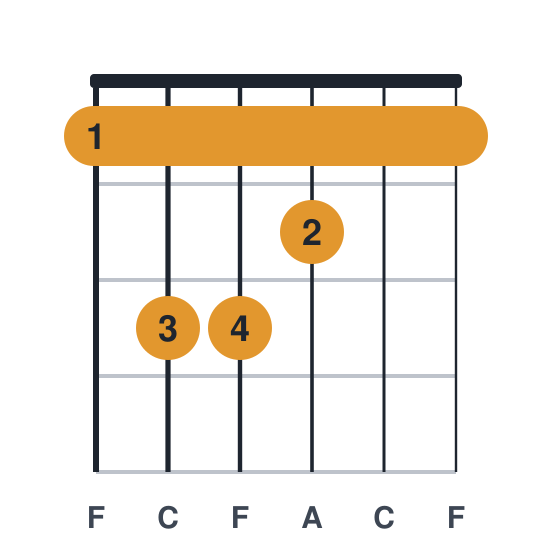
- Fthe relative major of Dm
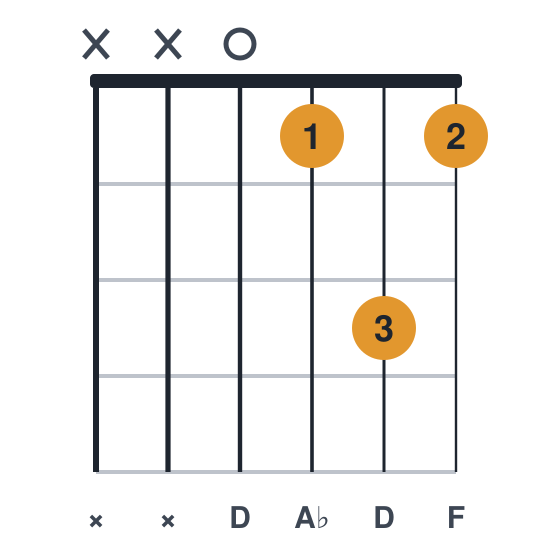
- Ddimone note away, tenser and unresolved


Other D chords
Dm guitar chord chart (xx0231) from melodician.com