A Guitar Chord
A is the A major chord. It has three notes: A, C♯ and E. It is one of the first chords most players learn, and the open shape needs no barre: three fingers side by side in the 2nd fret. The only real difficulty is keeping those three fingers from crowding each other.

The standard open A. Three fingers line up in the 2nd fret while the A and high E strings ring open.
How to play A, step by step
- Index finger: 2nd fret, D string
- Middle finger: 2nd fret, G string
- Ring finger: 2nd fret, B string
- Leave the A and high E strings open. Strum from the A string down, skipping the low E.
Once A rings cleanly, learn D and E. A, D and E are the three chords of the key of A, and they carry hundreds of songs on their own.
More ways to play A
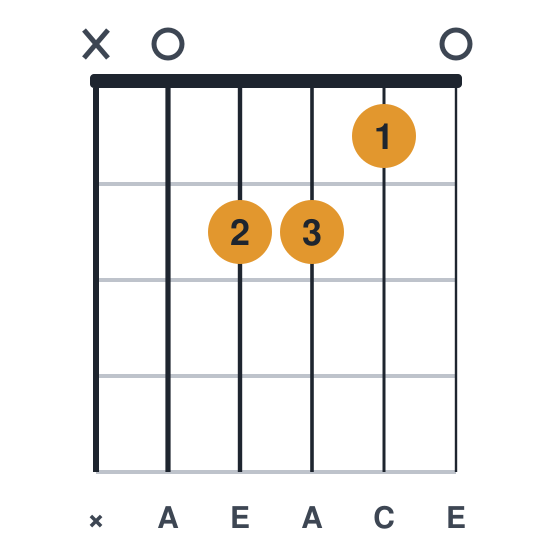
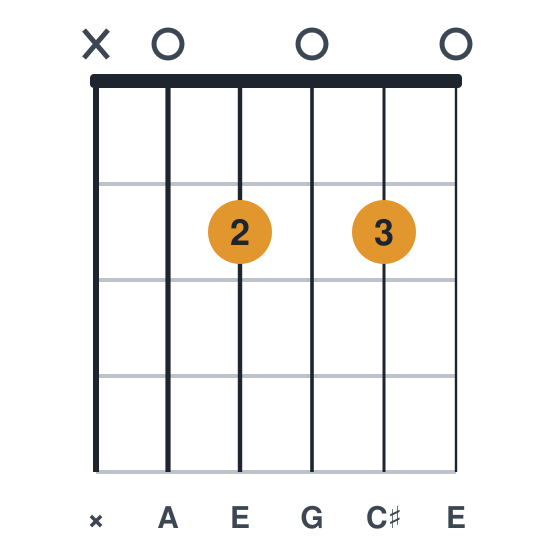
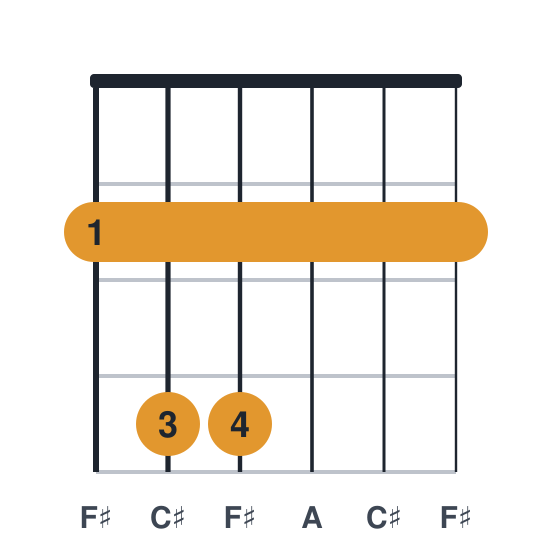
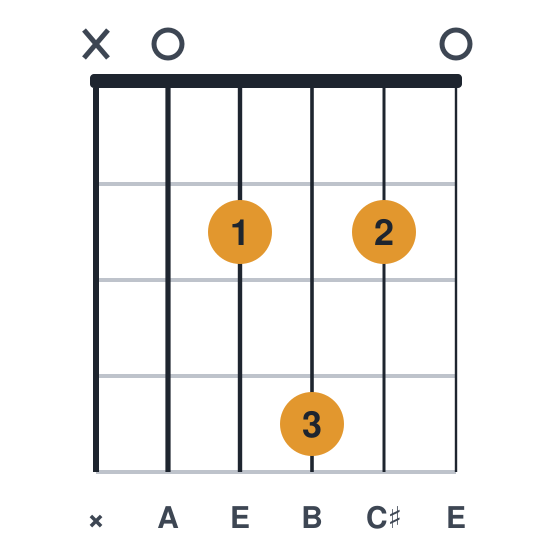
There are 3 common A shapes in total: the standard one at the top of the page, plus these, easiest first. You only ever need one. Tap any card to hear it.

Thicker and rounder than the open shape, with no open string shimmer.

Small and clear, handy when the open A would sound too heavy.
Songs that use the A chord
- Learn this song(opens a new tab on our partner site)
Highway To Hell
AC/DC
- Learn this song(opens a new tab on our partner site)
TNT
AC/DC
- Learn this song(opens a new tab on our partner site)
La Grange
ZZ Top
- Learn this song(opens a new tab on our partner site)
Hells Bells
AC/DC
- Learn this song(opens a new tab on our partner site)
Back In Black
AC/DC
Boulevard of Broken Dreams
Green Day
Capo 1
Learn this song(opens a new tab on our partner site)
If A will not ring clean
- High E sounds dead
- The ring finger is leaning on it. Curl all three fingers so they press straight down with their tips, then pick the high E alone to check it.
- Buzzing in the 2nd fret
- Squeeze the three fingertips into a tight row and place the row as close to the fret wire as it will go. The further a finger sits from the fret, the harder it has to press.
- Low E rumbles underneath
- The low E is not part of the chord. Start your strum from the open A string, or hang your thumb over the top of the neck to keep the low E quiet.
What makes it an A
A · C♯ · E 1 3 5
A major is a plain major triad: the root A, the major third C♯ and the fifth E. The third is what makes it sound bright rather than sad. A does three common jobs: it is the home (I) chord in the key of A, the IV chord in E, and the V chord in D. That last job matters in practice: in a song in D, hitting A builds tension that relaxes when the music lands back on D.
A vs Am
One note separates them: A has C♯, Am has C. On guitar the open shapes are close cousins: the finger on the B string slides back one fret and the chord turns minor. Because the change is so small, this pair is the easiest place on the neck to hear what major versus minor really means. Play them back to back and the mood flips.
A in major keys
Every note of A sits inside these keys. See how it works alongside the other chords in each one.
A chord questions
Is the A chord easy for beginners?
Yes. It has no barre and no stretch. The only common problem is three fingers crowding one fret, which passes with a little practice.
Do you strum all six strings on A?
No. Skip the low E, which is not a chord note. Strum five strings, from the open A down.
What is the difference between A and Am?
One note. A contains C♯, Am contains C. On the open shapes you move one finger back a fret on the B string.
Which fingers should I use for A?
This page shows index, middle and ring in a row. Some players use middle, ring and pinky instead so the index stays free. Both work; pick the one your hand prefers.
What songs use the A chord?
On this page alone: Twist and Shout, Bad Moon Rising, Boulevard of Broken Dreams and Everybody Hurts. A is everywhere in the keys of A, D and E.
Chords to learn next
- Amthe minor version of A
- A7A with the seventh that pushes to D
- F#mthe relative minor of A
- Aadd9adds a ninth on top for extra shimmer, same root


Other A chords
A guitar chord chart (x02220) from melodician.com