Aaug Guitar Chord
Aaug is the A augmented chord. It has three notes: A, C♯ and F. There is a real open shape, which is rare for augmented chords, and it is simply open A major with the two E notes pushed up a half step. In songs it almost never stays put: it passes between A and whatever comes next.

Open A major with both E notes raised a half step: the pinky takes the 3rd fret on the D string and the index lands on the 1st fret of the high E. Four fingers, no barre.
How to play Aaug, step by step
- Index finger: 1st fret, high E string
- Middle finger: 2nd fret, G string
- Ring finger: 2nd fret, B string
- Pinky finger: 3rd fret, D string
- Leave the A string open. Strum from the A string down, skipping the low E.
If you already play open A, learn this as a variation of it: the E notes on the D and high E strings each rise one fret. Switching between A and Aaug is the move you will actually use in songs.
More ways to play Aaug
There are 2 common Aaug shapes in total: the standard one at the top of the page, plus these, easiest first. You only ever need one. Tap any card to hear it.

Tighter and higher than the open shape, with no open strings. Good for a short stab before a chord change.
If it buzzes or sounds muffled
- Open A string goes quiet
- The pinky on the D string is the usual culprit. Arch it so its underside does not rest on the A string.
- High E buzzes at the 1st fret
- The index gets crowded by the other three fingers. Pull it back right behind the fret wire and press with the very tip.
- Low E rings into the chord
- The low E is not part of Aaug. Start the strum from the A string, or hang your thumb over the top of the neck to touch it.
What makes it an Aaug
A · C♯ · F 1 3 ♯5
Aaug is an augmented triad: an A major chord with the fifth raised a half step, so E becomes F. That raised fifth is what makes the chord sound restless. The F sits between the plain fifth and the sixth, and it wants to keep climbing, which is why Aaug almost always moves somewhere within a bar or two.
Its most common job is the V chord with a raised fifth in the key of D: A to Aaug to D turns a plain cadence into a small chromatic climb, because the F rises to F♯ inside the D chord. The other classic move keeps the bass on A and lets the fifth walk up: A, Aaug, then A6 or D. Either way, treat Aaug as a chord you pass through, not one you sit on.
A vs Aaug
A major and Aaug differ by one note: the fifth, E, rises a half step to F. On guitar that means two small changes to the open A shape, since the shape contains two E notes. The character changes more than the fingering does: A is stable and happy to be the home chord, Aaug is tense and temporary. Use A when the song rests, and slip in Aaug for a bar when you want the harmony to lean toward D or climb back into A.
Aaug chord questions
Is Aaug the same as A+?
Yes. A+, Aaug and A augmented all name the same chord: A, C♯ and F. The plus sign is just shorthand.
Is Aaug hard to play?
Not especially. The open shape has no barre, but four fingers share three frets, so it feels cramped at first. Most players who know open A get it clean in a few sessions.
What does Aaug resolve to?
Most often D, because Aaug works as the V chord of D major with a raised fifth. It also slides back to plain A, with the F dropping to E.
Why does Aaug share notes with C♯aug and Faug?
The augmented triad splits the octave into three equal major thirds. A to C♯ and C♯ to F are the same distance, so Aaug, C♯aug and Faug all contain the same three notes, just starting from a different one.
When would a song actually use Aaug?
As a passing chord, usually for one or two beats. Typical spots: between A and D, or between A and F♯m, where the F note bridges the gap. It is rare as a chord a song stays on.
Chords to learn next
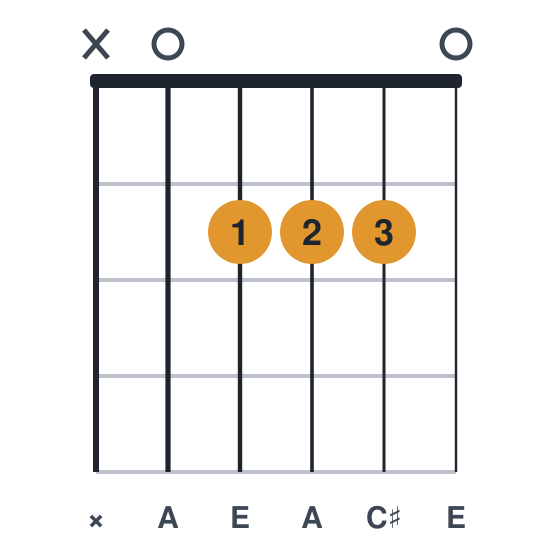
- Athe plain major, one note apart
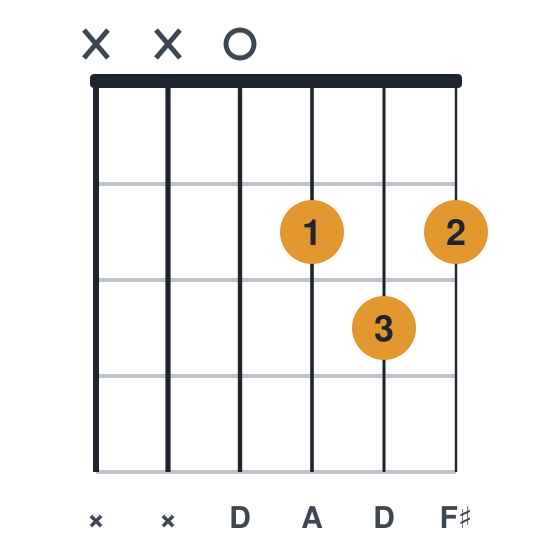
- Dwhere Aaug usually resolves
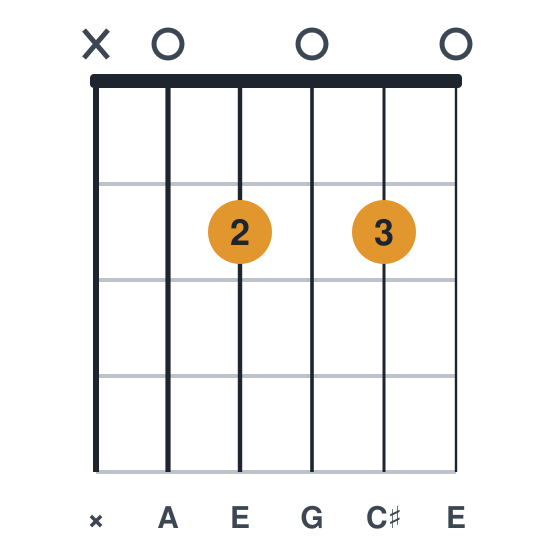
- A7another chord built to push forward
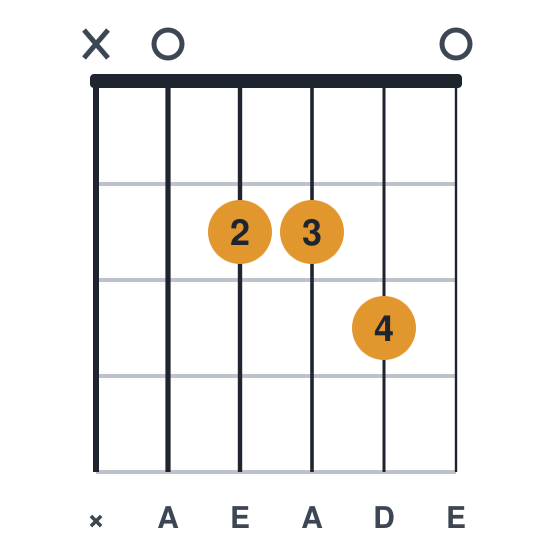
- Asus4another color built on the same root, pulling elsewhere


Other A chords
Aaug guitar chord chart (x03221) from melodician.com