Am Piano Chord
A minor is the Am piano chord. It has three notes: A, C and E. All three are white keys, which makes it the minor chord almost everybody learns first.

A at the bottom, then C and E. Right hand 1-3-5, left hand 5-3-1. Every key here is white.
How to play Am on piano, step by step
- Start on the A below middle C. That is the lowest note of the chord.
- Thumb (1): A
- Middle finger (3): C
- Little finger (5): E
- Press them together with the right hand. The left hand plays the same notes with fingers 5, 3, 1 an octave lower, or just A on its own as a bass note.
A minor and C major share two notes, C and E, so they sit next to each other under the hand. Moving between them is one of the first things worth practising.
Inversions of Am
The same 3 notes with a different one at the bottom. All of them are Am; which you play depends on what the hand is coming from. Tap any card to hear it.


If it sounds wrong
- It sounds bright instead of sad
- The middle note must be C, not C sharp. C sharp is the black key to the right, and it turns the chord into A major.
- The little finger is quiet
- E is under the weakest finger. Lean the hand very slightly outward so the arm's weight reaches it, rather than pressing harder.
- The notes arrive one at a time
- Shape the hand above the keys first, then drop all three fingers together. A chord is one movement.
What makes it an Am
A · C · E 1 ♭3 5
A minor is the first, flat third and fifth of the A scale: A, C and E. Three half steps from A to C make it a minor third, and that one interval is the whole difference between sad and bright.
It is the relative minor of C major, which means the two share a key signature and every note. That is why A minor is the vi chord of C, the ii of G and the iii of F, and why so much music in C leans on it.
Am vs A
The middle note. A minor uses C; A major uses C sharp, the black key just above it. Nothing else changes.
A minor is the easier of the two on piano, since all three notes are white. Rocking the middle finger between C and C sharp while the outer fingers stay put is the clearest way to hear what minor means.
Am in major keys
Every note of Am sits inside these keys. See how it works alongside the other chords in each one.
Questions about Am
Which notes are in an Am chord on piano?
A, C and E. All three are white keys. From A, skip B for C, then skip D for E.
What fingers do you use for Am?
Right hand: thumb on A, middle finger on C, little finger on E. Left hand: little finger on A, middle on C, thumb on E.
Is Am the easiest minor chord?
It is one of them. A minor, D minor and E minor all use white keys only, which makes them the three minor chords to learn first.
What is the difference between Am and C?
They share C and E and differ in the third note: A minor adds A below, C major adds G above. That closeness is why they follow each other so naturally in songs.
Where is the Am chord used?
As the vi chord in C, the ii in G and the iii in F. It is the most used minor chord in pop music, because C and G are the most used keys.
Chords to learn next
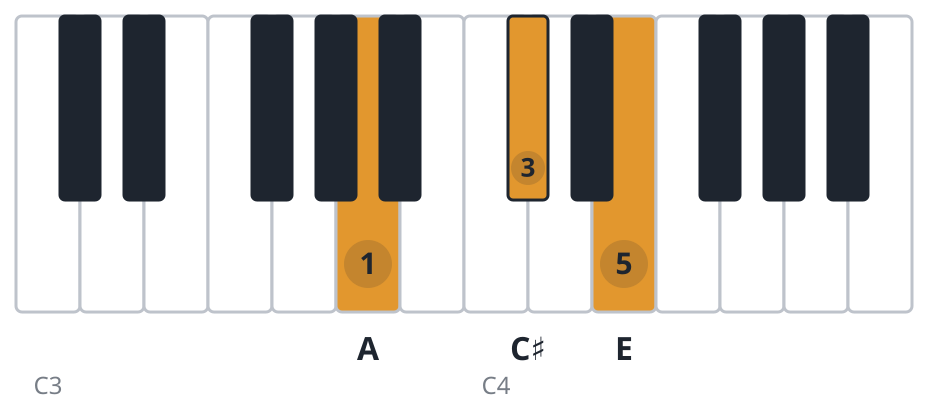
- Athe major version of Am
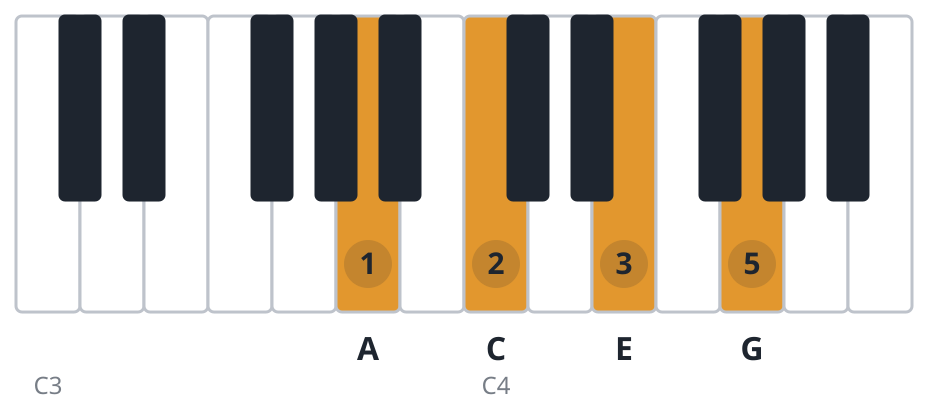
- Am7a seventh added, which softens the minor
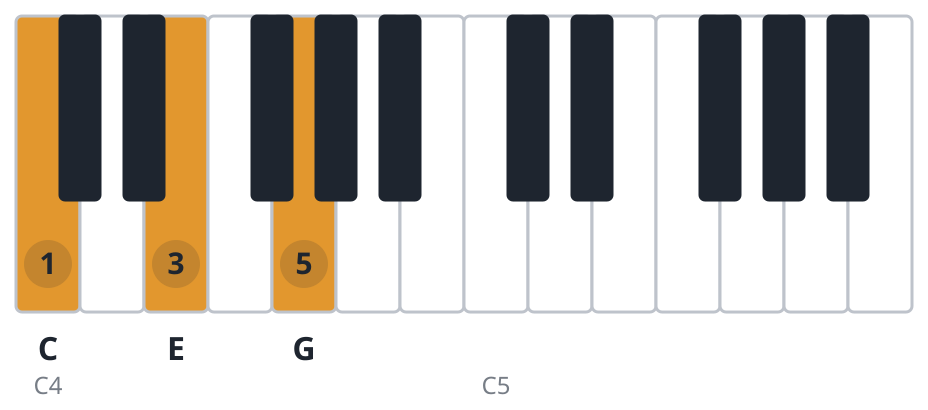
- Cthe relative major of Am
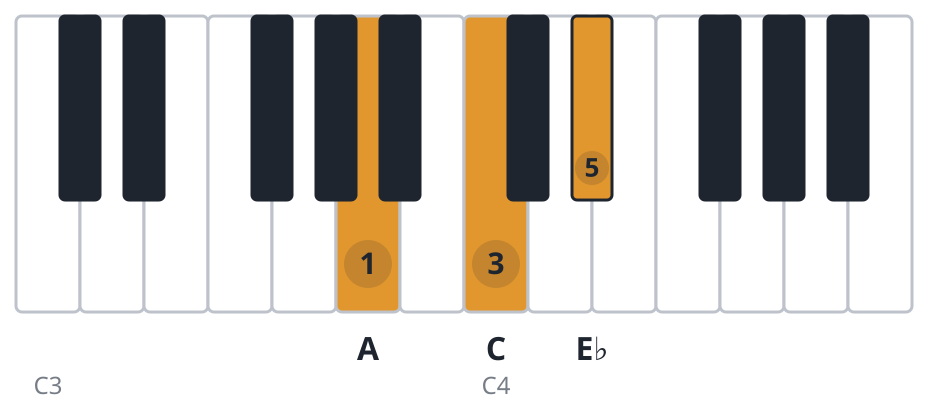
- Adimthe fifth lowered as well as the third