D Guitar Chord
D is the D major chord. It has three notes: D, F♯ and A. The open shape is a small triangle on the three thinnest strings, with the open D string as the root. Because nothing lower is played, D sounds lighter than the other open chords.

The open D triangle. Three fingers on the top three strings, root on the open D.
How to play D, step by step
- Index finger: 2nd fret, G string
- Middle finger: 2nd fret, high E string
- Ring finger: 3rd fret, B string
- Leave the D string open. Strum from the D string down, skipping the two lowest strings.
Next, drill the change from D to G and from D to A. D, G and A are the three chords of the key of D and they turn up together constantly.
More ways to play D
There are 4 common D shapes in total: the standard one at the top of the page, plus these, easiest first. You only ever need one. Tap any card to hear it.

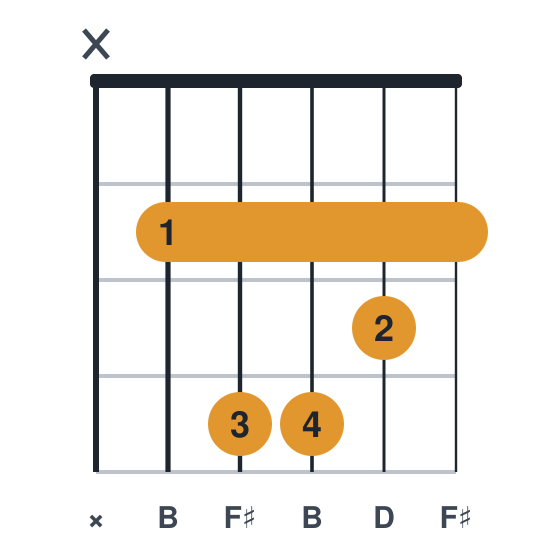
Fuller and warmer than the open triangle, closer to a rhythm guitar backbone.

Even and slightly darker than the open shape, with the same four string footprint.

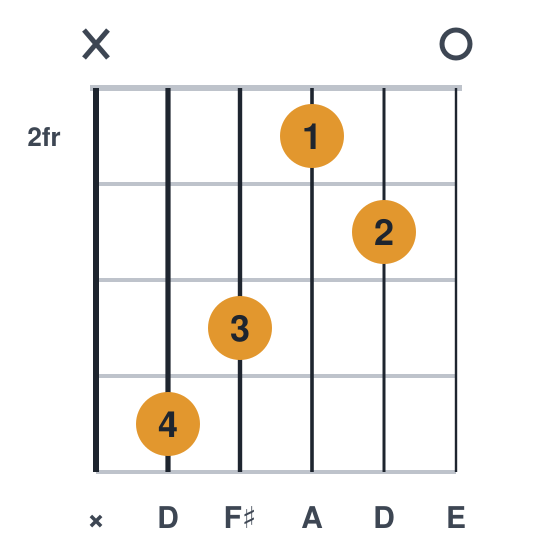
The heaviest D on this page, though it lives high up the neck.
Songs that use the D chord
- Learn this song(opens a new tab on our partner site)
Highway To Hell
AC/DC
- Learn this song(opens a new tab on our partner site)
Come As You Are
Nirvana
The Night We Met
Lord Huron
Capo 2
Learn this song(opens a new tab on our partner site)Perfect
Ed Sheeran
Capo 1
Learn this song(opens a new tab on our partner site)All Of Me
John Legend
Capo 1
Learn this song(opens a new tab on our partner site)- Learn this song(opens a new tab on our partner site)
Wish You Were Here
Pink Floyd
If D sounds thin or buzzy
- High E is dead
- The ring finger on the B string is leaning into it. Curl the ring finger, then pick the high E on its own to confirm it rings.
- The chord rumbles
- You are catching the two lowest strings. Aim the strum at the open D string; the low E is not in the chord at all.
- Buzz on the G string
- The index finger is sitting too far behind the 2nd fret. Slide it up against the fret wire and press with the tip.
What makes it a D
D · F♯ · A 1 3 5
D major is the root D, the major third F♯ and the fifth A. It works as the I chord in the key of D, the IV chord in A, and the V chord in G. The V job is the one you will feel most: in the huge family of songs in G, the D chord is the moment of tension, and the return to G is the release. In the key of D it is the opposite: D is the resting point everything else leans toward.
D vs Dm
The F♯ in D falls to F in Dm, and that single half step flips the chord from bright to dark. On guitar both are compact shapes on the top four strings, but the fingers trade places: in Dm the index moves to the high E string at the 1st fret. The two shapes feel similar under the hand, so the choice is purely about the sound the song needs.
D in major keys
Every note of D sits inside these keys. See how it works alongside the other chords in each one.
D chord questions
Why do you skip the two lowest strings on D?
The low E is not a note of the chord. The open A actually is a chord tone, but the standard shape leaves it out so the root D sits on the bottom and the chord sounds clean.
Is D a good beginner chord?
Yes, it is usually among the first three or four chords anyone learns. The shape is small; the common early mistake is hitting too many bass strings.
What is the difference between D and Dm?
One note: F♯ versus F. D sounds bright, Dm sounds sad. The open shapes differ by where the index finger goes.
How can I make D sound bigger?
Use the barre versions on this page. The A shape barre at fret 5 adds a low root on the A string, and the fret 10 barre plays all six strings.
What songs use the D chord?
From this page: Sweet Home Alabama, I'm Yours, Fast Car and Wagon Wheel. Songs in the keys of D, A and G all reach for it.
Chords to learn next
- Dmthe minor version of D
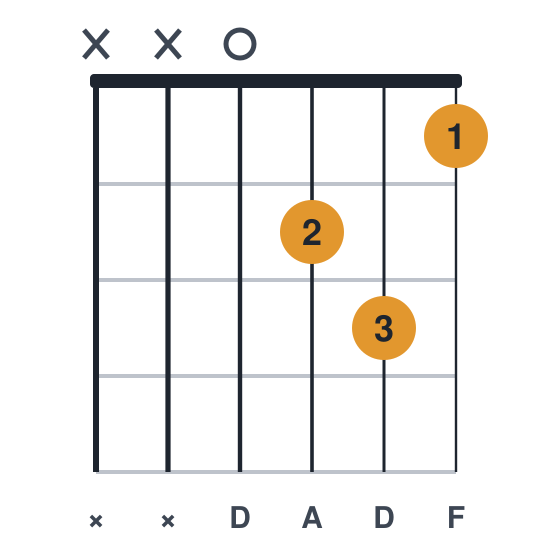
- D7D with the seventh that pushes to G
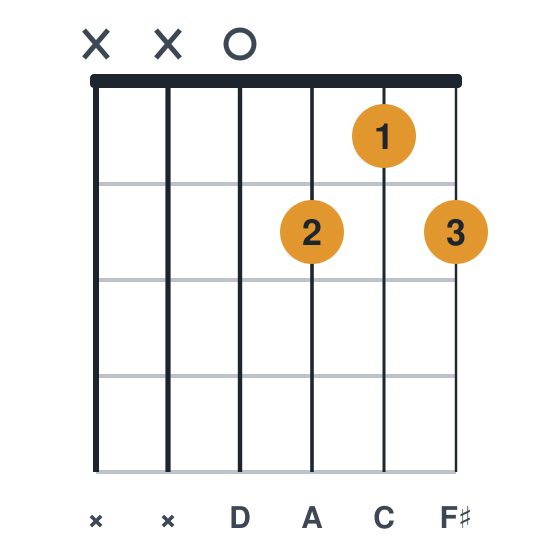
- Bmthe relative minor of D
- Dadd9adds a ninth on top for extra shimmer, same root


Other D chords
D guitar chord chart (xx0232) from melodician.com