Daug Guitar Chord
Daug is the D augmented chord. It has three notes: D, F♯ and A♯. It is one of the friendliest augmented chords on guitar: the open shape is just D major with one note moved up a fret, three fingers and no barre. Its signature move is rocking back and forth with plain D.

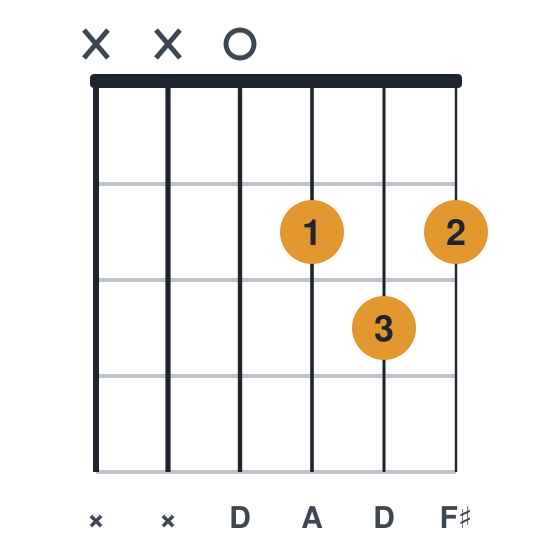
Open D major with the G string note raised one fret: middle and ring sit together at fret 3, index at fret 2 on the high E. The open D string carries the root.
How to play Daug, step by step
- Index finger: 2nd fret, high E string
- Middle finger: 3rd fret, G string
- Ring finger: 3rd fret, B string
- Leave the D string open. Strum from the D string down, skipping the two lowest strings.
Practice switching between D and Daug until it is automatic. Only the note on the G string changes, from the 2nd fret to the 3rd, and that switch is exactly how songs use this chord.
More ways to play Daug
There are 2 common Daug shapes in total: the standard one at the top of the page, plus these, easiest first. You only ever need one. Tap any card to hear it.

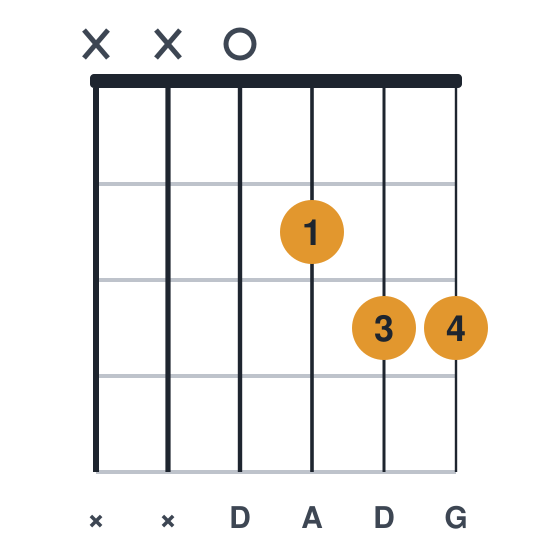
Fuller and darker than the open shape, with all four notes fretted and even.
If a string buzzes or dies
- High E buzzes at the 2nd fret
- The index sits a fret below the middle and ring pair and gets pushed flat. Curl it and press with the tip, close behind the fret.
- Open D string sounds muted
- Check the middle finger on the G string. If it leans back at all, its base brushes the D string. Arch it away.
- The low strings ring into the chord
- Neither the low E nor the A belongs in Daug. Aim the strum at the D string; if the A keeps sneaking in, rest your thumb tip over the edge of the neck.
What makes it a Daug
D · F♯ · A♯ 1 3 ♯5
Daug is an augmented triad: D major with the fifth raised a half step, A becoming A♯. That A♯ is restless on purpose. It sits one fret above the note your ear expects, and it wants to keep moving, either up to B or onward into the next chord. This is why Daug almost always appears in motion.
The most famous use is the vamp between D and Daug: the fifth rocks from A to A♯ and back while the rest of the chord holds still, exactly what Baby Hold On rides for its whole groove. The other standard job is the V chord of G with a raised fifth, D to Daug to G, where the A♯ resolves up to B inside the G chord.
D vs Daug
One note separates them: the A on the G string of open D major rises a half step to A♯ in Daug. Your fingers reshuffle slightly to make room, but the shape and feel stay close. D is the stable chord you can strum for days; Daug is the same chord leaning forward. Alternate them for a vamp that never quite settles, or use Daug once, for a bar, to push a progression from D into G.
Daug chord questions
Is Daug a beginner friendly chord?
Yes. The open shape uses three fingers with no barre, and anyone comfortable with open D major can learn it in minutes since only one note moves.
What songs use Daug?
Baby Hold On by Eddie Money is the classic example: the main riff alternates D and Daug throughout. The D to Daug rock is the chord's signature sound.
What is the difference between D and Daug?
Daug raises the fifth of D major a half step, from A to A♯. On the open shape that is one finger moving up one fret on the G string.
What does Daug resolve to?
Either back to D, with the A♯ falling to A, or onward to G, where the A♯ climbs to B. Both moves are half steps, which is why the chord feels so smooth in motion.
Is D+ the same as Daug?
Yes. D+, Daug and D augmented all name the same three notes: D, F♯ and A♯.
Chords to learn next
- Dthe plain major, one note apart
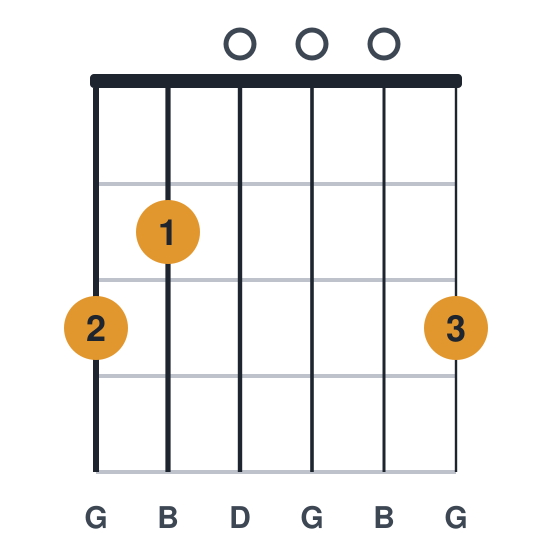
- Gwhere Daug usually resolves
- D7another chord built to push forward
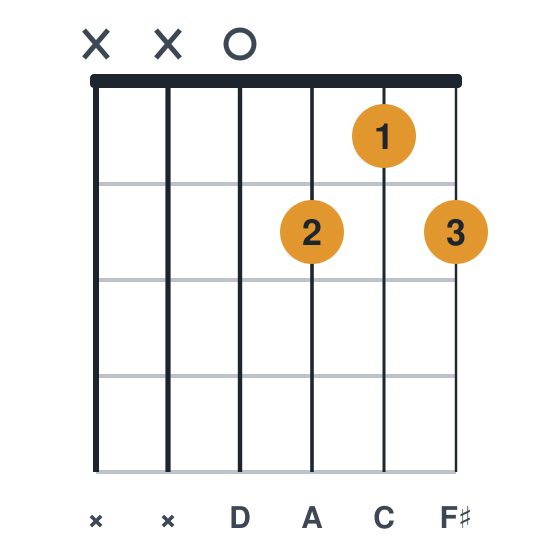
- Dsus4another color built on the same root, pulling elsewhere


Other D chords
Daug guitar chord chart (xx0332) from melodician.com