C Guitar Chord
C is the C major chord. It has three notes: C, E and G. The open shape is part of the core beginner set, and it brings the first real stretch: three fingers on three different frets, walking diagonally across the neck.

The classic open C. The fingers step down one fret per string, from the ring on the A string to the index on the B string.
How to play C, step by step
- Index finger: 1st fret, B string
- Middle finger: 2nd fret, D string
- Ring finger: 3rd fret, A string
- Leave the G and high E strings open. Strum from the A string down, skipping the low E.
The slow part is the change into and out of C. Drill C to G and C to Am; those two changes appear in an enormous number of songs.
More ways to play C
There are 5 common C shapes in total: the standard one at the top of the page, plus these, easiest first. You only ever need one. Tap any card to hear it.

Quiet and light next to the full shape, but perfectly clean.

Punchier and more contained than the open C, with no open strings ringing over.

The deepest C on this page, with the root all the way down on the low E string.

High and glassy, useful when a second guitar already covers the low end.
Songs that use the C chord
- Learn this song(opens a new tab on our partner site)
Come As You Are
Nirvana
The Night We Met
Lord Huron
Capo 2
Learn this song(opens a new tab on our partner site)Perfect
Ed Sheeran
Capo 1
Learn this song(opens a new tab on our partner site)All Of Me
John Legend
Capo 1
Learn this song(opens a new tab on our partner site)- Learn this song(opens a new tab on our partner site)
Wish You Were Here
Pink Floyd
- Learn this song(opens a new tab on our partner site)
Stay
Rihanna
If your C buzzes or cuts out
- Open high E is silent
- The index finger is lying too flat and brushing it. Arch the index so only its tip touches the B string.
- Open G string is muted
- The middle finger is leaning back into it. Curl the middle finger over the D string so the G has room to ring.
- A string buzzes at the 3rd fret
- The ring finger is stretched furthest and tends to land too far behind its fret. Bring your elbow closer to your body so the ring fingertip lands next to the fret wire.
What makes it a C
C · E · G 1 3 5
C major is the root C, the major third E and the fifth G. It is the I chord in the key of C, the IV chord in G, and the V chord in F. The middle job is the one guitarists use most: a huge amount of guitar music sits in the key of G, where C is the warm chord that answers G. In the key of C itself, C is home, and the other chords pull toward it.
C vs Cm
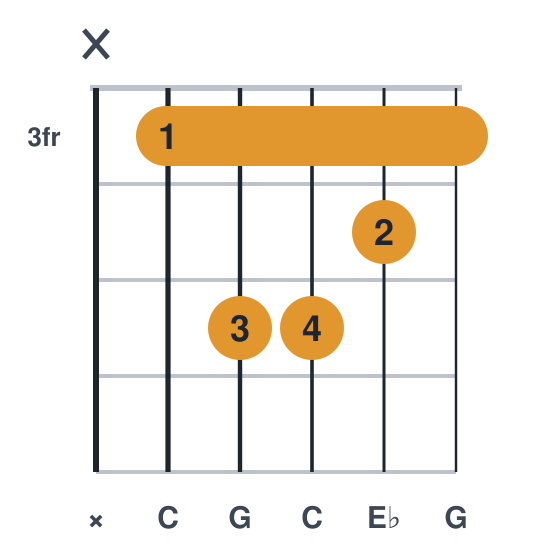
One note changes: the E in C drops to E♭ in Cm. On guitar the practical gap is much wider. C has a comfortable open shape; Cm has no standard open version and is normally played as a barre at the 3rd fret. Most beginners learn C in their first weeks and meet Cm months later, usually in sadder or more dramatic songs.
C in major keys
Every note of C sits inside these keys. See how it works alongside the other chords in each one.
C chord questions
Is the C chord hard for beginners?
It is the stretchiest of the open beginner chords, but there is no barre. Most players get it ringing within their first weeks, and the one finger version on this page works immediately.
Is there an easy version of C?
Yes. Fret the B string at the 1st fret with one finger and play just the top three strings. That small shape contains G, C and E, a complete C chord.
Do you strum the low E string in C?
No. Start from the A string, where the ring finger holds the root. The open low E is an E, a chord tone, but the standard voicing keeps C on the bottom for a cleaner sound.
What is the difference between C and Cm?
Cm lowers the middle note: E becomes E♭. On guitar C is an open chord and Cm is usually a barre chord at fret 3, so they feel very different to play.
What songs use the C chord?
From this page: Take Me Home, Country Roads, Blowin' in the Wind, Ring of Fire and Wonderful Tonight. Any song in the keys of C or G is likely to lean on it.
Chords to learn next
- Cmthe minor version of C
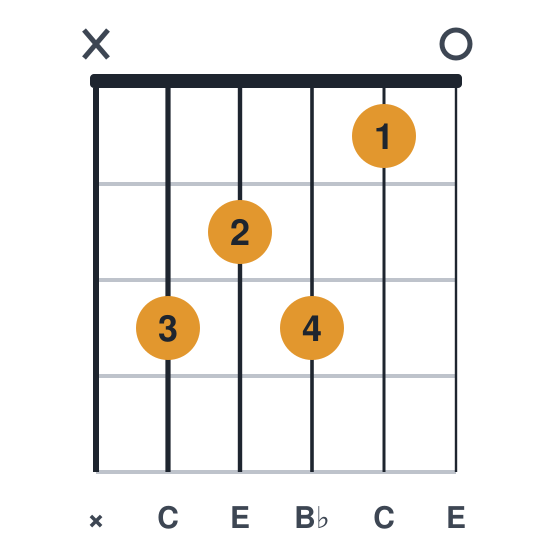
- C7C with the seventh that pushes to F
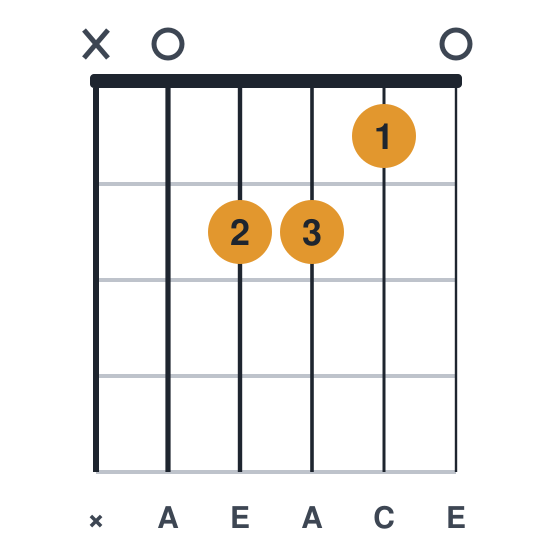
- Amthe relative minor of C
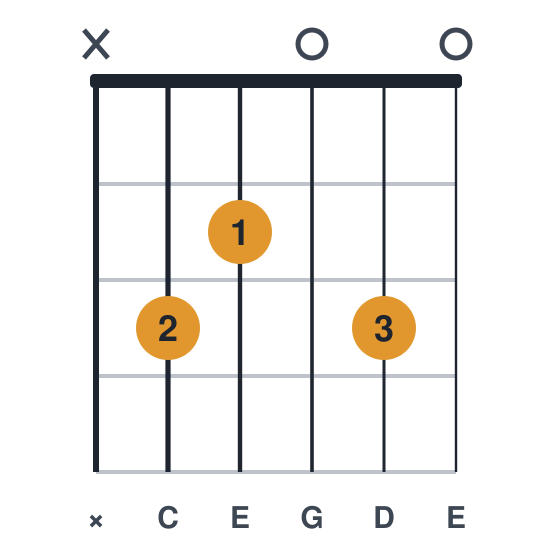
- Cadd9adds a ninth on top for extra shimmer, same root


Other C chords
C guitar chord chart (x32010) from melodician.com