Cm Guitar Chord
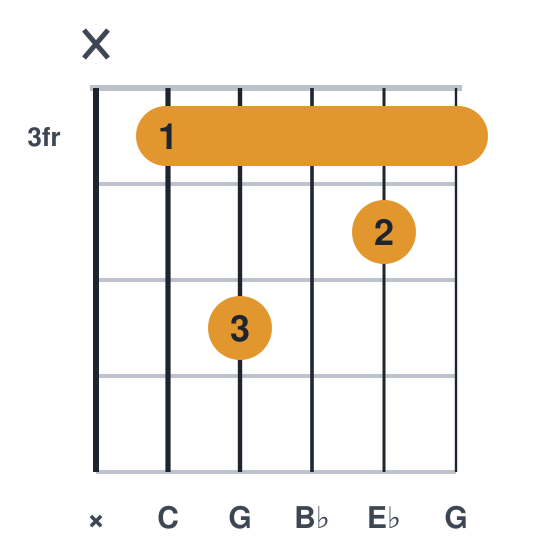
Cm is the C minor chord. It has three notes: C, E♭ and G. Unlike C major, it has no open shape: the standard Cm is a barre at the 3rd fret. If barres are still new to you, the four string version below plays the same three notes without one.

The Am shape barred at fret 3. It is the same grip as Bm one fret higher, where most hands find the barre a touch easier.
How to play Cm, step by step
- Index finger: press flat across the A to high E strings at fret 3
- Middle finger: 4th fret, B string
- Ring finger: 5th fret, D string
- Pinky finger: 5th fret, G string
- Strum from the A string down, skipping the low E.
This grip is fully movable. Slide it two frets down for Bm, two up for Dm; learning it once buys you every minor chord along the A string.
Easy Cm for beginners (no barre)
You can play a real C minor without any barre: xx5543, which is the standard shape's top four strings with each note given its own finger.
No apology needed for the smaller shape. What makes a minor chord itself is the root, the third and the fifth, and xx5543 carries all three: G, C, E♭ and G again on top. Only the low C is absent, and in a band the bass player covers it anyway.
When you want the full version, remember that fret 3 is a forgiving place to learn a barre, softer than frets 1 and 2. Cm is actually a better first barre project than the more famous F.
More ways to play Cm
There are 4 common Cm shapes in total: the standard one at the top of the page, plus these, easiest first. You only ever need one. Tap any card to hear it.

Cleaner and smaller, the same minor color minus the low root.

Six strings deep, with the root sounding in three octaves.

Bright and tidy, a good choice when a full barre would sound too heavy.
Songs that use the Cm chord
- Learn this song(opens a new tab on our partner site)
Wake Me Up When September Ends
Green Day
- Learn this song(opens a new tab on our partner site)
Blackbird
The Beatles
- Learn this song(opens a new tab on our partner site)
Sharp Dressed Man
ZZ Top
- Learn this song(opens a new tab on our partner site)
Aqualung
Jethro Tull
- Learn this song(opens a new tab on our partner site)
Holy Diver
Dio
At This Moment
Billy Vera
Capo 1
Learn this song(opens a new tab on our partner site)
If notes crackle or vanish
- The high E buzzes at the barre
- The barre only truly sounds two strings in this shape, the A and the high E. Tip the index onto its edge and make sure its outer end lands hard on the high E.
- The B string note chokes
- The middle finger holds the 4th fret alone while its neighbors sit at the 5th. If they pull it flat, it mutes the high E; keep the middle finger curled on its tip.
- Low E rumbles underneath
- The open low E is not in Cm. Start each strum from the A string, and let the barre's fingertip lean against the low E as insurance.
What makes it a Cm
C · E♭ · G 1 ♭3 5
Cm is a minor triad: C, a minor third E♭, and a fifth G. It is the relative minor of E♭ major, and it works as the ii chord in B♭ and the vi chord in E♭, keys beloved by horns and piano. On guitar you often meet Cm as a borrowed color inside a major key: Creep uses the C to Cm drop inside G major, and Bohemian Rhapsody leans on Cm in its B♭ sections.
Cm vs C
Only one note changes: C major's E becomes E♭. On guitar the gap feels wider than that, because C major has a friendly open shape and Cm does not; you jump from open strings to a 3rd fret barre. The pair is worth practicing together anyway: major to minor on the same root is a classic songwriting move, and Creep does exactly that.
Cm in major keys
Every note of Cm sits inside these keys. See how it works alongside the other chords in each one.
Cm chord questions
Why is there no open Cm chord?
Its notes do not line up with the open strings the way C major's do. E♭ has no open string at all, so every practical Cm voicing needs fretted notes across the shape.
How do I play Cm without a barre?
Use xx5543: four fingers on the top four strings. It contains the complete triad and works in any song that asks for Cm.
What songs use Cm?
Creep uses it for its famous major to minor drop, and Bohemian Rhapsody passes through it repeatedly.
What is the difference between Cm and C?
One note: E♭ in Cm against E in C major. That single half step is the whole major versus minor divide.
What key is Cm in?
Cm is the ii chord of B♭ major, the vi chord of E♭ major, and the home chord of C minor, which shares its three flats with E♭ major.
Chords to learn next
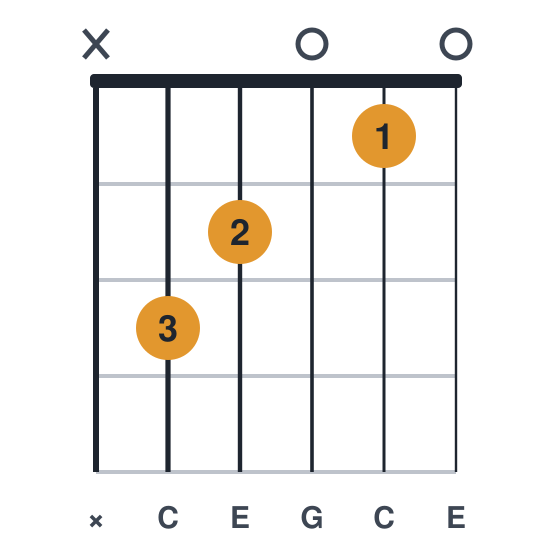
- Cthe major version of Cm
- Cm7adds a seventh for a softer Cm
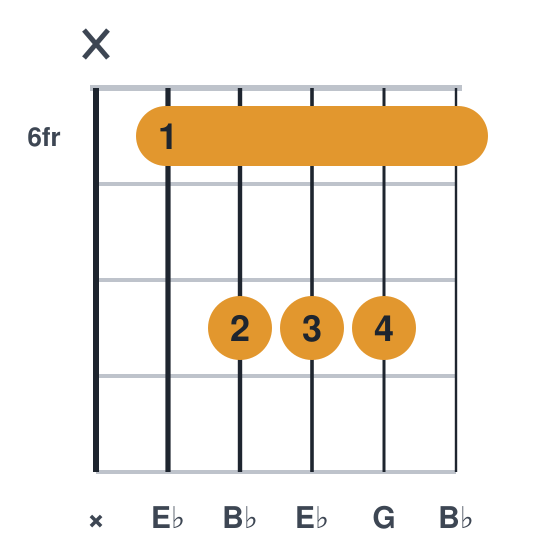
- Ebthe relative major of Cm
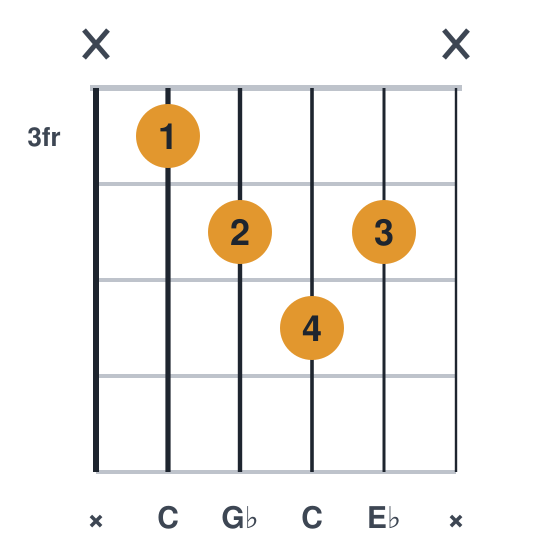
- Cdimone note away, tenser and unresolved


Other C chords
Cm guitar chord chart (x35543) from melodician.com