Caug Guitar Chord
Caug is the C augmented chord. It has three notes: C, E and G♯. The standard shape uses a small two string barre at the 1st fret, a step up from open chords but far from a full barre. The payoff is that the grip is movable: learn it once and you can play any augmented chord with it.

A diagonal stack: ring finger on the root, middle a fret below on the D string, and a small index barre across the G and B strings at fret 1. Fully movable, root under the ring finger.
How to play Caug, step by step
- Index finger: press flat across the G to B strings at fret 1
- Middle finger: 2nd fret, D string
- Ring finger: 3rd fret, A string
- Strum from the A string down, skipping the low E. The high E string stays muted; let the nearest fretting finger touch it lightly.
This is the movable root on the A string grip. Slide the whole thing up two frets and you have Daug; the root always sits under your ring finger.
More ways to play Caug
There are 2 common Caug shapes in total: the standard one at the top of the page, plus these, easiest first. You only ever need one. Tap any card to hear it.

Thinner and brighter than the barre shape, a high chime with no low end.
If it buzzes or cuts out
- One note of the mini barre buzzes
- The index covers only the G and B strings, but it has to press both evenly. Use the flat pad of the first segment and keep the finger close to the fret wire.
- The C root on the A string sounds weak
- At the 3rd fret the ring finger is doing real work. Bring your thumb behind the neck, roughly opposite the middle finger, so the hand can squeeze without strain.
- The high E sneaks in
- Let the underside of the index lean on it. An open high E is actually an E, a Caug chord tone, so it will not sound wrong here, but mute it anyway so the grip works when you move it to other frets.
What makes it a Caug
C · E · G♯ 1 3 ♯5
Caug is an augmented triad: C major with the fifth raised from G to G♯. The G♯ is what your ear notices. It sits a half step above the note it replaced and a half step below A, so the chord feels like it is caught mid climb, which is why writers use it to connect chords rather than to rest on.
The textbook move is C to Caug to F: Caug acts as the V chord of F with a raised fifth, and the G♯ resolves up to A, the third of F. The same idea works in A minor, where the G♯ is the leading tone. And because C to E and E to G♯ are both major thirds, Caug contains exactly the same notes as Eaug and Abaug, one reason a single movable grip goes such a long way.
C vs Caug
The two chords differ by one fret: the open G string of C major becomes G♯ at the 1st fret in Caug. Everything stable about C turns tense the moment that note rises. On guitar you also give up the ringing open strings, since the practical Caug shapes are fretted and compact. Stay on C for the body of a progression; use Caug for a beat or two when the music should lift toward F, Am or back into C.
Caug chord questions
Is Caug hard to play?
It sits in the middle: the standard shape needs a two string barre with the index while the other fingers stack diagonally above it, all within three frets. It is less forgiving than an open chord, but far easier than a full six string barre.
Is Caug the same as C+?
Yes. C+, Caug and C augmented all mean the same three notes: C, E and G♯.
What does Caug usually resolve to?
F major is the most common target, with the G♯ rising to A. Caug also resolves well to A minor, and can simply fall back to C.
Does Caug really have the same notes as Eaug?
Yes, and as Abaug too. The augmented triad stacks two identical major thirds, so C, E and G♯ can be read as a chord on any of those three roots.
Can I avoid the barre in Caug?
Mostly yes. The compact shape higher up the neck spreads the same notes across four strings with one finger each on three of them. It trades the barre for a wider stretch.
Chords to learn next
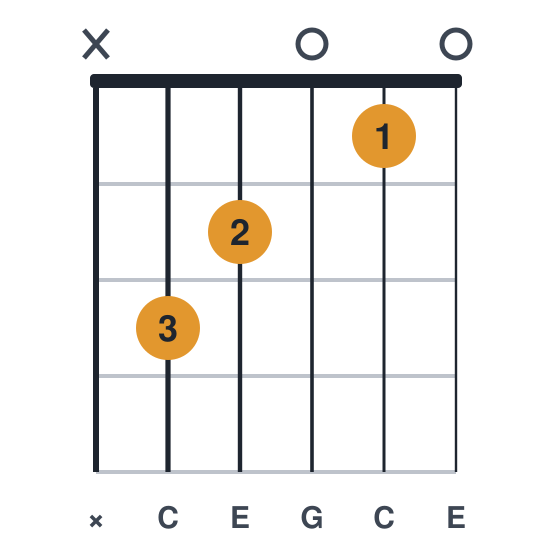
- Cthe plain major, one note apart
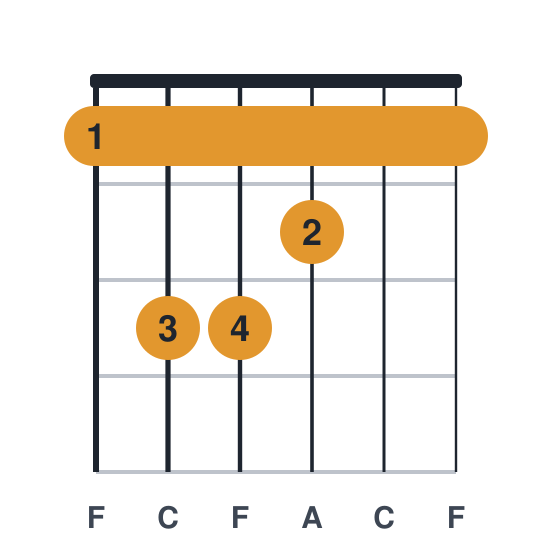
- Fwhere Caug usually resolves
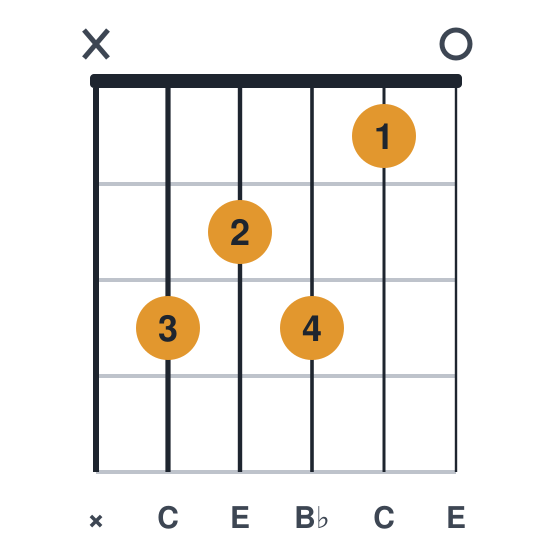
- C7another chord built to push forward
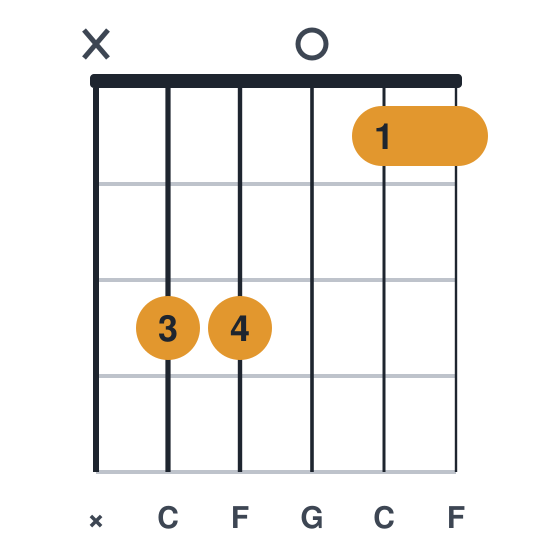
- Csus4another color built on the same root, pulling elsewhere


Other C chords
Caug guitar chord chart (x3211x) from melodician.com