E Ukulele Chord
E is the E major chord, and by reputation the hardest common chord on the ukulele. It has three notes: E, G sharp and B. The standard shape stacks three fingers at the 4th fret with the index behind them on the A string at the 2nd.

The famous one: middle, ring and pinky stacked at the 4th fret on the G, C and E strings, index on the A string at the 2nd. Every note fretted.
How to play E on ukulele, step by step
- Index finger: 2nd fret, A string
- Middle finger: 4th fret, G string
- Ring finger: 4th fret, C string
- Pinky finger: 4th fret, E string
- Strum all four strings.
Nobody plays a clean E in their first week; the chord is a rite of passage. Set the index first, then land the other three fingers as one block. Slow, deliberate repetitions win here, not force.
More ways to play E
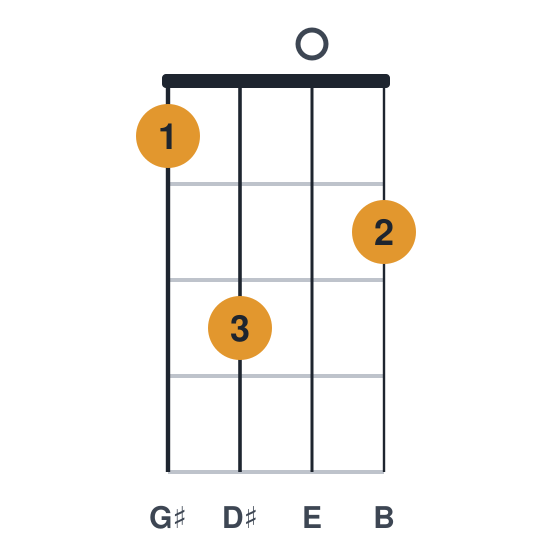
There are 3 common E shapes: the standard one at the top of the page, plus these further up the neck. You only ever need one. Tap any card to hear it.

Slightly rounder than the standard stack, with the root doubled at the top of the chord.

Tight and trebly, right where a concert neck runs out. Mostly a tenor player's option.
If E defeats you (it defeats everyone at first)
- The three notes at the 4th fret will not all sound
- Three fingertips are crowding one fret. Turn the wrist forward, stagger the fingers slightly, and check each string one at a time before strumming.
- The A string note dies
- The index is being flattened under the stack above it. Keep its tip upright at the 2nd fret and let the other three fingers arch over it.
- The hand cramps
- Practise in short bursts and shake the hand out. The barre version at the 4th fret lower on the page trades the finger crowd for one flat index, which many hands prefer.
What makes it an E
E · G♯ · B 1 3 5
E major is the root E, the major third G sharp and the fifth B. The open E string supplies the root in the 1402 shape, while the familiar 4442 shape frets all four strings; that crowded shape is why E has a reputation for being hard.
E is the I chord in the key of E, the IV chord in B and the V chord in A. Songs in A need E constantly, and that is where most players finally have to tame it; the effort pays for itself across the whole key.
E vs Em
One note moves: the G sharp in E drops to G in Em. Harmonically the two chords are next door neighbours.
Physically they could not be further apart on a ukulele. E is the instrument's famous hard chord, while Em is a friendly staircase of a shape. Guitarists find this exactly backwards from their instrument, where E is the easy one.
E chord questions
Why is E so hard on ukulele?
Three fingers must share the 4th fret while the index holds the 2nd in the familiar 4442 shape. The easier 1402 shape leaves the open E string ringing, so not every useful E voicing frets all four strings.
Is there an easier way to play E?
The barre version at the 4th fret on this page suits many hands better. While learning, many players also substitute E7, which is far easier and works in most songs that call for E.
Which fingers play the standard E?
Index on the A string at the 2nd fret, then middle, ring and pinky on the G, C and E strings at the 4th.
What is the difference between E and Em?
The third: G sharp in E, G in Em. The shapes share nothing on the ukulele, so learn them as two separate pictures.
Can I skip the E chord?
For a while. Beginner songbooks lean on C, F and G territory partly to avoid it. But songs in the key of A will keep asking, so it rewards patient practice.
Chords to learn next
- Emthe minor version of E
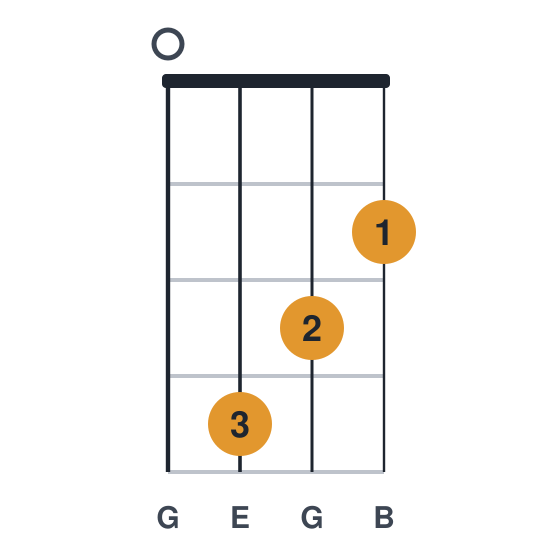
- E7E with the seventh that pushes to A
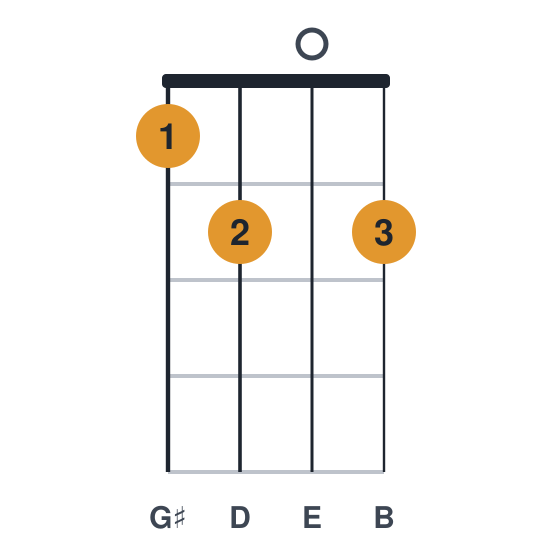
- C#mthe relative minor of E
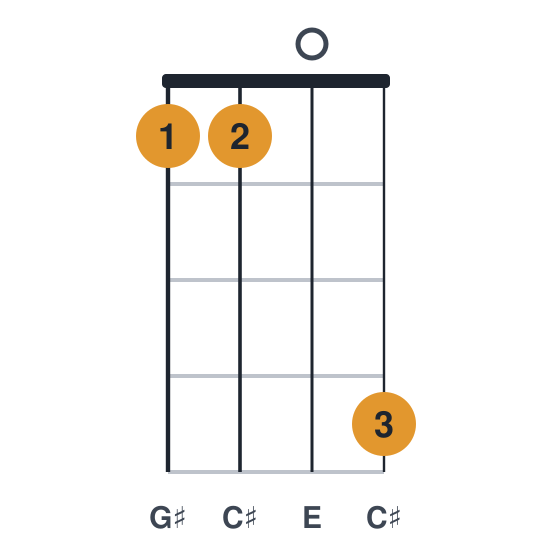
- Emaj7the soft version of the same chord


Other E chords
E ukulele chord chart (4442) from melodician.com