E7 Ukulele Chord
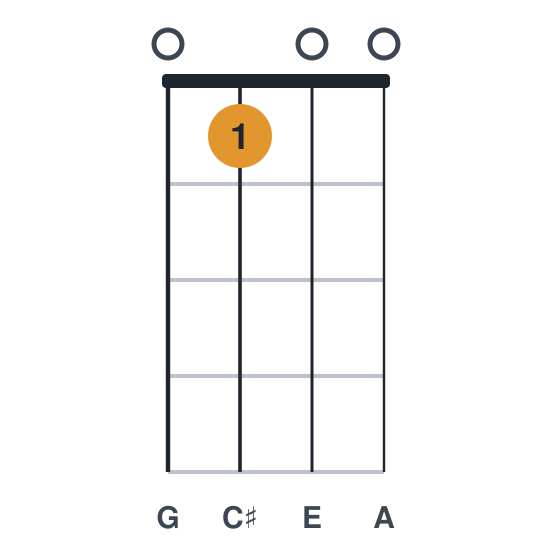
E7 is the E dominant seventh chord. It has four notes: E, G sharp, B and D. The shape is three fingers: index on the 1st fret of the g string, middle on the 2nd fret of the C string, ring on the 2nd fret of the A string, with the E string open.

Index on the 1st fret of the g string, middle and ring on the 2nd fret of the C and A strings, E string open. The open string is the root.
How to play E7 on ukulele, step by step
- Index finger: 1st fret, G string
- Middle finger: 2nd fret, C string
- Ring finger: 2nd fret, A string
- Leave the E string open. Strum all four strings.
E7 is the chord players reach for when full E major will not land. E major (4442) is the hardest common shape on the ukulele; E7 needs three relaxed fingers near the nut. It adds a seventh to the sound, but in most songs in A it does the job.
More ways to play E7
There are 3 common E7 shapes: the standard one at the top of the page, plus these further up the neck. You only ever need one. Tap any card to hear it.

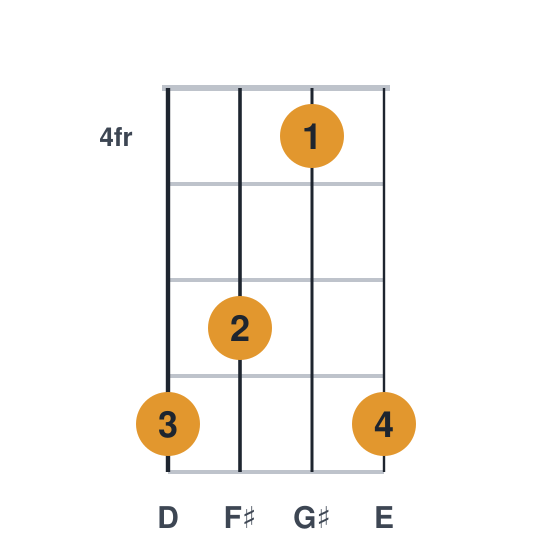
Tighter and rounder than the open shape, all fretted notes. Sits nicely when the song is already working the middle of the neck.

The biggest E7 here: high, full and even. A reach on a soprano, comfortable on a tenor, and worth it when you want the chord to shout a little.
If it sounds wrong
- The open E string dies
- The middle finger on the C string is the usual culprit: it leans forward and brushes the E string. Stand it up on its tip and let the open string ring.
- The g string buzzes
- The index has the lightest job and gets lazy. Tip right behind the 1st fret, and press just enough for a clean note.
- Notes blur together
- Three fingers inside two frets is a crowd. Place ring and middle first, then tuck the index in under them rather than the other way round.
What makes it an E7
E · G♯ · B · D 1 3 5 ♭7
E7 is a dominant seventh: an E major triad (E, G sharp, B) plus a minor seventh, D. The D is the note that leans: E7 is the V7 of A, and it pulls toward A major and A minor with the strongest pull in either key.
That makes E7 a working chord rather than a rare one. A is one of the friendliest ukulele keys, and every blues in A runs on A7, D7 and E7, with E7 doing the turning.
E7 vs E
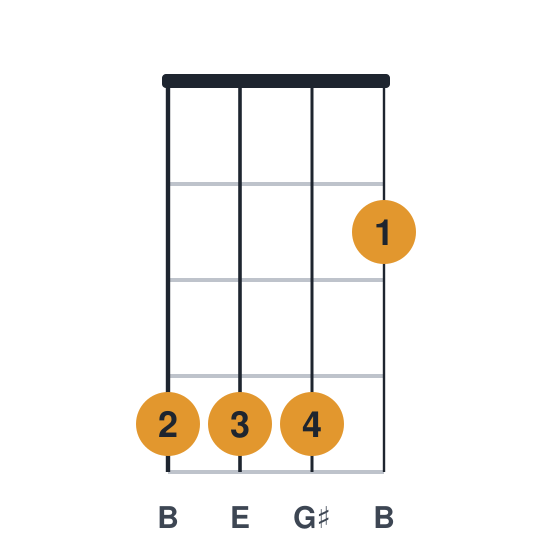
E major is famously the hardest common chord on the ukulele: four fingers stacked at the 4th fret (4442). E7 is three easy fingers at the nut. The two chords differ by one note, D, and by a world of effort.
Because of that, E7 is the traditional dodge: where a song in A asks for E, E7 usually passes. The seventh adds a lean the plain chord does not have, so listen once before you swap it in for the whole song.
E7 chord questions
Is E7 easier than E?
Much. E major needs four fingers in a row at the 4th fret; E7 needs three fingers on the first two frets. Most players can play E7 months before E.
Can I play E7 instead of E?
Usually. E7 contains all of E plus the seventh, and in songs in A the seventh even helps, since E7 naturally pulls back to A. In a ballad that wants a plain, settled E, the substitution is audible.
What does E7 resolve to?
A. E7 is the V7 chord of A major and A minor, and the engine of every blues in A.
Which fingers play E7?
Index on the g string at the 1st fret, middle on the C string at the 2nd, ring on the A string at the 2nd. The E string stays open.
Where is E7 used?
In songs in A at every turnaround, in blues in A beside A7 and D7, and anywhere a chart says E and the four finger E major shape is not ready yet.
Chords to learn next
- A7E7 resolves to A
- Ethe plain major underneath it
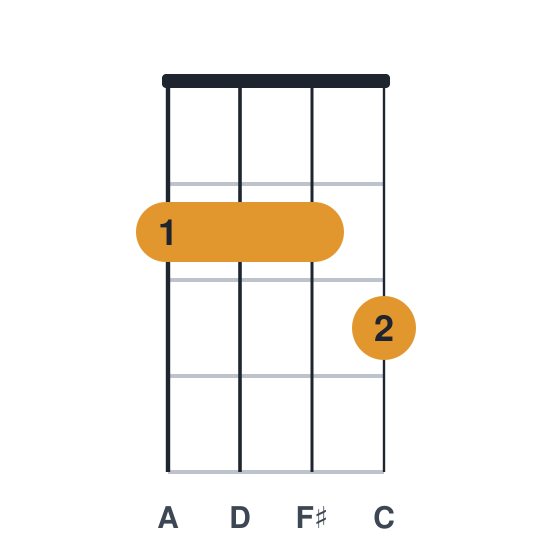
- D7the IV chord next to E7 in blues in A
- E9the same seventh with a ninth on top


Other E chords
E7 ukulele chord chart (1202) from melodician.com