Emaj7 Ukulele Chord
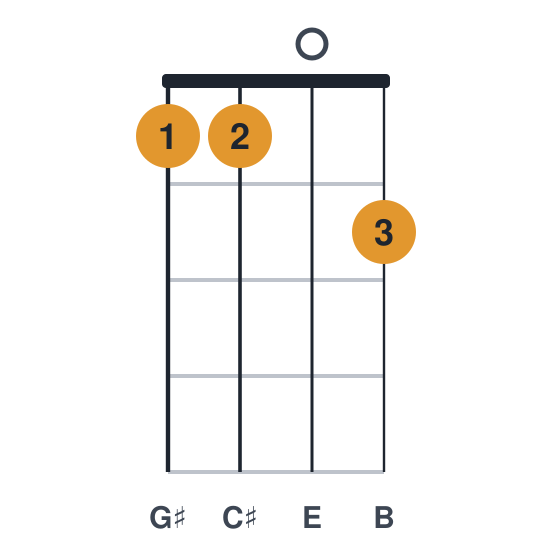
Emaj7 is the E major seventh chord. It has four notes: E, G sharp, B and D sharp. Plain E is the famously hard ukulele chord, but Emaj7 is not: three fingers near the nut with the open E string ringing in the middle.

Index at the 1st fret of the G string, middle at the 2nd of the A, ring at the 3rd of the C, with the open E ringing in the middle.
How to play Emaj7 on ukulele, step by step
- Index finger: 1st fret, G string
- Middle finger: 2nd fret, A string
- Ring finger: 3rd fret, C string
- Leave the E string open. Strum all four strings.
Enjoy the irony: E major is the shape ukulele players dread, and its major seventh takes three relaxed fingers. When a song lets you soften E into Emaj7, the dreamier chord is also the easier one.
More ways to play Emaj7
There are 3 common Emaj7 shapes: the standard one at the top of the page, plus these further up the neck. You only ever need one. Tap any card to hear it.

Solid and fretted through, with more bite than the open shape.

High and singing; the root on top makes it feel like a melody note with a chord attached.
If it sounds cloudy
- The open E string is muffled
- The ring finger at the 3rd fret of the C string is arching over its neighbour. Curl it up onto its tip; the open E is the root and has to ring.
- The G string note bends sharp
- At the 1st fret a heavy squeeze pulls the string sideways. Press just enough for a clean note and keep the finger close behind the fret wire.
- One note is louder than the rest
- Three fretted notes and one open string want an even strum. Slow the right hand down until all four speak at the same volume, then bring the speed back.
What makes it an Emaj7
E · G♯ · B · D♯ 1 3 5 7
Emaj7 is a major seventh chord: an E major triad (E, G sharp, B) plus a major seventh (D sharp). The D sharp shimmers a half step under the root, the closeness that gives every maj7 chord its glow.
Emaj7 is the I chord of E major and the IV chord of B major. E major itself is the instrument's awkward corner, which makes this chord a happy surprise: the key's soft home chord sits comfortably at the bottom of the neck.
E vs Emaj7
E major is 4442, four fingers bunched at the 4th fret and the shape most players learn last. Emaj7 is 1302, spread across the first three frets with an open string in the middle. For once the added seventh removes difficulty instead of adding it.
Plain E is bright and emphatic; Emaj7 is hushed, the D sharp leaning into the root. In slow songs in E, trying the maj7 in place of the plain chord is the fastest way to hear what the seventh does.
Emaj7 chord questions
Is Emaj7 easier than E on the ukulele?
Yes, much. Plain E needs four fingers stacked at the 4th fret; Emaj7 needs three fingers near the nut and an open string. Many players can play Emaj7 weeks before a clean E.
What is the difference between Emaj7 and E7?
One fret on the C string. E7 is 1202 with a D natural; Emaj7 is 1302 with a D sharp. The flat seventh pushes toward A, the major seventh stays home.
Do you strum all four strings in Emaj7?
Yes. The open E in the middle is the root; the fretted notes around it carry the third, fifth and seventh.
Is there a movable Emaj7 shape?
Yes, 4446: the plain E grip with the A string taken to the 6th fret. It is the same movable shape as Dmaj7 at 2224, two frets higher.
What keys use Emaj7?
It is the I chord of E major and the IV chord of B major, and it appears anywhere a song in E wants its home chord softened.
Chords to learn next
- Ethe plain major
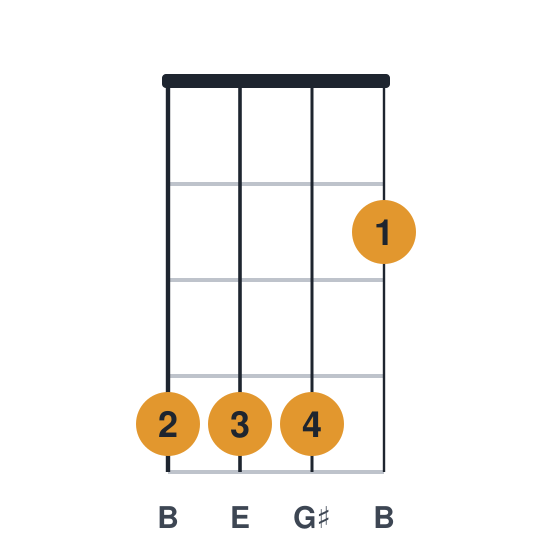
- F#m7the ii chord beside Emaj7 in the key of E
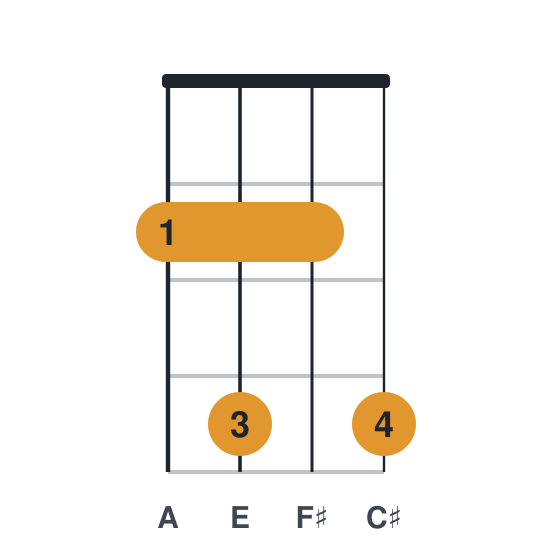
- B7the V chord of E
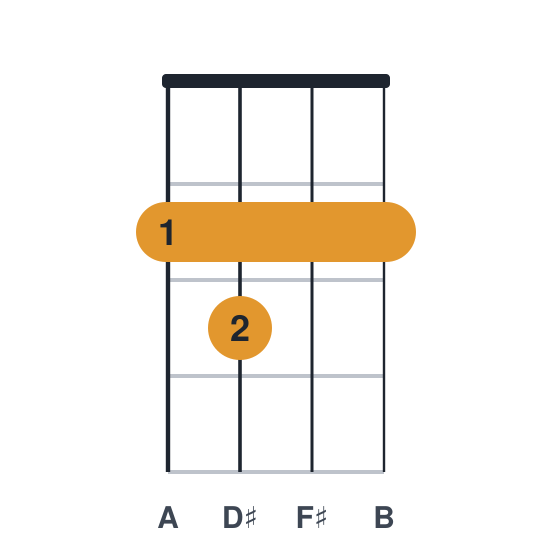
- E6the other soft colour on the same major


Other E chords
Emaj7 ukulele chord chart (1302) from melodician.com