Eaug Ukulele Chord
Eaug is the E augmented chord. It has three notes: E, G sharp and C. The standard shape needs just two fingers with the C and E strings open, which makes it a rare thing: an E family chord that is genuinely easy on a ukulele.

Index at the 1st fret of the G string, middle at the 3rd fret of the A string, C and E strings open. The root E rings on the open E string.
How to play Eaug on ukulele, step by step
- Index finger: 1st fret, G string
- Middle finger: 3rd fret, A string
- Leave the C and E strings open. Strum all four strings.
Plain E is famously the hardest common ukulele chord; Eaug is one of the easiest. If a song lets you pass through Eaug on the way to A, enjoy the irony and the rest for your hand.
More ways to play Eaug
There are 3 common Eaug shapes: the standard one at the top of the page, plus these further up the neck. You only ever need one. Tap any card to hear it.

Denser and more deliberate, the shape to use mid song when the open strings would ring too freely.

Wide and slightly eerie, the open root inside a moving shape. A colour worth keeping for endings.
If it buzzes or sounds wrong
- The open strings get smothered
- Both middle strings ring open, so both fretting fingers must stand on their tips. If the C or E string dies, the index on the G string has flattened out.
- The chord sounds vague
- With two open strings the two fretted notes carry the identity. Check the 1st fret G string (G sharp, the third) and the 3rd fret A string (C, the raised fifth) one at a time.
- The A string buzzes at fret 3
- The middle finger is far from the index and easy to place lazily. Keep it just behind the fret wire and press straight down.
What makes it an Eaug
E · G♯ · C 1 3 ♯5
Eaug is an augmented triad: E major with the fifth raised a half step, B becoming C. Strictly spelled that note is B sharp, but it is the same key as C and chord charts print the plain name. The raised note hangs a half step below C sharp, so the chord leans hard toward anything with a C sharp in it.
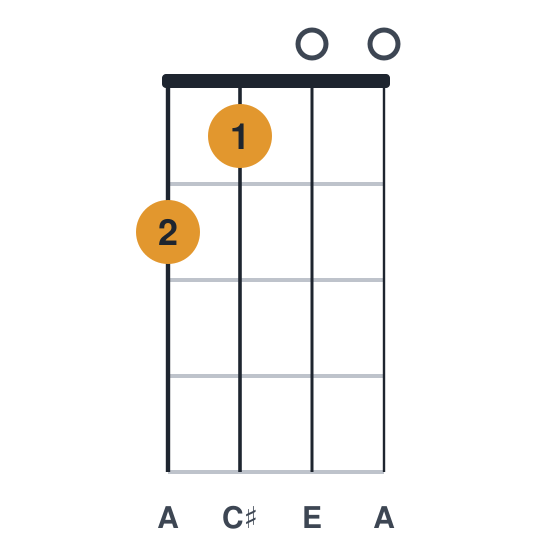
That mostly means A: Eaug is the V chord of A with a raised fifth, and E to Eaug to A is the textbook line, the C climbing to C sharp. It resolves to A minor just as naturally, where the C is already home. And because E to G sharp and G sharp to C are both major thirds, Eaug shares all three notes with Abaug and Caug.
E vs Eaug
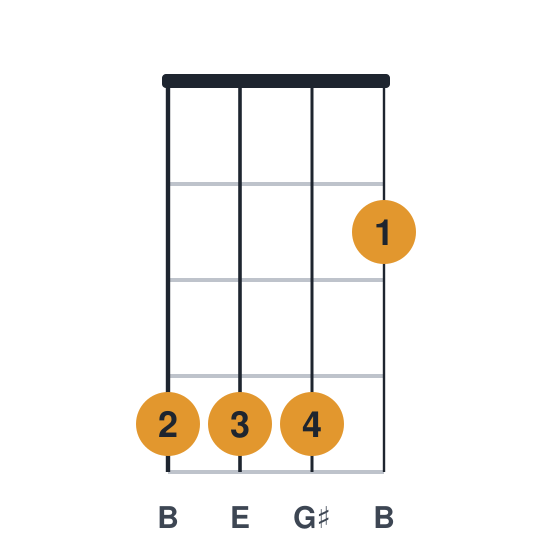
Plain E on ukulele is the four finger 4442 that beginners dread; Eaug is two fingers and two open strings. They differ by one note, B against C, but on this instrument they differ even more in effort.
Musically the roles are the usual ones: E is a place to stand, Eaug a step to somewhere else, usually A or A minor. The raised fifth is the leading note and it wants to move.
Eaug chord questions
Is Eaug easier than E?
Much easier. Plain E needs four fingers crammed at the 4th fret; Eaug needs two fingers and leaves the middle strings open. They are one note apart in theory and worlds apart under the hand.
Is Eaug the same as E+?
Yes. E+, Eaug and E augmented all name the same three notes: E, G sharp and C.
Why C and not B sharp?
Raising E major's fifth, B, strictly gives B sharp, which is the same key as C. Charts print the plain enharmonic name, and this page does the same.
What does Eaug resolve to?
A major first, with the raised fifth climbing to C sharp. A minor second. It can also fall back to plain E.
Does Eaug share notes with other chords?
Yes, with Caug and Abaug. An augmented triad splits the octave into three equal major thirds, so its notes serve three roots equally.
Chords to learn next
- Ethe plain major, one note apart
- Awhere Eaug usually resolves
- E7another chord built to push forward
- Edimthe other chord built out of equal intervals


Other E chords
Eaug ukulele chord chart (1003) from melodician.com