A Ukulele Chord
A is the A major chord. It has three notes: A, C sharp and E. The open shape uses two fingers at the bottom of the neck: index on the C string at the 1st fret, middle on the G string at the 2nd, with the E and A strings open.

The open A: index on the C string at the 1st fret, middle on the G string at the 2nd, E and A strings open.
How to play A on ukulele, step by step
- Index finger: 1st fret, C string
- Middle finger: 2nd fret, G string
- Leave the E and A strings open. Strum all four strings.
A sits one finger from two other chords: lift the index and it becomes Am, lift the middle instead and it becomes A7. Practising those two swaps covers changes that hundreds of songs use.
More ways to play A
There are 3 common A shapes: the standard one at the top of the page, plus these further up the neck. You only ever need one. Tap any card to hear it.

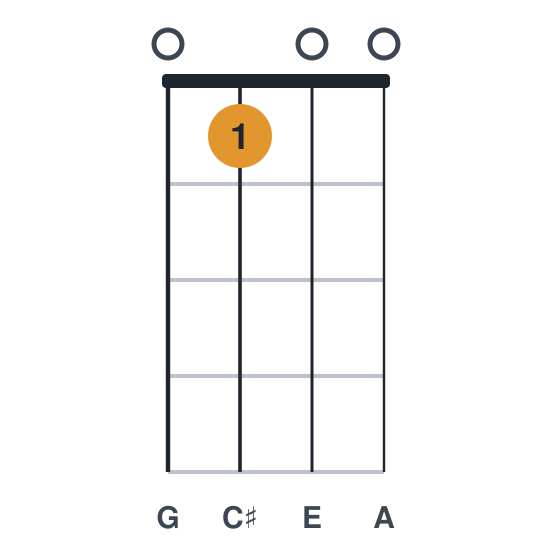
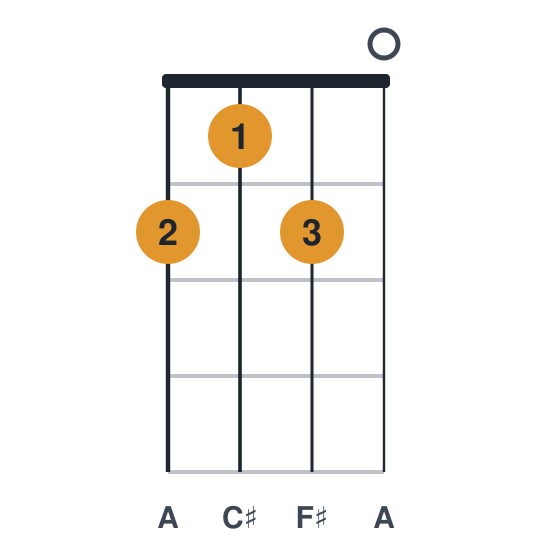
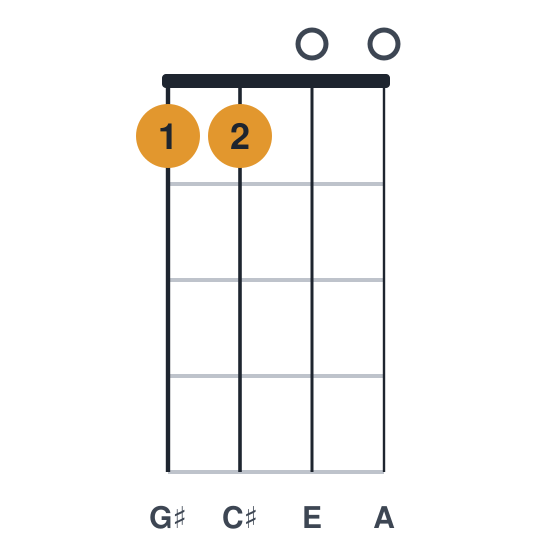
The C sharp on the re-entrant g string rings above the open strings, giving this one a shimmering, spread out colour.

High and glassy. More a colour to end a song on than an everyday grip.
If your A sounds muffled
- The open E string is quiet
- The index on the C string is leaning into it. Arch the index so only its tip touches, leaving the E string free to ring.
- The C string buzzes
- The index has drifted back from the 1st fret. Keep the fingertip snug behind the fret wire; at the 1st fret there is very little room for error.
- The two notes land at different times
- Place index and middle together as one pinch rather than one after the other. The chord should arrive as a unit.
What makes it an A
A · C♯ · E 1 3 5
A major is the root A, the major third C sharp and the fifth E. In the open shape the two fretted notes supply the root and third while the open E and A strings double the fifth and root, so two fingers deliver a complete, full sounding chord.
A is the I chord in the key of A, the IV chord in E and the V chord in D. The V of D job is the one ukulele players meet most, since D is a friendly songbook key and A is the chord that pulls everything home to it.
A vs Am
One note separates them: the C sharp in A drops to C in Am. Major becomes minor by that single half step.
On the ukulele the change is literally one finger: A is 2100 and Am is 2000. Lift the index off the C string and the bright chord turns wistful. No other pair of chords on the instrument makes the major minor difference this easy to hear.
A chord questions
Is A an easy ukulele chord?
Yes. Two fingers close together at the bottom of the neck, two open strings, and no stretch. It usually arrives in a player's first week.
What is the difference between A and Am?
The third: C sharp in A, C in Am. On the ukulele you just lift the index finger off the C string and A becomes Am.
What is the difference between A and A7?
A7 adds a G to the chord. On the ukulele keep the index where it is and lift the middle finger instead: 2100 becomes 0100, which is A7.
What songs use the A chord?
Songs in the keys of A, D and E lean on it constantly. In D, the most common of those for ukulele, A is the chord that sets up the return home.
Chords to learn next
- Amthe minor version of A
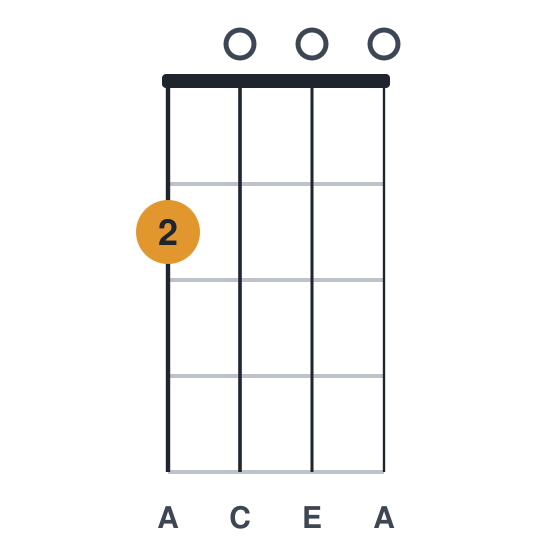
- A7A with the seventh that pushes to D
- F#mthe relative minor of A
- Amaj7the soft version of the same chord


Other A chords
A ukulele chord chart (2100) from melodician.com