F#m Ukulele Chord
F#m is the F sharp minor chord. It has three notes: F sharp, A and C sharp. The standard shape frets the C string at the 1st fret and the G and E strings at the 2nd, with the open A string sounding the minor third.

Index on the 1st fret of the C string, middle and ring on the 2nd fret of the G and E strings, A string open.
How to play F#m on ukulele, step by step
- Index finger: 1st fret, C string
- Middle finger: 2nd fret, G string
- Ring finger: 2nd fret, E string
- Leave the A string open. Strum all four strings.
F#m is A major with one extra note: fret the E string at the 2nd fret on top of the A shape and the chord turns from A into F#m. They are relative major and minor, and on the ukulele they sit one finger apart.
More ways to play F#m
There are 3 common F#m shapes: the standard one at the top of the page, plus these further up the neck. You only ever need one. Tap any card to hear it.

Darker and more centred than the open shape, with the fifth at both ends.

Wide and ringing, the open A glowing against fretted notes high on the neck.
If it sounds wrong
- The open A string dies
- The ring finger on the E string is the neighbour leaning over it. Keep it curled on its tip; the open A is the note that makes the chord minor.
- The middle of the chord buzzes
- The index on the C string sits a fret behind the other two fingers. Make sure it is close behind the 1st fret wire, not stranded halfway to the nut.
- It sounds like A major
- Check the E string is fretted at the 2nd fret. Left open it plays an E, and the chord collapses into A major, which shares its other three notes.
What makes it an F#m
F♯ · A · C♯ 1 ♭3 5
F#m is a minor triad: F sharp, a minor third A, and a fifth C sharp. In the standard shape the root sits on the E string with the open A above it, and the grip shares three of its four notes with A major, its relative major.
F#m works as the ii of E and the vi of A, keys guitars love, so ukulele players playing along with guitar songs meet F#m early and often.
F#m vs F#
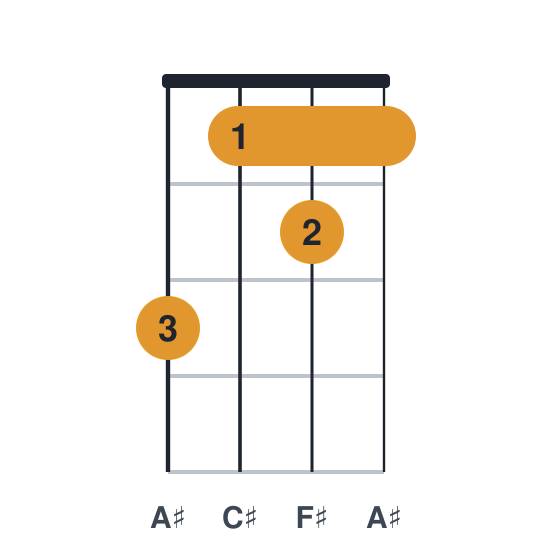
F# major frets the G string at the 3rd fret and the A string at the 1st, and both of those notes are A sharp, the major third. F#m lowers that pitch to A natural in both places at once: the G string drops one fret and the A string simply rings open.
Minor turning out easier than major is a ukulele habit: the open strings lean toward the sharp side minors. Here the minor frees a finger and an open string at the same time.
F#m chord questions
Is F#m the same as Gbm?
Yes, the same pitches under two names. Sharp keys write F#m, flat keys write Gbm. On the fretboard nothing changes.
Is F#m a hard chord?
No. Three fingers inside two frets with an open string. The major version is the harder of the pair.
What is the difference between F#m and A?
One note: fret the E string at the 2nd fret on top of the A major shape and you have F#m. They are relative major and minor, which is why they share so much.
What is the difference between F#m and F#?
The third: F# major has an A sharp, F#m has an A natural. In the shapes, the G string drops a fret and the A string goes from fretted to open.
What keys use F#m?
It is the ii chord of E major, the vi chord of A major, and the home chord of F sharp minor.
Chords to learn next
- F#the major version of F#m
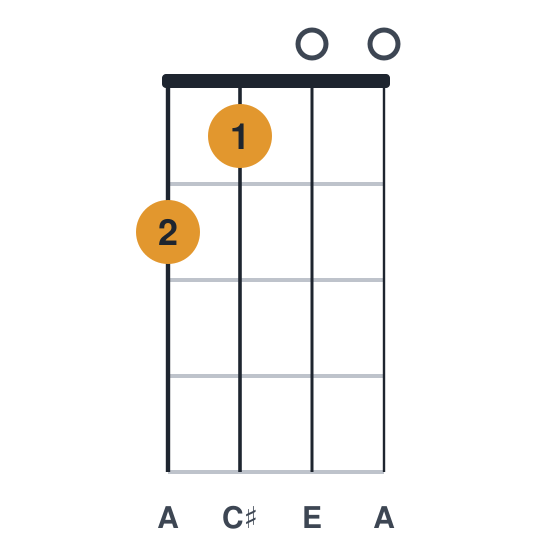
- F#m7adds a seventh for a softer F#m
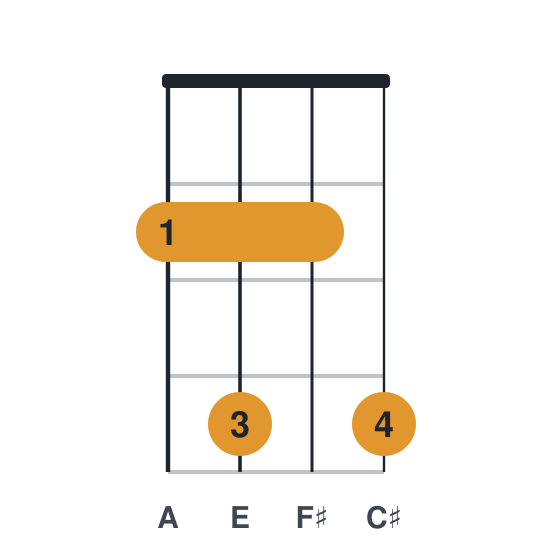
- Athe relative major of F#m
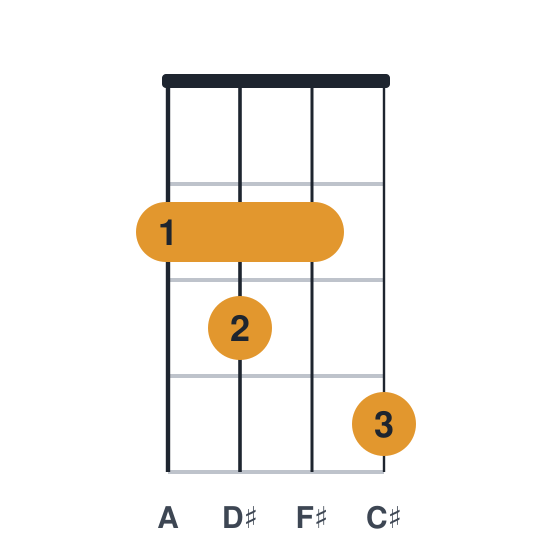
- F#m6the same minor with an old-fashioned sixth


Other F# chords
F#m ukulele chord chart (2120) from melodician.com