F#7 Ukulele Chord
F#7 is the F sharp dominant seventh chord. It has four notes: F sharp, A sharp, C sharp and E. The standard shape is four fingers: index on the 2nd fret of the E string, middle on the 3rd fret of the g string, ring and pinky on the 4th fret of the C and A strings.

Four fingers between the 2nd and 4th frets: index on the E string at 2, middle on the g string at 3, ring and pinky on the C and A strings at 4. F7 moved up one fret.
How to play F#7 on ukulele, step by step
- Index finger: 2nd fret, E string
- Middle finger: 3rd fret, G string
- Ring finger: 4th fret, C string
- Pinky finger: 4th fret, A string
- Strum all four strings.
The grip is F7 moved up one fret, finger for finger. Movable shapes pay off like that: learn the F7 spread once and F#7, G7 in its fretted form, and everything above them come free.
More ways to play F#7
There are 3 common F#7 shapes: the standard one at the top of the page, plus these further up the neck. You only ever need one. Tap any card to hear it.

Airy and unusual: the seventh rings open inside a fretted shape. Softer than the standard grip, and a pretty colour for a slow tune.

Even and easy to keep clean, two working fingers. The most reliable F#7 once short barres feel natural.
If it sounds wrong
- The shape collapses mid strum
- Four fingers, no anchor: place ring and pinky first at the 4th fret, then set middle and index. Building top down keeps the hand from twisting.
- The E string is muted
- The index holds the shape's lowest fret and hides under the other three fingers. Keep it on its tip; flat, it takes the A string with it.
- Notes pull sharp
- Mid neck, a four finger squeeze bends strings easily. Press just to the fret, no further, and check each string against the open string two frets down.
What makes it an F#7
F♯ · A♯ · C♯ · E 1 3 5 ♭7
F#7 is a dominant seventh: an F sharp major triad (F sharp, A sharp, C sharp) plus a minor seventh, E. It is the V7 of B, pulling to B major and B minor alike.
B is a common enough song key that F#7 earns its keep, and the chord also passes for Gb7 in flat key charts: one grip, two names, the same pull toward its home a fourth up.
F#7 vs F#
F# major is 3121, a barre shape; F#7 is the four finger F7 spread moved up a fret. The two do not share a grip, so the seventh is not a small edit here the way C7 is from C: it is its own shape to learn.
The sound difference is the usual one. F# rests; F#7 leans into B. The second shape on this page, with its open E string, softens that lean into something gentler when the song can use it.
F#7 chord questions
Is F#7 the same as Gb7?
Yes, one chord spelled two ways. Sharp key charts write F#7, flat key charts Gb7; the shape does not change.
Is F#7 hard to play?
The standard shape uses all four fingers, like F7. The 6667 barre alternative needs only the index flat across three strings plus the middle finger.
What does F#7 resolve to?
B. F#7 is the V7 chord of B major and B minor.
Which shape here is easiest?
The barre at the 6th fret: index across the g, C and E strings, middle on the A string. Two working fingers, C7's grip moved up six frets.
Where is F#7 used?
In songs in B, in charts written as Gb7 for flat key instruments, and one fret above F7 in chromatic seventh climbs.
Chords to learn next
- B7F#7 resolves to B
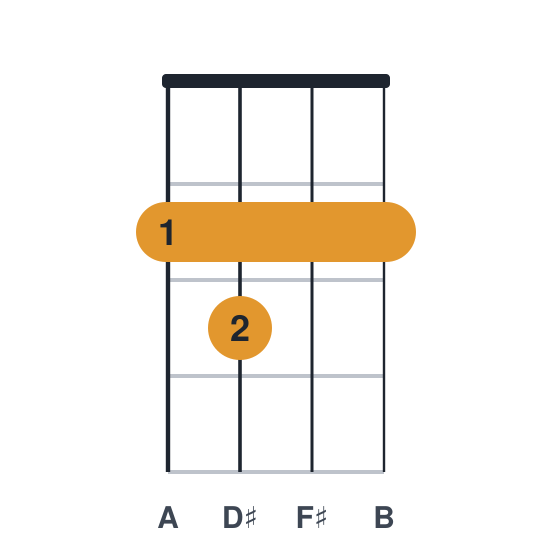
- F#the plain major underneath it
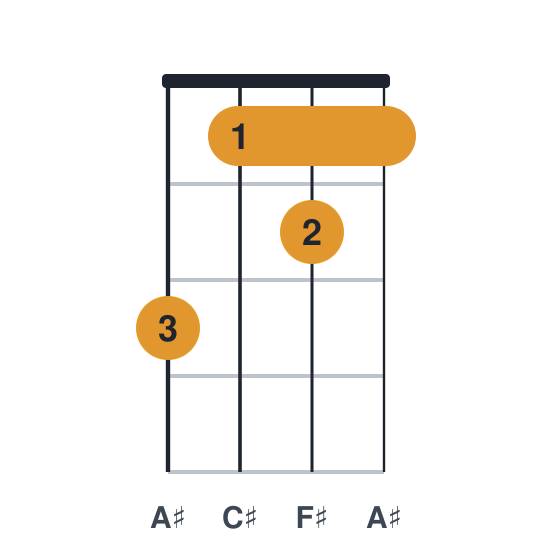
- E7the IV chord next to F#7 in blues in B
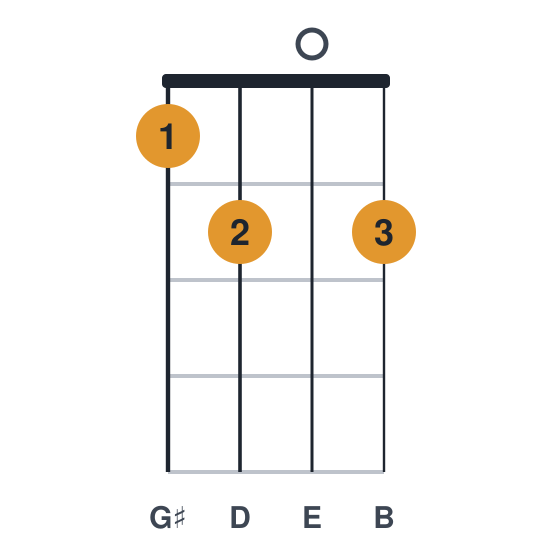
- F#9the same seventh with a ninth on top
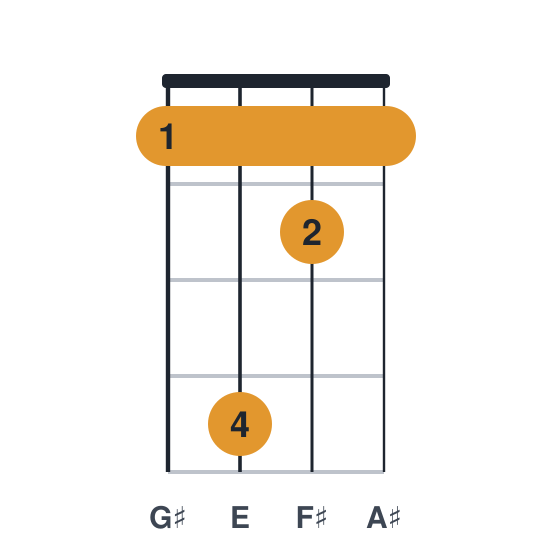


Other F# chords
F#7 ukulele chord chart (3424) from melodician.com