F#dim Ukulele Chord
F#dim is the F sharp diminished chord, a diminished triad. It has three notes: F♯, A and C. The open C and A strings already sound two of them, so the standard shape is just two fingers at the 2nd fret. In songs in G it is the classic one fret climb into the home chord.

Two fingers at the 2nd fret with two open strings between and beside them: the open C is the flat five, the open A the flat three, and A also sounds fretted on the G string.
How to play F#dim on ukulele, step by step
- Index finger: 2nd fret, G string
- Middle finger: 2nd fret, E string
- Leave the C and A strings open. Strum all four strings.
Both fingers sit at the same fret with an open string between them, so the grip settles fast. For the same chord higher up, the closed shape at the 3rd fret slides to any root.
More ways to play F#dim
There are 3 common F#dim shapes: the standard one at the top of the page, plus these further up the neck. You only ever need one. Tap any card to hear it.

Firmer and darker than the open grip, and silent as soon as you lift, which suits a strict passing chord.

A hybrid of the other two: closed shape bite on top, open string sustain underneath.
If it buzzes or sounds dead
- The open C goes quiet
- The index on the G string is leaning over and resting on the C string beside it. Stand it on its tip so the open string rings clear.
- The open A goes quiet
- Same story from the other side: the middle finger on the E string is brushing the A string. Curl it and check both open strings one at a time.
- The two fretted notes do not match
- Index and middle finger share the 2nd fret on non neighbouring strings, which can leave one lighter than the other. Even out the pressure until the four strings speak at one volume.
What makes it an F#dim
F♯ · A · C 1 ♭3 ♭5
F#dim is two minor thirds stacked: F♯ up to A, then A up to C. F♯ minor would reach up to C♯; the diminished chord stops one fret short, and the flat fifth from F♯ to C is where the tension sits.
F#dim is the chord built on the seventh note of the G major scale, so it belongs to the key of G and pulls one fret up into G. Its three notes are also three quarters of D7, the key's dominant chord, which is why a writer can swap one for the other on the way home.
F#dim vs F#m
Both start with F♯ and A. F♯ minor finishes with C♯ and sounds settled; F#dim finishes with C, one fret lower, and leans toward G.
F♯m can hold a verse. F#dim is a doorway into G: a beat or two of climb, then through. When a chart in the key of G writes F#°, this two finger shape is what it is asking for.
F#dim chord questions
Are F#dim and Gbdim the same chord?
Yes, identical notes and shapes. F♯ is the usual spelling because the chord almost always resolves up to G, and F♯ to G reads more naturally than G♭ to G.
Is F#dim really a two finger chord?
Yes. The open C string is the chord's flat five and the open A its flat three, so only two notes need fretting. Alongside C#dim it is one of the easiest diminished chords on the instrument.
What is the difference between F#dim and F#dim7?
F#dim is the three note triad: F♯, A, C. F#dim7 adds a diminished seventh, E♭, for four notes. Ukulele songbooks often chart the four note grip whenever they write dim.
What does F#dim resolve to?
G, one half step up, or G minor. It is the leading tone chord of G, so the climb home is built in.
When would a song use F#dim?
Mostly in the key of G, walking up into the G chord or adding a chromatic step inside a turnaround. It is a chord you pass through for a beat or two.
Chords to learn next
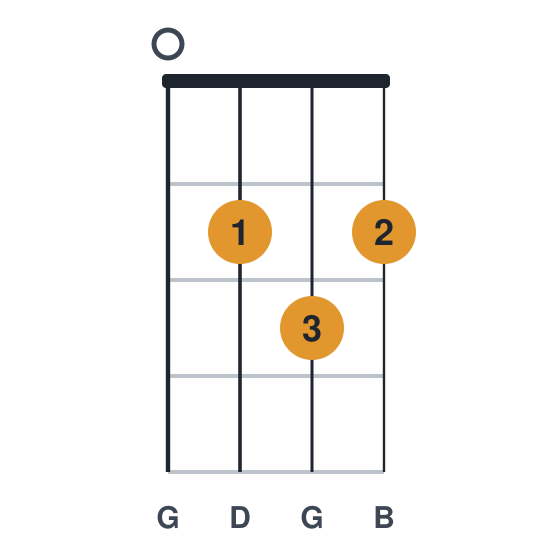
- GF#dim pulls up a half step to G
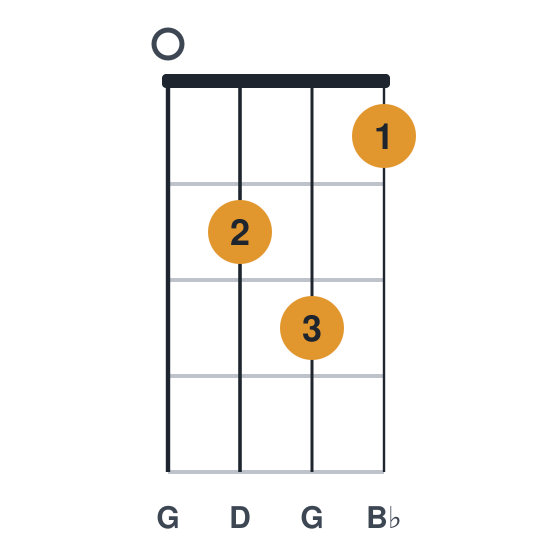
- Gmthe minor resolution one fret up
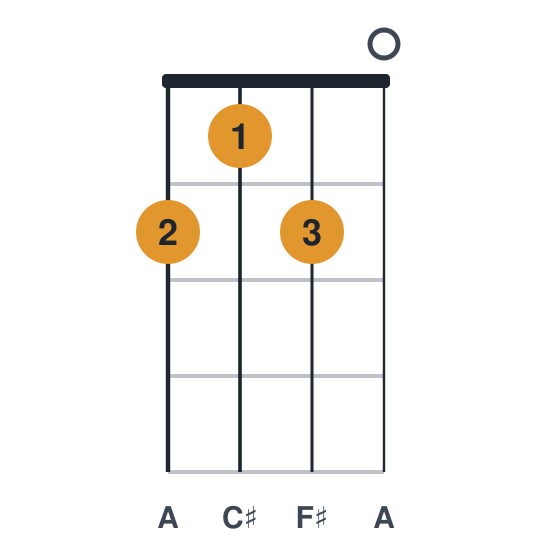
- F#mone note away from F# minor
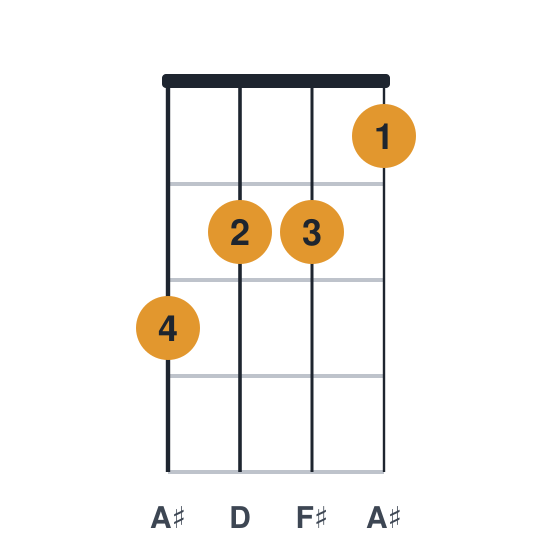
- F#augthe other chord built out of equal intervals


Other F# chords
F#dim ukulele chord chart (2020) from melodician.com