F#aug Ukulele Chord
F#aug is the F sharp augmented chord, also written Gbaug. It has three notes: F sharp, A sharp and D. The standard shape is a diagonal stack across the first three frets, one finger per string, with the root on the E string.

The diagonal staircase in first position: pinky on the G string at 3, middle and ring paired at 2, index on the A string at 1. Root on the E string.
How to play F#aug on ukulele, step by step
- Index finger: 1st fret, A string
- Middle finger: 2nd fret, C string
- Ring finger: 2nd fret, E string
- Pinky finger: 3rd fret, G string
- Strum all four strings.
This diagonal moved four frets higher, 7665, is still F#aug: an augmented chord repeats itself every four frets because its notes are all a major third apart. Both positions are on this page.
More ways to play F#aug
There are 3 common F#aug shapes: the standard one at the top of the page, plus these further up the neck. You only ever need one. Tap any card to hear it.

Broader and warmer, trading the tight diagonal for a stretch. Sustains better for slow songs.

Neat and bright in the middle of the neck, the go-to when the song lives above the open position.
If it buzzes or sounds wrong
- The staircase collapses
- Four fingers across three frets is the hardest grip in the augmented family. Place the pinky at 3 first, then the middle pair at 2, then the index at 1, and strum only when all four ring alone.
- The paired 2nd fret fingers buzz
- Middle and ring sit on the C and E strings at the same fret. Keep a knuckle's gap between them and press with the tips.
- The root disappears
- F sharp lives at the 2nd fret of the E string under the ring finger, in the middle of the pile. If the chord sounds rootless, that finger has gone soft.
What makes it an F#aug
F♯ · A♯ · D 1 3 ♯5
F#aug is an augmented triad: F sharp major with the fifth raised a half step. Strictly that note is C double sharp, which is the same key as D, and charts print the plain name. The raised note hangs a half step below D sharp, so the chord pulls toward B major, whose third it wants to reach.
The textbook line is F# to F#aug to B, the D climbing to D sharp. The same climb serves B minor. And because F sharp to A sharp and A sharp to D are both major thirds, F#aug contains exactly the same notes as Bbaug and Daug: one pitch set, three roots.
F# vs F#aug
Plain F# on ukulele is 3121; F#aug rearranges the hand into the 3221 diagonal. The moving note is the fifth, C sharp rising to D, and with it the chord stops settling and starts pointing at B.
Use F# as a place and F#aug as a corridor: a beat or two between F# and B, or as a chromatic shimmer before B minor. It is not a chord to sit on.
F#aug chord questions
Are F#aug and Gbaug the same chord?
Yes. F sharp and G flat are one pitch with two spellings, so the two names mean the same shape and sound. Sharp keys write F#aug, flat keys Gbaug.
Why does the chart say D and not C double sharp?
Raising F sharp major's fifth, C sharp, strictly gives C double sharp, the same key as D. Chord charts print the plain enharmonic name, and so does this page.
What does F#aug resolve to?
B major first, the raised fifth climbing to D sharp. B minor works with the same motion, and plain F# takes it back.
Is F#aug hard to play?
It is the four finger diagonal, the toughest shape in the ukulele augmented family, though it spans only three frets. The same grip at 7665 gives the chord with a little more room between frets.
Does F#aug share notes with other chords?
Yes, with Bbaug and Daug. The augmented triad stacks two equal major thirds, so its three notes can each act as the root.
Chords to learn next
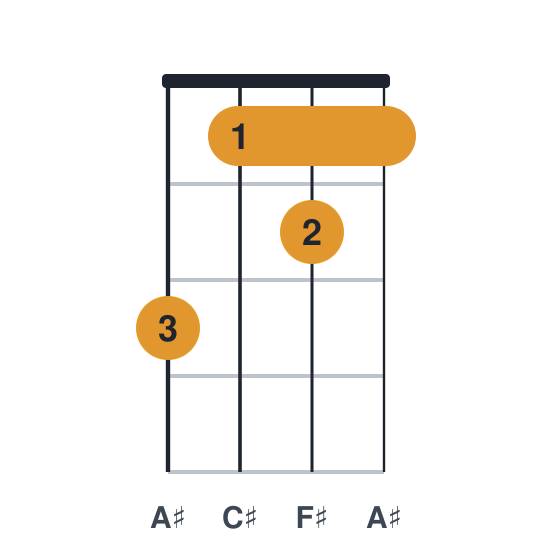
- F#the plain major, one note apart
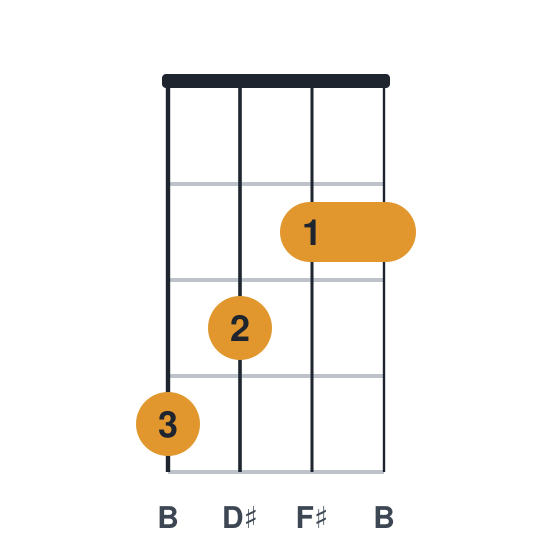
- Bwhere F#aug usually resolves
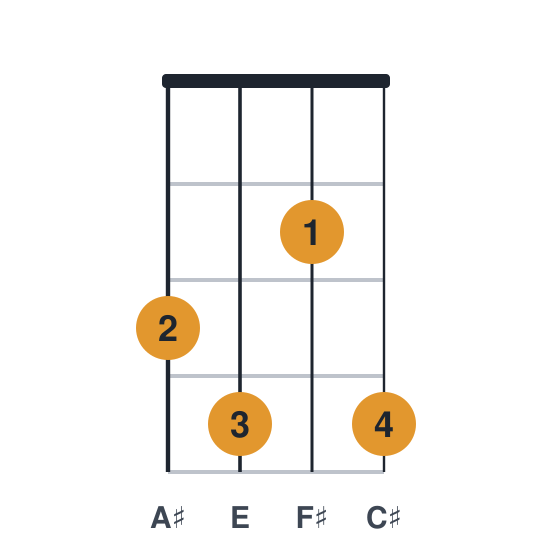
- F#7another chord built to push forward
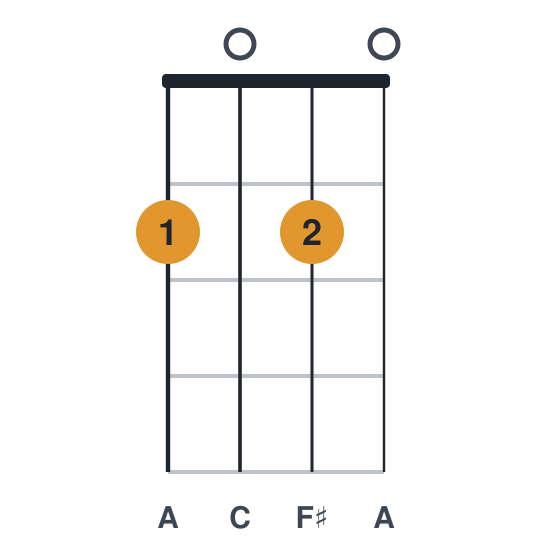
- F#dimthe other chord built out of equal intervals


Other F# chords
F#aug ukulele chord chart (3221) from melodician.com