F#9 Ukulele Chord
F#9 is the F sharp dominant ninth chord. On ukulele it keeps four of its five notes: F sharp, A sharp, E and G sharp, with the fifth left out. The standard shape is a small barre at the 1st fret with two fingers above it.

The index bars all four strings at the 1st fret, the middle finger takes the root on the E string at the 2nd and the pinky the C string at the 4th.
How to play F#9 on ukulele, step by step
- Index finger: press flat across the G to A strings at fret 1
- Middle finger: 2nd fret, E string
- Pinky finger: 4th fret, C string
- Strum all four strings.
This is F9's movable cousin one fret up: the two open strings F9 enjoys become a 1st fret barre, and from here the grip slides anywhere. The root sits on the E string at the 2nd fret, just above the barre.
More ways to play F#9
There are 3 common F#9 shapes: the standard one at the top of the page, plus these further up the neck. You only ever need one. Tap any card to hear it.

Rounder and fuller than the barre shape, mid neck where every string speaks evenly.

Thin, bright and percussive at the last usable frets. A stab voice for band style playing.
If the shape is not clean
- The barre leaks at the 1st fret
- The index lies across all four strings at the stiffest fret on the neck. Roll it slightly onto its bony edge and keep the thumb low behind the neck.
- The pinky note goes quiet
- The pinky reaches the C string at the 4th fret, the far corner of the shape. It carries the seventh; give it a deliberate press before strumming.
- Notes above the barre buzz
- The middle finger at the 2nd fret must press independently of the barre under it. If both share the work, neither note speaks; let the barre hold its own strings alone.
What makes it an F#9
F♯ · A♯ · C♯ · E · G♯ 1 3 5 ♭7 9
F#9 is an F#7 chord with a ninth added: F sharp, A sharp and E carry the seventh chord and the G sharp is the ninth. A ukulele has four strings for those five notes, so the fifth, C sharp, is left out, the same note guitar ninth grips drop.
It is the V chord of B, which puts it in reach of many song keys despite the sharp looking name. Charts in flat keys write the same chord Gb9.
F#9 vs F#7
F#9 adds a G sharp on top of F#7. Both resolve toward B, and the ninth is the rounder way to make the move.
F#7 is a compact fretted shape and F#9 answers with a small barre. The seventh chord suits a driving strum; the ninth suits the bar where the song breathes.
F#9 chord questions
Is F#9 the same as Gb9?
Yes, one chord with two names. Fretted instrument charts usually write F sharp, horn and piano charts G flat; this page follows the fretted habit.
Why is there no C sharp in these shapes?
A ukulele has four strings and F#9 has five notes. The fifth adds the least to a ninth chord, so it is the note left out.
Is the barre hard?
It is short: four narrow strings at the 1st fret. It asks less strength than a guitar barre, and the two fingers above it do the detailed work.
Can I move this shape?
Yes. The barre form is fully fretted, so one fret down it is F9 and two frets up it is G#9. The root stays on the E string, one fret above the barre.
Where is F#9 used?
As the V chord in B, in charts written in G flat, and in soul and gospel changes that pass a half step above F.
Chords to learn next
- F#7the same chord without the ninth
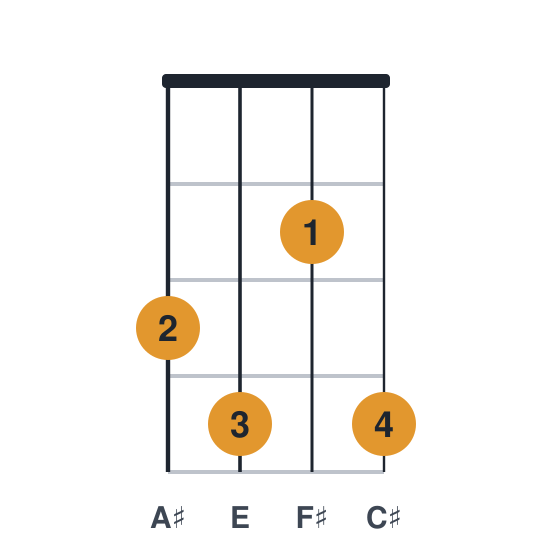
- Bwhere F#9 wants to resolve
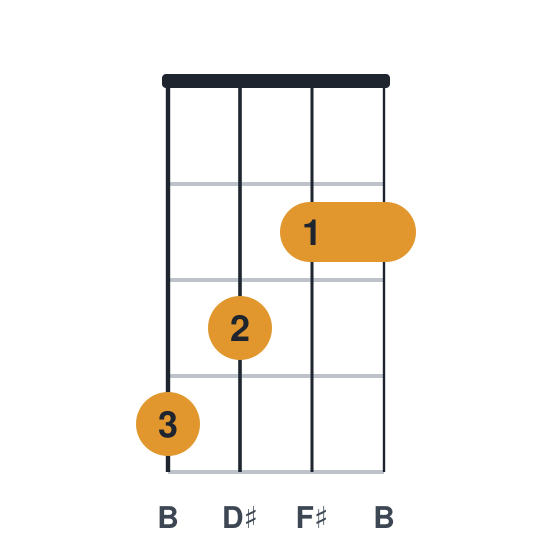
- F#maj7the other seventh built on this root
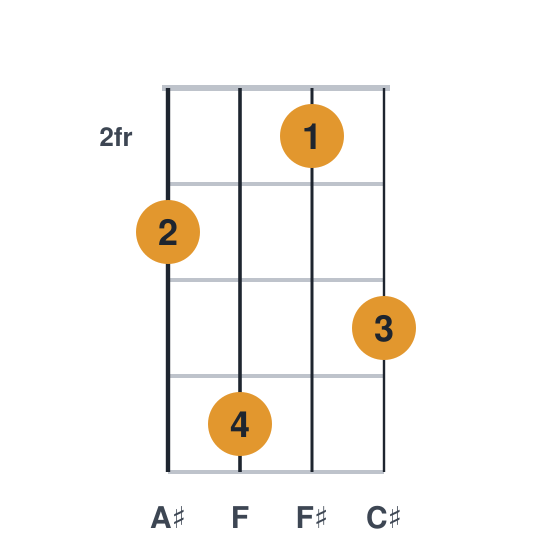
- F#6the same root with a sixth instead of a seventh
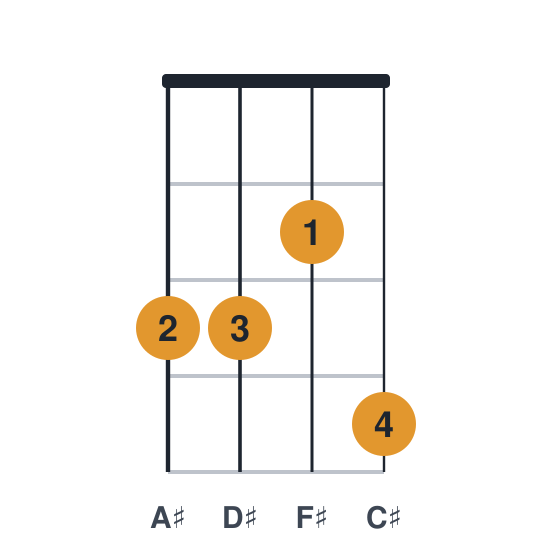


Other F# chords
F#9 ukulele chord chart (1421) from melodician.com