F#sus4 Ukulele Chord
F♯sus4 is the F sharp suspended fourth chord. It has three notes: F♯, B and C♯. The standard shape uses all four fingers, one per string: index at the 1st fret, middle and ring at the 2nd, pinky up at the 4th. Flat key charts spell the identical chord G♭sus4.

One finger per string: index at the 1st fret on the C, middle and ring at the 2nd on the E and A, pinky at the 4th on the G.
How to play F#sus4 on ukulele, step by step
- Index finger: 1st fret, C string
- Middle finger: 2nd fret, E string
- Ring finger: 2nd fret, A string
- Pinky finger: 4th fret, G string
- Strum all four strings.
Coming from F♯, both copies of the third rise one fret at once, which is why the hand rearranges rather than one finger moving. Practise the two shapes as a slow swap before using them in a song.
More ways to play F#sus4
There are 3 common F#sus4 shapes: the standard one at the top of the page, plus these further up the neck. You only ever need one. Tap any card to hear it.

Broad and even, the barre version of the same lean.

High and concentrated; a stab chord more than a strummer.
If four fingers feel like too many
- The 2nd fret pair collides
- Middle and ring sit side by side on the E and A strings. Keep both on their tips, angled slightly apart, so each presses only its own string.
- The pinky reach to the 4th fret fails
- Bring the thumb low behind the neck and lead with the pinky when you set the chord; the other fingers fall in behind it more easily than the reverse.
- Some notes vanish when you strum
- With every string fretted there is nothing to hide behind. Slow the strum and listen string by string; whichever voice is missing shows you which finger is flat.
What makes it an F#sus4
F♯ · B · C♯ 1 4 5
Sus4 means the third is suspended: replaced by the fourth. F♯sus4 keeps the root and fifth of F♯ (F♯ and C♯) but plays B where the third, A♯, would be. The B hangs one half step above A♯ and wants to fall back onto it, which is why the chord resolves to F♯.
Expect it in the keys of F♯, B and C♯, and in their flat spellings G♭, B and D♭. The standard shape doubles the B, so this sus4 leans harder than most.
F#sus4 vs F#sus2
The two suspensions replace the third of F♯ in opposite directions. F♯sus4 pushes it up to B and pulls back toward F♯. F♯sus2 drops it to G♯ and floats instead.
Choose sus4 when the music needs to land on F♯ afterwards; choose sus2 when the chord can stay unresolved and airy.
F#sus4 chord questions
Are F#sus4 and Gbsus4 the same?
Yes, the same chord spelled two ways. F♯ and G♭ are one pitch; sharp keys use the F♯ name.
Why does F#sus4 take four fingers?
None of its notes falls on an open string, and turning F♯ into the sus4 raises both copies of the third at once. Every note has to be fretted.
What does F#sus4 resolve to?
F♯ major, almost always. Both B notes fall one half step onto A♯ and the tension releases.
Is F#sus4 major or minor?
Neither. The third has been replaced by the fourth, which is what sus means.
Do you strum all four strings?
Yes. All four strings are fretted and all four are strummed.
Chords to learn next
- F#where the suspension usually lands
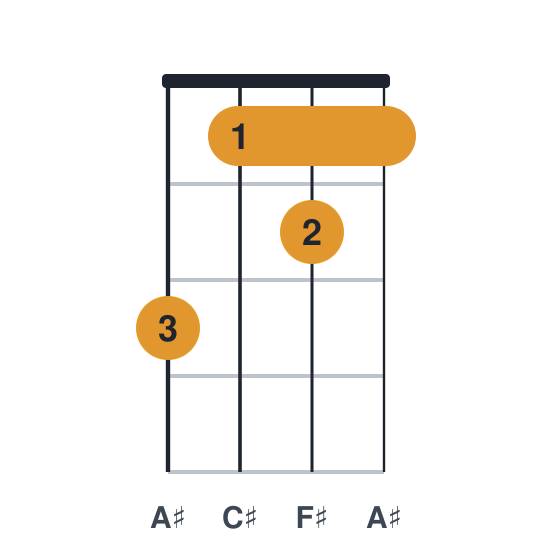
- F#sus2the other suspension
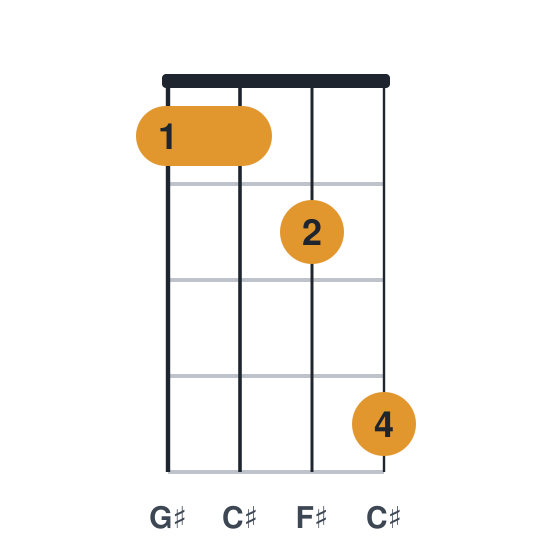
- F#7sus4 loves to decorate the seventh chord
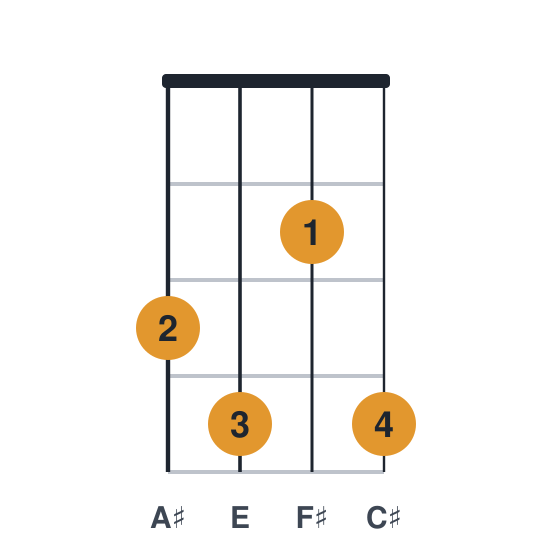
- F#mthe minor on the same root
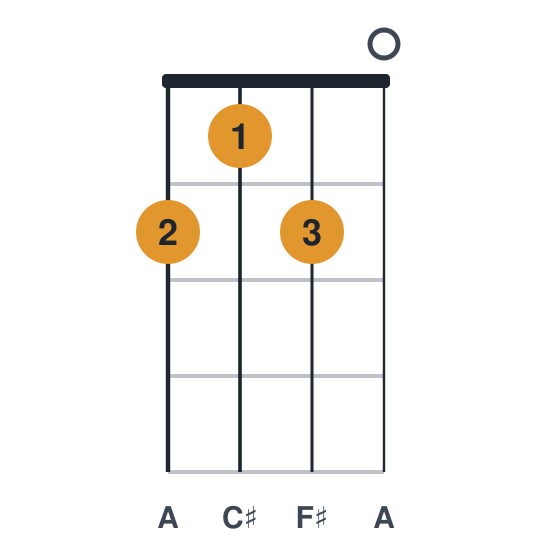


Other F# chords
F#sus4 ukulele chord chart (4122) from melodician.com