F#add9 Ukulele Chord
F#add9 is the F sharp added ninth chord. It has four notes: F sharp, A sharp, C sharp and G sharp. The standard shape is a barre across the strings at the 1st fret with the middle finger on the 2nd fret of the E string, the Gadd9 grip moved down a fret.

A barre across the strings at the 1st fret with the middle finger one fret higher on the E string. The movable add9 grip at its lowest position.
How to play F#add9 on ukulele, step by step
- Index finger: press flat across the G to A strings at fret 1
- Middle finger: 2nd fret, E string
- Strum all four strings.
Nothing in this shape is specific to F sharp. Slide it up one fret for Gadd9 or up three for Aadd9; the fingers never change.
More ways to play F#add9
There are 3 common F#add9 shapes: the standard one at the top of the page, plus these further up the neck. You only ever need one. Tap any card to hear it.

Clearer and brighter than the barre shape, with the third at the bottom of the stack. The grip to use if barres are the enemy.

Round and mid-heavy, with the fifth at the bottom. A good voicing when the song sits in the middle of the neck.
If it buzzes or sounds wrong
- The barre is hardest at the 1st fret
- Strings are stiffest right next to the nut. Keep the index tight behind the fret wire and roll it slightly onto its edge; a barre in the middle of the fret space needs twice the pressure.
- The E string thuds
- The middle finger reaching the 2nd fret has to arch over the barre. Land it on the very tip so it does not damp the A string beside it.
- The chord sounds dull
- All four strings depend on firm pressure with no open strings to help. Pull the elbow in toward your ribs; that adds barre pressure without squeezing the thumb harder.
What makes it an F#add9
F♯ · A♯ · C♯ · G♯ 1 3 5 9
F#add9 is an F sharp major triad (F sharp, A sharp, C sharp) with a ninth added: G sharp. The ninth is the second note of the F sharp scale moved up an octave, and because the third (A sharp) stays in the chord, it keeps its major character and gains brightness.
It is the I chord of F sharp, the IV of C sharp and the V of B, and the added G sharp belongs to all three keys. F sharp turns up often for ukulele players who capo or transpose guitar songs, where sharp keys are everyday territory.
F#add9 vs F#sus2
Both chords add a G sharp to F sharp, but F#sus2 removes the third (A sharp) to make room for it, while F#add9 keeps the third and stacks the G sharp alongside. One stays clearly major with shimmer, the other floats without committing.
If a chart says F# and the moment wants sparkle, add9 is the safe colour: the chord keeps its identity. The sus2 changes the harmony and usually wants to resolve.
F#add9 chord questions
Is F#add9 the same as Gbadd9?
Yes, one chord with two names. F sharp is the spelling fretted-instrument charts use most, so it is the name used here.
What is the difference between F#add9 and F#9?
F#9 also contains a flat seventh, E, which makes it a dominant chord with a blues flavour. F#add9 adds only the G sharp and stays a bright major chord.
What is the difference between F#add9 and F#sus2?
Both contain a G sharp, but F#sus2 removes the third (A sharp) and floats, while F#add9 keeps the third and still sounds fully major.
Is there an F#add9 without the barre?
Yes: the middle shape on this page uses four separate fingers at the 3rd to 6th frets. It asks for a stretch instead of a barre; pick your fight.
Where does the ninth sit in the standard shape?
On the re-entrant g string under the barre, so it rings near the top of the chord even though it is the leftmost string on the diagram.
Chords to learn next
- F#the plain major
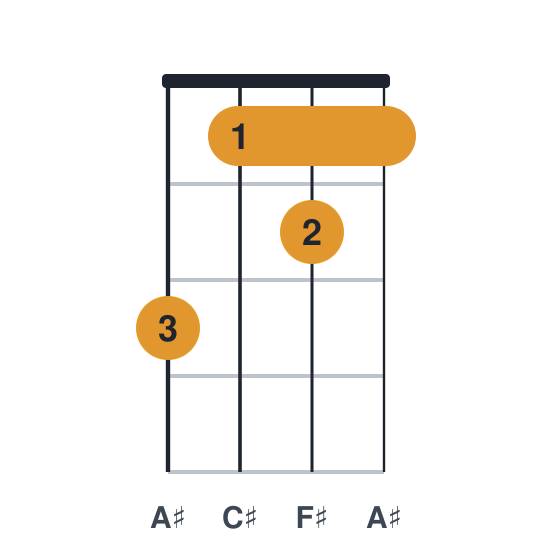
- F#sus2the 9 without the 3
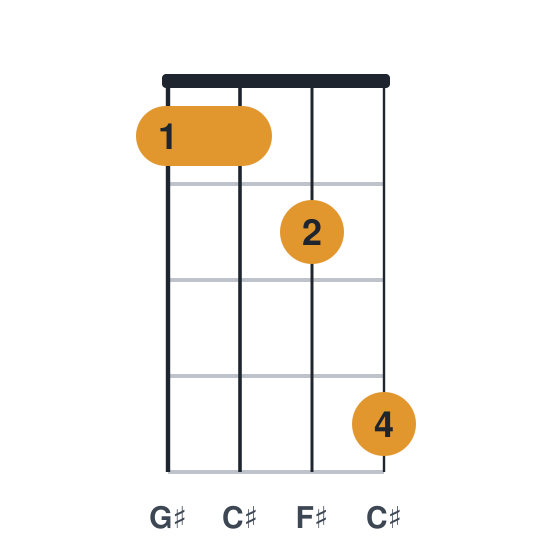
- F#maj7another colour on the same major
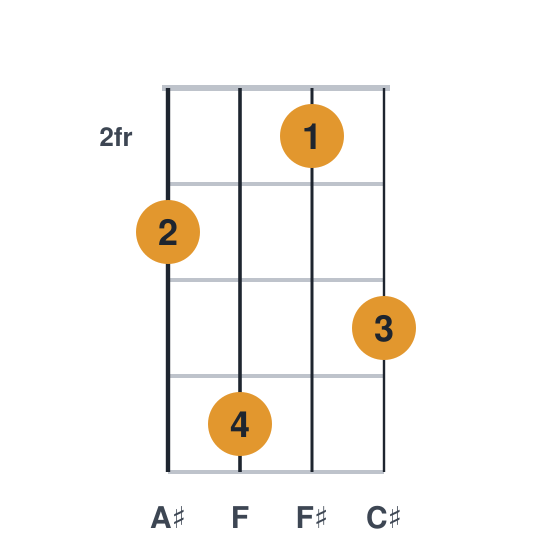
- F#mthe minor chord on the same root, a darker place to go next
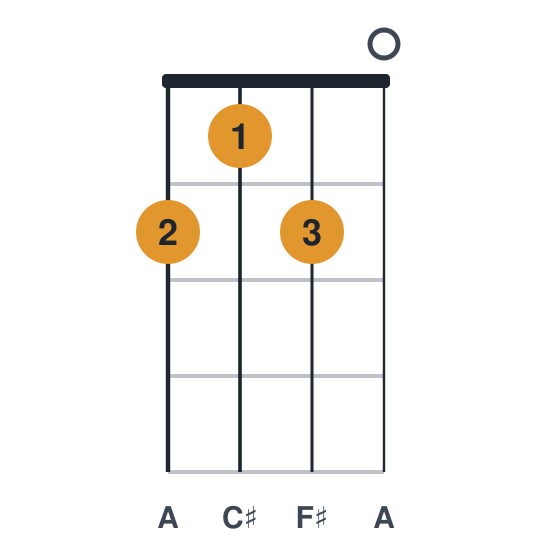


Other F# chords
F#add9 ukulele chord chart (1121) from melodician.com