F# Ukulele Chord
F# is the F sharp major chord, also written Gb. It has three notes: F sharp, A sharp and C sharp. The standard shape is the open F moved up one fret: index barred across the C, E and A strings at the 1st fret, middle at the 2nd, ring at the 3rd.

The open F moved up one fret: index across the C, E and A strings at the 1st fret, middle on the E string at the 2nd, ring on the G string at the 3rd.
How to play F# on ukulele, step by step
- Index finger: press flat across the C to A strings at fret 1
- Middle finger: 2nd fret, E string
- Ring finger: 3rd fret, G string
- Strum all four strings.
The barre only has to cover three strings, and it can relax on the far side: the G string above it belongs to the ring finger, so the index tip does not need to reach it.
More ways to play F#
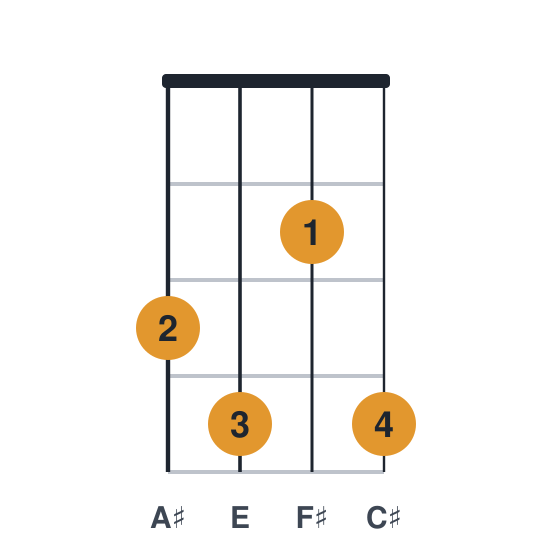
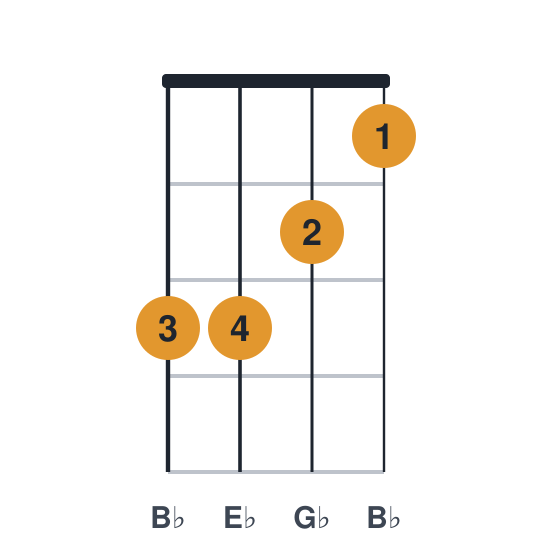
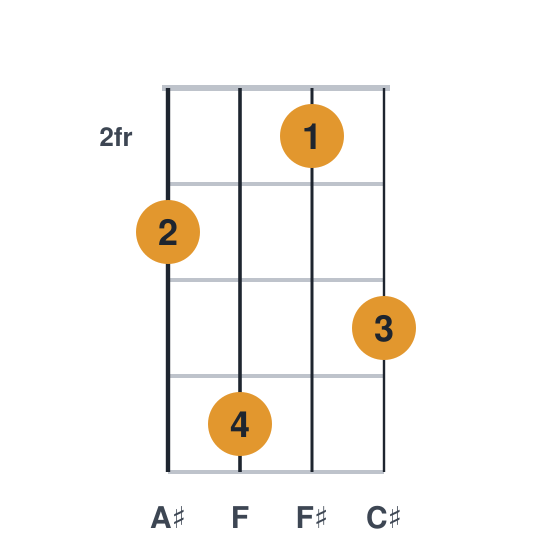
There are 3 common F# shapes: the standard one at the top of the page, plus these further up the neck. You only ever need one. Tap any card to hear it.

Wide voiced and shimmering: the G and E strings land on the same A sharp, and the unison doubling adds a chorused edge.

High and compact, with the root ringing brightest at the top of the chord.
If F# sounds smothered
- The E string inside the barre goes missing
- The middle of the barre is sagging. Press the index closer to the fret wire and let the arm, not the thumb, supply the weight.
- The G string note arrives late
- Set the barre and the ring finger together as one movement. The ring finger's 3rd fret note is the root; the chord is nameless until it lands.
- The chord rings sour
- Too much barre pressure this close to the nut pulls strings sideways and sharp. Ease off until the notes just clear, then stop.
What makes it an F#
F♯ · A♯ · C♯ 1 3 5
F sharp major is the root F sharp, the major third A sharp and the fifth C sharp. The standard shape is the open F chord moved up one fret, with the index barre replacing the two open strings, so the two chords are the same picture a half step apart.
F# is the I chord in the key of F sharp, the IV chord in C sharp and the V chord in B. Ukulele players usually meet it in songs from guitar keys like B and E, where it does the pushing that G and A do in friendlier keys.
F# vs F#m
One note moves: the A sharp in F sharp major falls to A in the minor.
On the ukulele the minor is the more relaxed of the pair: F#m needs no barre at all, just three fingertips. Going from F# to F#m feels like the shape exhaling.
F# chord questions
Is F# the same chord as Gb?
Yes. F sharp and G flat name the same pitch, so the shapes are identical. Sharp keys write F#, flat keys write Gb.
Is F# just the F chord moved up?
Yes, exactly one fret up, with the index barring the two notes the open strings used to provide. Every fretted shape on the instrument moves this way.
What is the difference between F# and F#m?
The third: A sharp in the major, A in the minor. The minor shape drops the barre entirely and is easier to play.
What keys use the F# chord?
F# is home in F sharp, the IV in C sharp and the V in B. Songs in B and E, common guitar keys, are where a ukulele player usually finds it.
Chords to learn next
- F#mthe minor version of F#
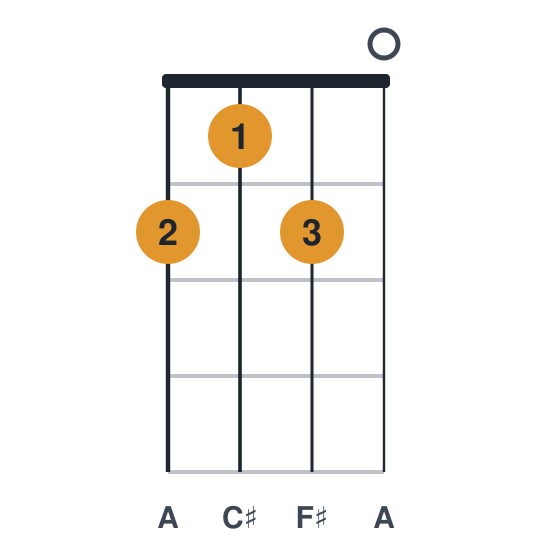
- F#7F# with the seventh that pushes to B
- Ebmthe relative minor of F#
- F#maj7the soft version of the same chord


Other F# chords
F# ukulele chord chart (3121) from melodician.com