G Ukulele Chord
G is the G major chord. It has three notes: G, B and D. The open shape is a small triangle: index on the C string at the 2nd fret, middle on the A string at the 2nd, ring on the E string at the 3rd, with the g string open.

The open G triangle: index and middle at the 2nd fret on the C and A strings, ring at the 3rd on the E string, g string open on top.
How to play G on ukulele, step by step
- Index finger: 2nd fret, C string
- Middle finger: 2nd fret, A string
- Ring finger: 3rd fret, E string
- Leave the G string open. Strum all four strings.
This is the same triangle guitarists know as the D chord, on a different instrument: same picture, different name. If you have played guitar, your hand already knows the shape.
More ways to play G
There are 3 common G shapes: the standard one at the top of the page, plus these further up the neck. You only ever need one. Tap any card to hear it.

Rounder and higher than the triangle, with the open g underneath. A good way to lift a second chorus.

Compact and high, right where a soprano neck ends. More comfortable on a concert or tenor.
If your G buzzes or mumbles
- The E string note chokes
- The ring finger is being crowded by the middle finger next to it. Stand each finger on its tip so the knuckles stack upright instead of leaning.
- The open g string goes quiet
- Nothing should touch it. Check the index is not stretching flat across the neck; curl it so the g string has clear air behind the nut.
- The triangle collapses between chords
- Practise landing all three fingers at once. Aim the ring finger at the E string first; the other two fall into place around it.
What makes it a G
G · B · D 1 3 5
G major is the root G, the major third B and the fifth D. In the open shape the g string and the E string at the 3rd fret both sound G, so the chord carries its root twice, which is what gives the little triangle its full voice.
G is the I chord in the key of G, the IV chord in D and the V chord in C. The last job is the big one: C is the ukulele's home key, so G is the chord that answers C in an enormous share of songs and then hands the music back.
G vs Gm
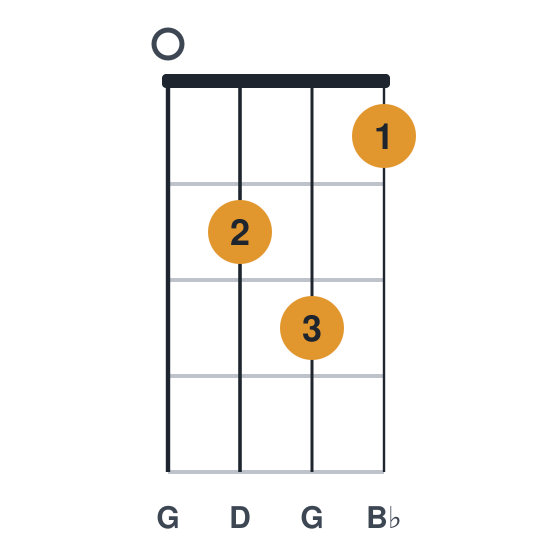
One note moves: the B in G falls to B flat in Gm. That half step is the entire distance between the major chord's brightness and the minor's shadow.
On the ukulele the moving note sits on the A string: it plays at the 2nd fret in G and at the 1st in Gm. The rest of the shape barely changes, which makes G to Gm a satisfying change to practise slowly and actually hear.
G chord questions
Is G hard for beginners?
It is usually the first three finger chord a player meets. The fingers sit close together in a compact triangle, so it comes faster than it looks.
Why does G on ukulele look like D on guitar?
A ukulele in gCEA tuning is pitched like a guitar capoed at the 5th fret, so guitar shapes reappear under new names. Guitar's D triangle lands on ukulele as G.
Does this G shape work on a baritone ukulele?
No. A baritone is tuned DGBE like the top four guitar strings, so this grip names a different chord there. On a baritone the same fingering is actually D.
What is the difference between G and G7?
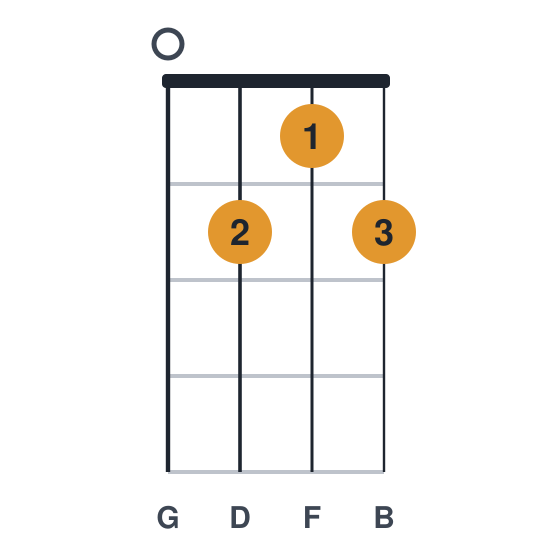
G7 swaps the top of the chord: the E string note moves from the 3rd fret down to the 1st. One finger slides and the chord starts pulling toward C.
What keys use the G chord?
G is home in the key of G and the essential V chord in C, the most common ukulele key of all. Between the two it appears in most songbooks on most pages.
Chords to learn next
- Gmthe minor version of G
- G7G with the seventh that pushes to C
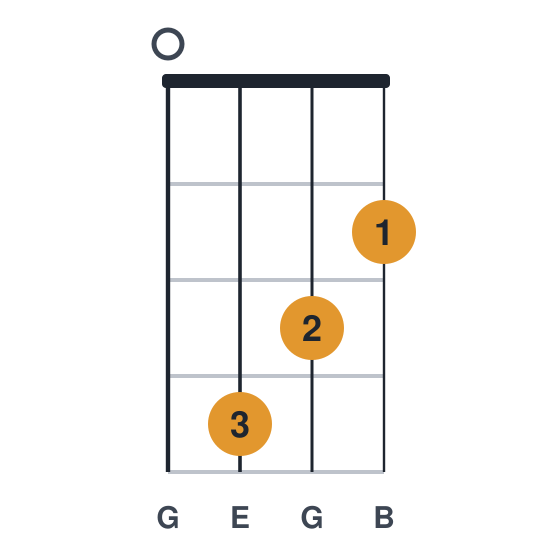
- Emthe relative minor of G
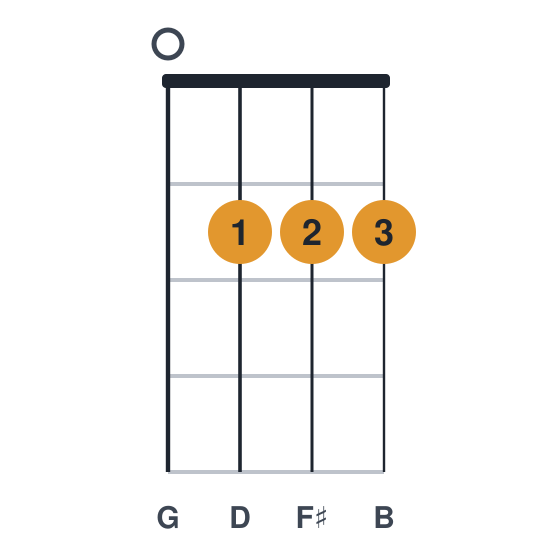
- Gmaj7the soft version of the same chord


Other G chords
G ukulele chord chart (0232) from melodician.com