Gadd9 Ukulele Chord
Gadd9 is the G added ninth chord. It has four notes: G, B, D and A. The standard shape is the plain G chord with the G string fretted at the 2nd fret instead of open, played as a small barre with the middle finger reaching the E string.

The plain G shape with the G string taken from open up to the 2nd fret, where the A lives. The index lies across at the 2nd fret and the middle finger takes the E string.
How to play Gadd9 on ukulele, step by step
- Index finger: press flat across the G to A strings at fret 2
- Middle finger: 3rd fret, E string
- Strum all four strings.
The shape has no open strings, so it moves: slide everything up one fret and the same grip plays G sharp add9, up two and it is Aadd9.
More ways to play Gadd9
There are 3 common Gadd9 shapes: the standard one at the top of the page, plus these further up the neck. You only ever need one. Tap any card to hear it.

Warmer and rounder, with the third at the bottom of the stack. A good voicing when the song lives mid-neck.

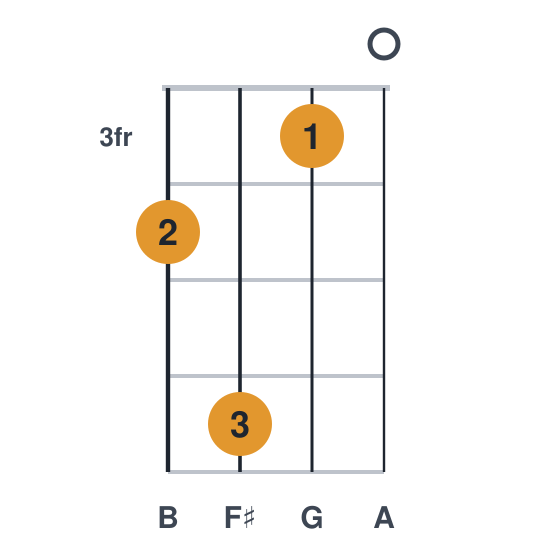
Chiming and open despite sitting high on the neck: the fretted wall of notes under an open string is a very ukulele sound.
If it buzzes or sounds wrong
- The E string thuds under the barre
- The middle finger has to clear the barre to reach the 3rd fret. Arch it so only its tip touches the E string, right behind the fret.
- The barre sounds uneven
- Three of the four strings sound from the index finger alone. Roll it slightly onto its bony edge and keep it close behind the 2nd fret so each string gets firm wood-to-string pressure.
- It sounds like plain G
- If the G string slips back to open you lose the A, the added ninth. Check the barre is really covering the G string, not starting at the C string.
What makes it a Gadd9
G · B · D · A 1 3 5 9
Gadd9 is a G major triad (G, B, D) with a ninth added: A. The ninth is the second note of the G scale moved up an octave, and because the third (B) stays in the chord, Gadd9 keeps its major character and simply gains air.
It does the same jobs plain G does: the I chord in G, the IV in D, the V in C. The added A belongs to all three of those keys, which is why the swap almost always works. On this shape the ninth sits on the re-entrant g string, so it rings at the top of the chord even though it is the leftmost string on the diagram.
Gadd9 vs Gsus2
Both chords add an A to G, but Gsus2 removes the third (B) to make room for it, while Gadd9 keeps the third and stacks the A alongside. Gadd9 is clearly major with extra brightness; Gsus2 floats, neither major nor minor.
If a chart just says G and you want more colour, Gadd9 is the safer upgrade because the chord stays major. Gsus2 changes the harmony enough that the melody has to agree with it.
Gadd9 chord questions
How do I play Gadd9 on ukulele?
Barre the strings at the 2nd fret with the index and put the middle finger on the 3rd fret of the E string. It is the plain G shape with the G string fretted instead of open.
What is the difference between Gadd9 and G9?
G9 also contains a flat seventh, F, which makes it a bluesy dominant chord. Gadd9 adds only the A and stays a bright major chord.
What is the difference between Gadd9 and Gsus2?
Both contain an A, but Gsus2 removes the third (B) and floats, while Gadd9 keeps the third and still sounds fully major.
Can I play Gadd9 instead of G?
Usually yes, especially in the keys of G, C and D, where the added A already belongs. Let your ear decide when the melody sits right on top of it.
Is there an easier Gadd9?
The last shape on this page frets three strings at the 7th fret and leaves the A string open, so there is no barre. It sits higher on the neck but the grip itself is simple.
Chords to learn next
- Gthe plain major
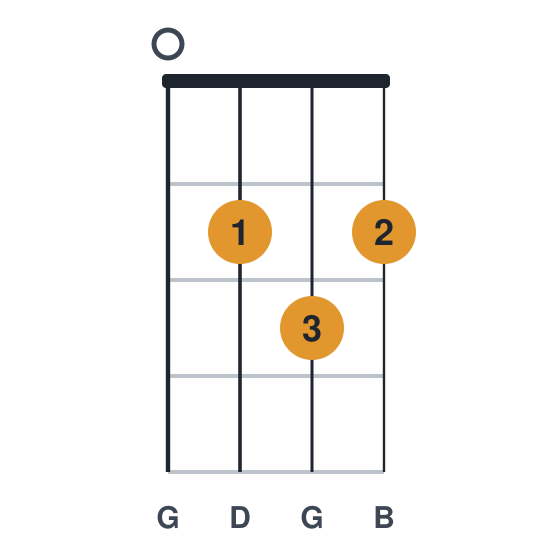
- Gsus2the 9 without the 3
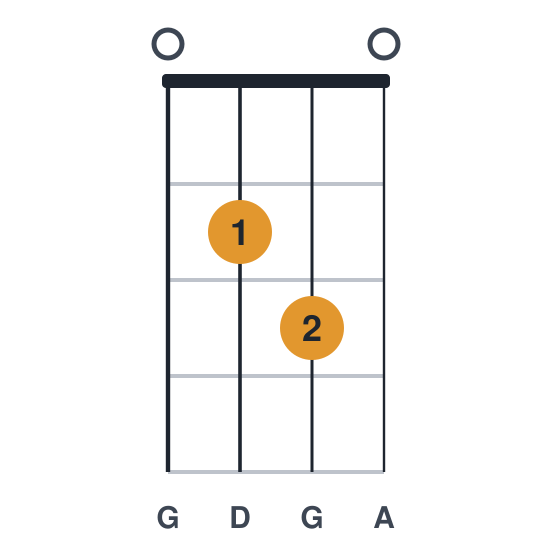
- Gmaj7another colour on the same major
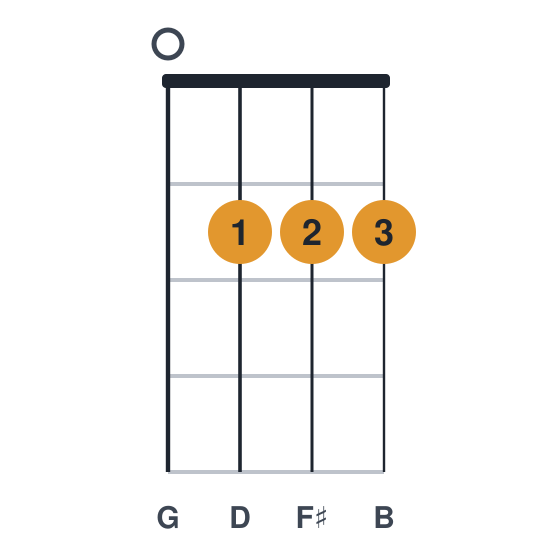
- Gmaj9the same ninth with the seventh under it


Other G chords
Gadd9 ukulele chord chart (2232) from melodician.com