Gaug Ukulele Chord
Gaug is the G augmented chord. It has three notes: G, B and D sharp. The standard shape is plain G with the middle of the chord lifted: the C string moves from the 2nd fret to the 3rd, and the G string stays open.

Plain G with the C string note raised one fret: index on the A string at 2, middle and ring stacked at the 3rd fret, G string open.
How to play Gaug on ukulele, step by step
- Index finger: 2nd fret, A string
- Middle finger: 3rd fret, C string
- Ring finger: 3rd fret, E string
- Leave the G string open. Strum all four strings.
Play G (0232), then slide the finger on the C string up one fret. That is the fifth rising from D to D sharp, and the whole difference between G and Gaug.
More ways to play Gaug
There are 3 common Gaug shapes: the standard one at the top of the page, plus these further up the neck. You only ever need one. Tap any card to hear it.

Compact and tense, no open strings. The pinky note doubles the third on top, which sharpens the chord's edge.

Bright and bell-like, the open G droning under a stack that has moved up the neck.
If it buzzes or sounds wrong
- It sounds like an odd G
- It probably is one. The D sharp lives at the 3rd fret of the C string; if that finger slips back to 2 you are playing plain G again. Check that string alone.
- The middle and ring fingers crowd
- They sit at the 3rd fret on the C and E strings. Stack them on their tips, middle above ring, with each pressing its own string only.
- The open G string is muted
- The index on the A string can lean across. Keep it upright so the re-entrant G rings; it is the root of the chord.
What makes it a Gaug
G · B · D♯ 1 3 ♯5
Gaug is an augmented triad: G major with the fifth raised a half step, D becoming D sharp. The raised note sits a half step below E, so the chord leans toward anything containing an E: it is motion pretending to be a chord.
The textbook resolution is C major, where Gaug works as the V chord with a raised fifth: G to Gaug to C, the D sharp climbing to E. The same climb lands on A minor's fifth, so Gaug decorates that cadence too. And because G to B and B to D sharp are both major thirds, Gaug shares all three notes with Baug and Ebaug.
G vs Gaug
One fret separates them: G is 0232, Gaug is 0332, the C string raised from the 2nd to the 3rd fret. The settled fifth becomes a leading note and the chord starts pulling at its leash.
The classic use is a chromatic line inside G: play G, then Gaug, then C or Em6, and the middle voice walks D, D sharp, E. One finger does all the storytelling.
Gaug chord questions
Is Gaug the same as G+?
Yes. G+, Gaug and G augmented all name the same three notes: G, B and D sharp.
What does Gaug resolve to?
C major first: the raised fifth D sharp climbs to E, the third of C. E minor and plain G are the other natural landings.
How is Gaug different from G?
One note. G is G, B, D; Gaug raises the D to D sharp. On the standard shape that is one finger moving up one fret on the C string.
Does Gaug share notes with other chords?
Yes, with Baug and Ebaug. The augmented triad stacks two identical major thirds, so the same three notes serve three roots.
Is Gaug hard to play?
No. It is exactly as hard as plain G: three fingers in the first three frets with the G string open.
Chords to learn next
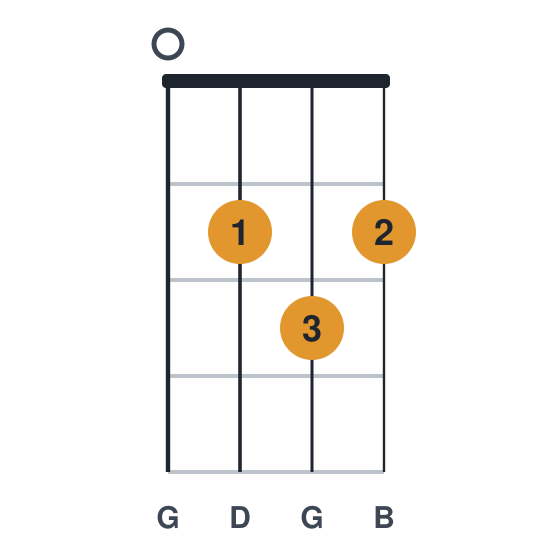
- Gthe plain major, one note apart
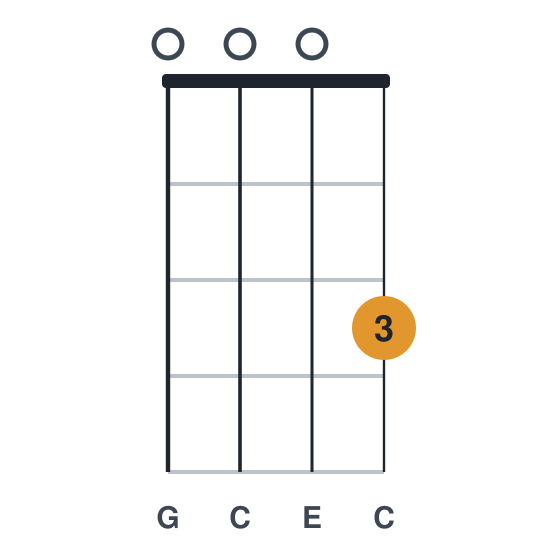
- Cwhere Gaug usually resolves
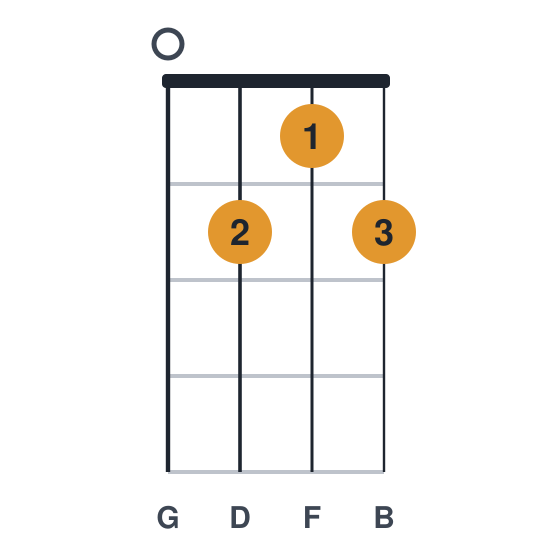
- G7another chord built to push forward
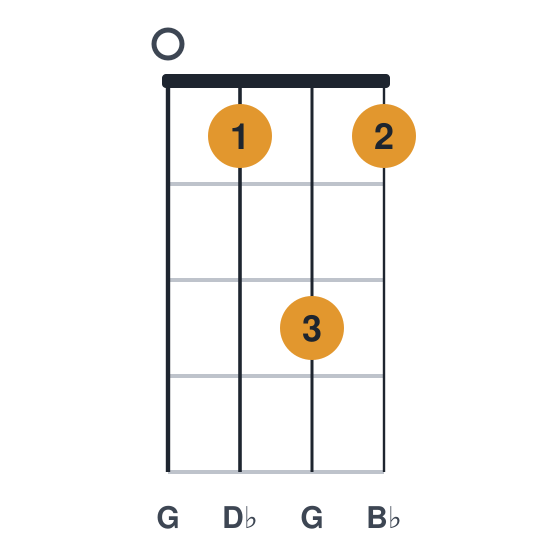
- Gdimthe other chord built out of equal intervals


Other G chords
Gaug ukulele chord chart (0332) from melodician.com