Em Ukulele Chord
Em is the E minor chord. It has three notes: E, G and B. The standard shape is a three finger staircase: index on the 2nd fret of the A string, middle on the 3rd fret of the E string, ring on the 4th fret of the C string, with the G string open.

The staircase: one finger per fret across frets 2, 3 and 4, with the G string open. The fretted E string doubles that open G in unison.
How to play Em on ukulele, step by step
- Index finger: 2nd fret, A string
- Middle finger: 3rd fret, E string
- Ring finger: 4th fret, C string
- Leave the G string open. Strum all four strings.
The fingers climb one fret per string as they cross the neck. Tilting the wrist slightly toward the floor lines the hand up with that diagonal and takes most of the strain out of it.
More ways to play Em
There are 3 common Em shapes: the standard one at the top of the page, plus these further up the neck. You only ever need one. Tap any card to hear it.

A wider spread than the standard shape, with the root doubled at the top.

High and even, with the open G droning under the row.
If the staircase collapses
- The open G string gets muted
- The ring finger on the C string is arching over its neighbour. Curl it tighter so the G string stays open; it is the minor third of the chord.
- The three fingers pile into each other
- Place the ring finger first, at the 4th fret of the C string, and stack the others down from it. The highest finger sets the angle for the whole hand.
- It sounds like G major
- Check the C string is at the 4th fret, not the 2nd. At the 2nd it plays a D and the chord becomes G, which shares two of Em's three notes.
What makes it an Em
E · G · B 1 ♭3 5
Em is a minor triad: E, a minor third G, and a fifth B. The open G string supplies the third, the C string carries the root, and the fretted E string doubles the open G in unison, which is where the shape's chiming quality comes from.
Em is the relative minor of G major and works as the ii of D and the vi of G, three of the most common song keys there are. That is why the shape earns its stretch: Em is everywhere.
Em vs E
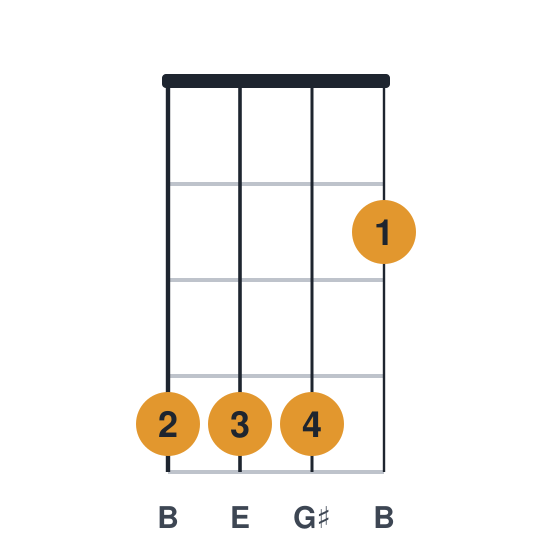
By reputation this is the mismatched pair of the instrument: Em is a beginner shape, and E major is famously the hardest common chord on the ukulele. The notes differ in the usual way, G natural in the minor against G sharp in the major.
The shapes share nothing. Em climbs frets 2, 3 and 4 with the G string open; E major squeezes three fingers onto the 4th fret with a fourth at the 2nd and no open string anywhere. Plenty of players transpose or capo purely to avoid it.
Em chord questions
Is Em hard to play?
The stretch across frets 2 to 4 surprises people, but there is no barre and the G string rings open. Most hands settle it within a few sessions.
What is the difference between Em and E?
One note on paper, G against G sharp, but on the neck the two shapes are unrelated, and E major is by far the harder grip.
Why does my Em sound like G?
Em and G major share two notes, so one misplaced finger flips between them. The C string must be at the 4th fret; at the 2nd, the chord turns into G.
Is the open G string part of the chord?
Yes, it is the minor third, the note that makes Em minor. Strum all four strings.
What keys use Em?
It is the ii chord of D major, the vi chord of G major, and the home chord of E minor.
Chords to learn next
- Ethe major version of Em
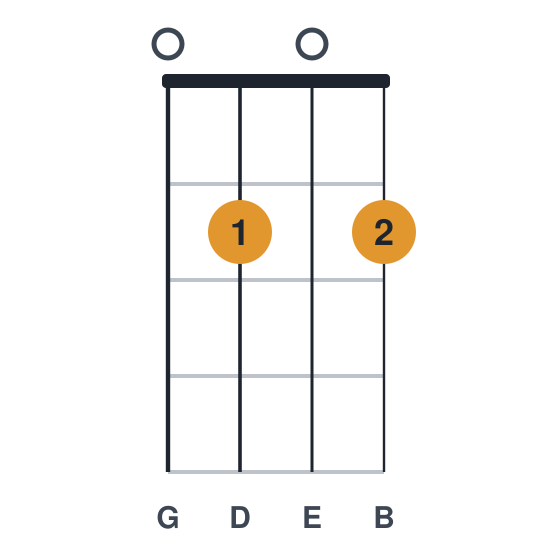
- Em7adds a seventh for a softer Em
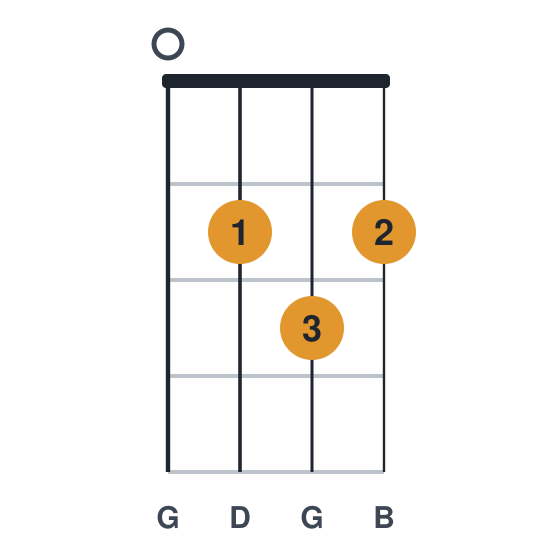
- Gthe relative major of Em
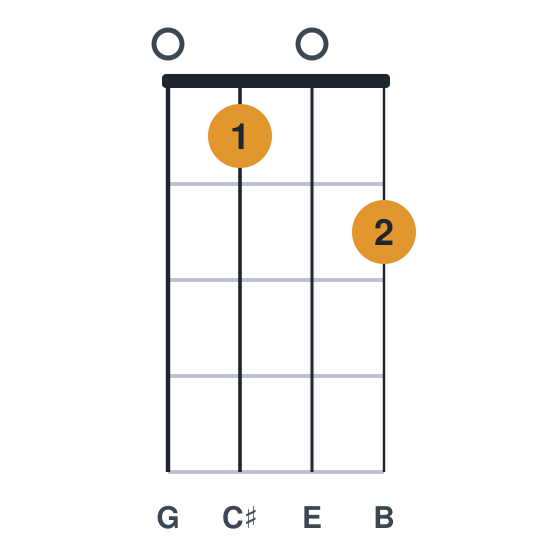
- Em6the same minor with an old-fashioned sixth


Other E chords
Em ukulele chord chart (0432) from melodician.com