A9 Ukulele Chord
A9 is the A dominant ninth chord. On ukulele it keeps four of its five notes: A, C sharp, G and B, with the fifth left out. The standard shape uses all four fingers in the first three frets.

All four fingers in the first three frets: root on the G string, third on the C, seventh and ninth on top. No open strings, so the whole grip slides.
How to play A9 on ukulele, step by step
- Index finger: 1st fret, C string
- Middle finger: 2nd fret, G string
- Ring finger: 2nd fret, A string
- Pinky finger: 3rd fret, E string
- Strum all four strings.
Nothing in this shape is specific to A. Slide every finger up one fret and it becomes Bb9; up two and it is B9. One grip covers the whole family of ninth chords.
More ways to play A9
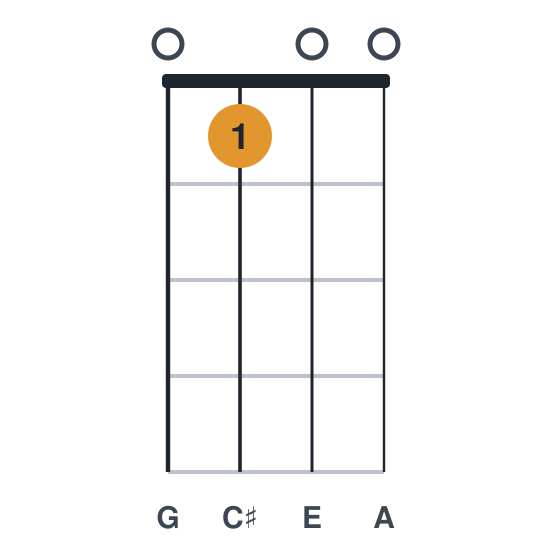
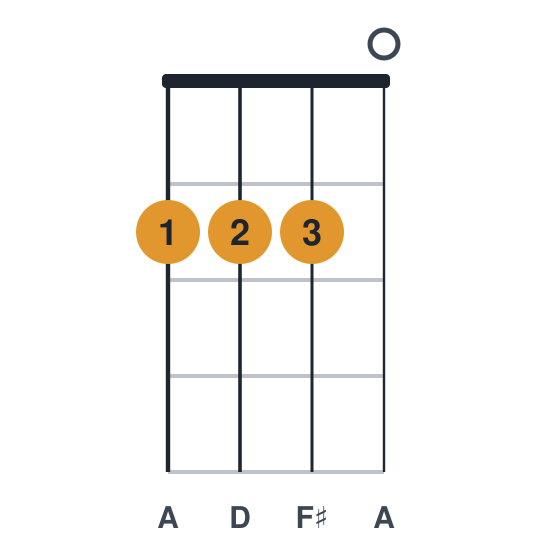
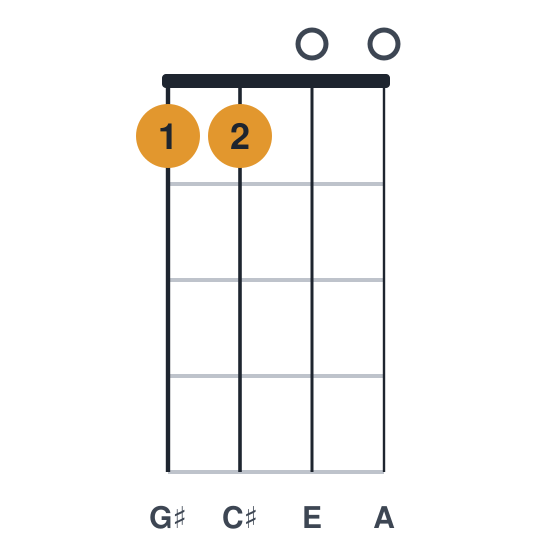
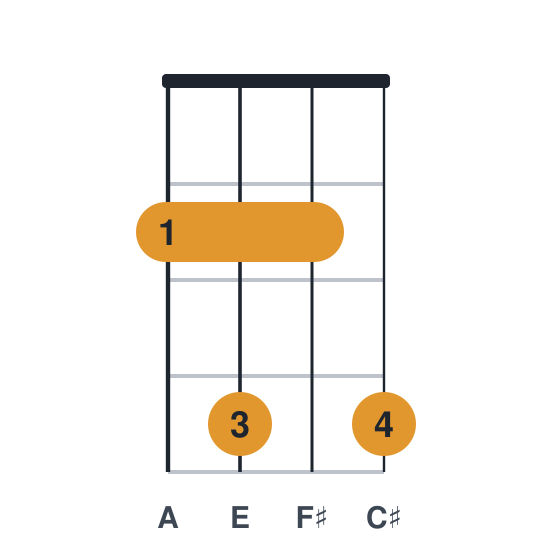
There are 3 common A9 shapes: the standard one at the top of the page, plus these further up the neck. You only ever need one. Tap any card to hear it.

Bigger and rounder than the nut position shape, with the ninth ringing on top. Worth the stretch when the chord has to sit for a whole bar.

Open and chiming, because the root rings loose while the fretted notes colour it. A good ending chord voice.
If the shape is not clean
- Four fingers land in a small space
- The index, middle, ring and pinky all press inside three frets. Place the index on the C string first and stack the others around it rather than landing all four at once.
- One note is dead in the middle
- It is usually the G string under the middle finger. Arch the knuckles so each fingertip comes down straight instead of leaning on a neighbour.
- The chord sounds sour
- Check the E string is at the 3rd fret, not the 2nd. That one note is the ninth, and a fret low it turns the chord into plain A7 with a wrong note.
What makes it an A9
A · C♯ · E · G · B 1 3 5 ♭7 9
A9 is an A7 chord with a ninth added: A, C sharp and G carry the seventh chord and the B on top is the ninth. A ukulele has four strings for those five notes, so the fifth, E, is left out. It is the note a ninth chord misses least, and guitar players drop it from most of their ninth grips too.
Its job is the V chord of D, and it is the I chord of a blues in A. The ninth keeps the dominant pull of A7 while adding a smoother, more modern colour.
A9 vs A7
A9 adds a B on top of A7. Both push toward D, but A7 sounds gritty and A9 sounds polished.
In a blues in A, A7 fits a raw shuffle and A9 fits a soul or jazz groove. Swapping one for the other is the quickest way to change the era a progression sounds like.
A9 chord questions
Why is there no E in these shapes?
A ukulele has four strings and A9 has five notes, so one has to go. The fifth is the note that adds the least to a ninth chord, which is why every chart drops it first.
What is the difference between A9 and Aadd9?
A9 contains G, the flat seventh, and behaves like a blues or jazz chord. Aadd9 has no seventh at all and sounds like a bright A major with an extra note.
Is A9 hard to play on ukulele?
It is one of the harder small chords: the standard shape needs all four fingers inside three frets. The barre form at the 4th fret trades that cluster for one flat index finger.
Can I move this shape?
Yes. The standard shape has no open strings, so the same grip one fret higher is Bb9 and two frets higher is B9. The root sits on the G string.
Where is A9 used?
As the V chord in D, as the I chord of a blues in A, and anywhere funk, soul or jazz wants a seventh chord with more colour.
Chords to learn next
- A7the same chord without the ninth
- Dwhere A9 wants to resolve
- Amaj7the other seventh built on this root
- A6the same root with a sixth instead of a seventh


Other A chords
A9 ukulele chord chart (2132) from melodician.com