Aaug Ukulele Chord
Aaug is the A augmented chord. It has three notes: A, C sharp and F. The standard shape sits in the first two frets with the A string open, one finger more than plain A, and it leans hard toward D the moment you strum it.

Index and middle side by side at the 1st fret, ring on the G string at 2, A string open. One finger more than plain A, with the raised fifth on the E string.
How to play Aaug on ukulele, step by step
- Index finger: 1st fret, C string
- Middle finger: 1st fret, E string
- Ring finger: 2nd fret, G string
- Leave the A string open. Strum all four strings.
This shape is one finger away from plain A: the open E string is fretted at 1, which is the fifth raised. Rock between 2100 and 2110 and you can hear exactly what an augmented chord does.
More ways to play Aaug
There are 3 common Aaug shapes: the standard one at the top of the page, plus these further up the neck. You only ever need one. Tap any card to hear it.

Fuller in the middle of the neck, the fretted notes ringing against the open A like a drone.

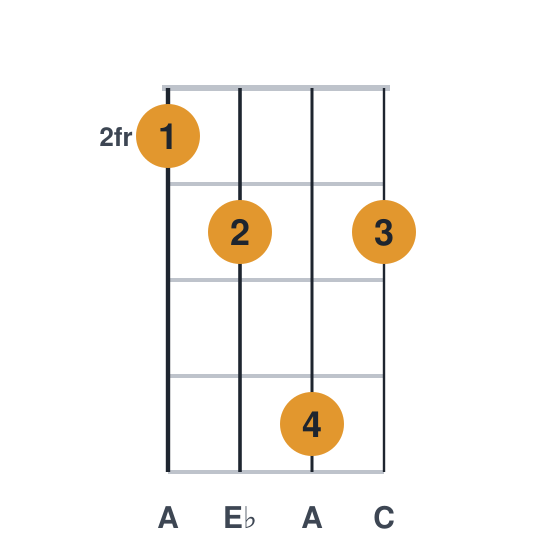
Tight and chiming this high up, the shape jazz players grab when the augmented chord passes by for a single beat.
If it buzzes or sounds wrong
- The two fret 1 notes buzz
- The index and middle sit side by side at the 1st fret on the C and E strings. Keep both on their tips with a knuckle's gap between them, close behind the fret wire.
- The open A string sounds dull
- Nothing should touch it. The middle finger on the E string is the usual culprit; arch it so the A string has a clear lane.
- The ring finger mutes the C string
- It reaches over to the 2nd fret of the G string. Come down on the very tip, or the finger's underside will rest on the strings below it.
What makes it an Aaug
A · C♯ · F 1 3 ♯5
Aaug is an augmented triad: A major with the fifth raised a half step, E becoming F. That one note is the whole story. It sits a half step above the fifth it replaced and a half step below F sharp, so the chord sounds caught mid climb, which is why writers use it to pass between chords rather than to rest on.
The textbook move is A to Aaug to D: Aaug works as the V chord of D with a raised fifth, and the F rises to F sharp, the third of D. It also slips back into plain A. And because A to C sharp and C sharp to F are both major thirds, Aaug contains exactly the same notes as C#aug and Faug, which is why one augmented grip goes such a long way on a ukulele.
A vs Aaug
One fret separates them. Plain A on ukulele is 2100 with the E string open; Aaug frets that string at 1, raising the fifth from E to F. Everything settled about A turns tense with that single move.
Use them accordingly: A holds the floor, Aaug tilts it. Give the augmented chord a beat or two on the way to D, or let it fall back into A, and it earns its keep.
Aaug chord questions
Is Aaug the same as A+?
Yes. A+, Aaug and A augmented all name the same three notes: A, C sharp and F.
What does Aaug resolve to?
D major is the classic target, with the raised fifth F climbing to F sharp. It also resolves back to plain A, or to D minor for a darker landing.
Why does the chord chart say F and not E sharp?
Strict spelling calls the raised fifth of A an E sharp, which is the same key as F. Chord charts print the plain name, and so does this site: the shape you play is identical.
Does Aaug share notes with other chords?
Yes. A, C sharp and F are also the notes of C#aug and Faug. The augmented triad splits the octave into three equal major thirds, so any of its notes can act as the root.
Is Aaug hard to play?
No. Two fingers sit side by side at the 1st fret, the ring finger adds the 2nd fret of the G string, and the A string rings open. It is barely harder than plain A.
Chords to learn next
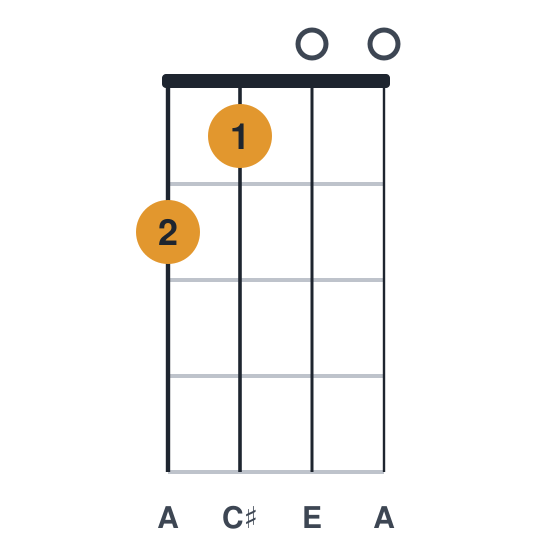
- Athe plain major, one note apart
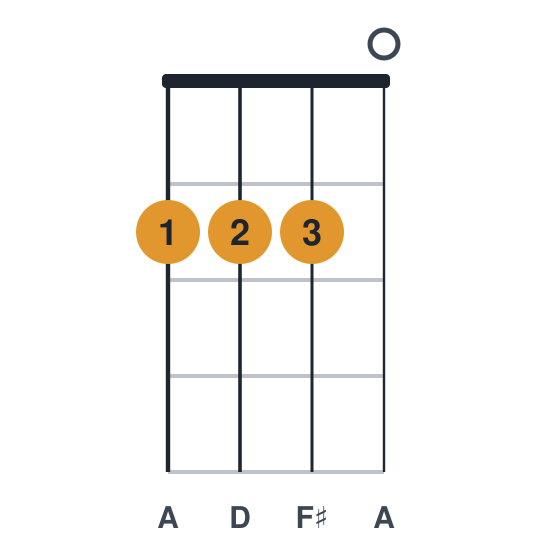
- Dwhere Aaug usually resolves
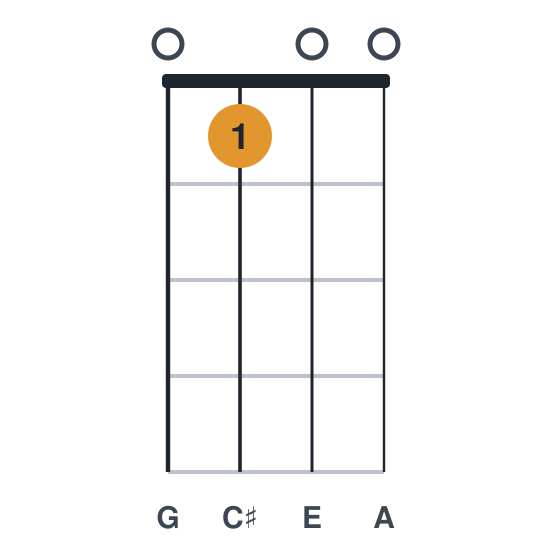
- A7another chord built to push forward
- Adimthe other chord built out of equal intervals


Other A chords
Aaug ukulele chord chart (2110) from melodician.com