D Ukulele Chord
D is the D major chord. It has three notes: D, F sharp and A. The standard shape puts three fingers side by side at the 2nd fret on the G, C and E strings, with the A string open. The squeeze is the whole difficulty.

Three fingers in a row at the 2nd fret: index, middle and ring on the G, C and E strings, A string open.
How to play D on ukulele, step by step
- Index finger: 2nd fret, G string
- Middle finger: 2nd fret, C string
- Ring finger: 2nd fret, E string
- Leave the A string open. Strum all four strings.
Three fingertips sharing one fret is a genuine squeeze. If they will not fit in a row, let the ring finger sit a little behind the other two: the notes care about being near the fret, not about queueing in a straight line.
More ways to play D
There are 3 common D shapes: the standard one at the top of the page, plus these further up the neck. You only ever need one. Tap any card to hear it.

Spread and songful. Each string carries its own chord tone, so it sounds half picked even under a plain strum.

Firm and high. The stretch is real, but it puts a complete D at the top of the neck.
If your D sounds cramped
- One of the three notes is dead
- The fingers are crowding each other flat. Stand all three on their tips with the nails short, and turn the wrist slightly forward to make room.
- The open A string chokes
- The ring finger on the E string is leaning over the edge. Pull the elbow in toward your body so the fingers stand upright and the A string stays clear.
- Three fingers simply do not fit
- Use the spread version at frets 5 to 7 lower on the page: it carries the same chord with each finger on its own fret.
What makes it a D
D · F♯ · A 1 3 5
D major is the root D, the major third F sharp and the fifth A. In the standard shape the open A string doubles the fifth, so the block of three fretted notes rings against an open string and sounds bigger than its size.
D is the I chord in the key of D, the IV chord in A and the V chord in G. The key of D is friendly territory on the ukulele, and G to D to G is one of the most travelled roads in the songbook.
D vs Dm
One note falls: the F sharp in D becomes F in Dm, and the chord turns from bright to sombre in a single half step.
On the ukulele the moving note is on the E string: 2nd fret in D, 1st fret in Dm. The other two fingers stay planted, so D to Dm is a small physical change with a large emotional one.
D chord questions
How do three fingers fit on one fret?
On their tips, knuckles upright, and not necessarily in a perfect row. Letting the ring finger trail slightly behind the other two is normal and sounds identical.
Can I play D with a barre instead?
Many players eventually flatten one finger across the G, C and E strings. It works as long as the finger stops before the A string, which must stay open.
What is the difference between D and Dm?
The third: F sharp in D, F in Dm. On the ukulele the E string finger steps back one fret and everything else stays put.
What keys use the D chord?
D is home in the key of D, the IV in A, and above all the V chord in G, where it does constant work pushing the music back toward G.
Chords to learn next
- Dmthe minor version of D
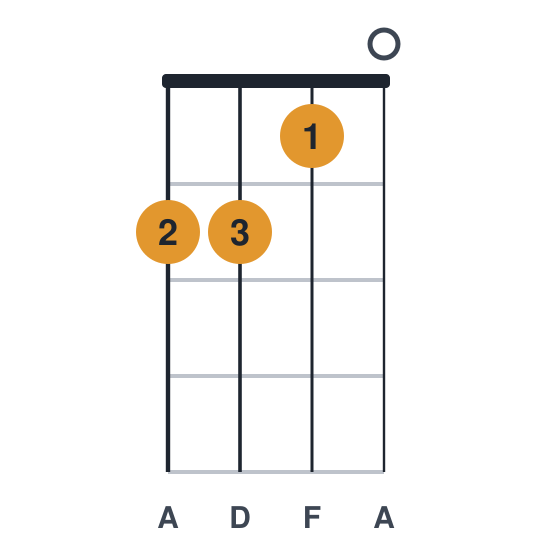
- D7D with the seventh that pushes to G
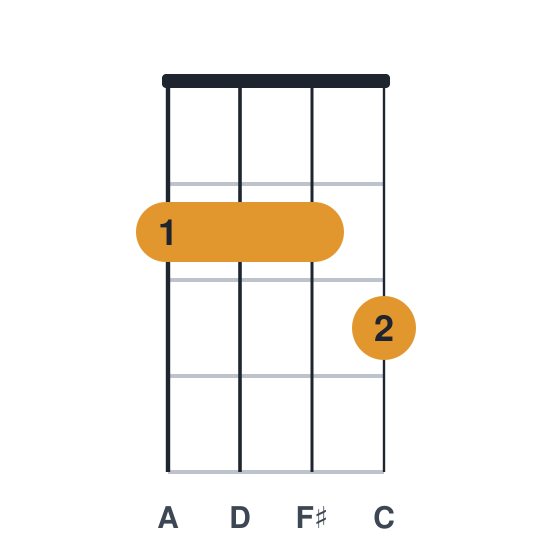
- Bmthe relative minor of D
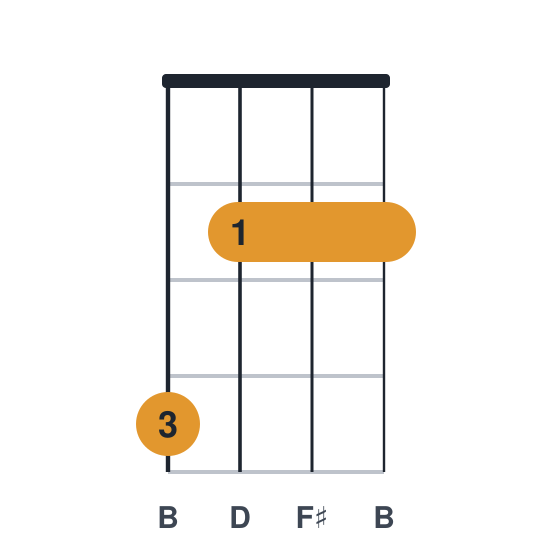
- Dmaj7the soft version of the same chord
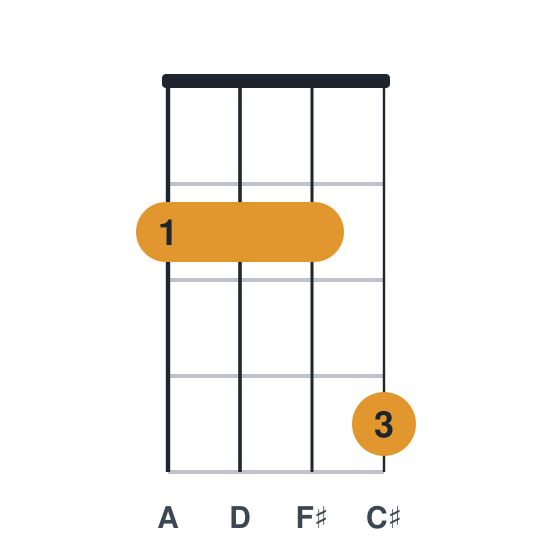


Other D chords
D ukulele chord chart (2220) from melodician.com