Daug Ukulele Chord
Daug is the D augmented chord. It has three notes: D, F sharp and A sharp. The standard shape is a diagonal stack across the first three frets, one finger per string, with the root on the C string.

A diagonal staircase: pinky on the G string at 3, middle and ring paired at 2, index on the A string at 1. The root D sits on the C string.
How to play Daug on ukulele, step by step
- Index finger: 1st fret, A string
- Middle finger: 2nd fret, C string
- Ring finger: 2nd fret, E string
- Pinky finger: 3rd fret, G string
- Strum all four strings.
Both copies of D's fifth move at once here: plain D is 2220, and in Daug the A note on the G string rises to the 3rd fret while the open A string is fretted at 1. Same half step, two strings.
More ways to play Daug
There are 3 common Daug shapes: the standard one at the top of the page, plus these further up the neck. You only ever need one. Tap any card to hear it.

Bigger and bolder, the same tension with more sustain from the longer string lengths.

Compact and singing high on the neck, the version that proves the augmented chord's four fret trick.
If it buzzes or sounds wrong
- Four fingers, three frets, chaos
- The shape is a staircase: pinky at 3, middle and ring at 2, index at 1. Build it from the A string upward, one finger at a time, before strumming.
- The middle pair mutes each other
- Middle and ring share the 2nd fret on the C and E strings. Keep them on their tips with the wrists low so neither finger lies across its neighbour.
- The 1st fret note is scratchy
- The index barely reaches past the other fingers. Slide it close behind the fret wire; at the 1st fret there is no slack for pressing far back.
What makes it a Daug
D · F♯ · A♯ 1 3 ♯5
Daug is an augmented triad: D major with the fifth raised a half step, A becoming A sharp. The raised note sits a half step below B, so the chord leans toward G major, whose third it wants to become.
The textbook line is D to Daug to G, the A sharp climbing to B. Writers also drop it between D and B minor, where the same climbing note lands on B as the root. And because D to F sharp and F sharp to A sharp are both major thirds, Daug contains exactly the same notes as F#aug and Bbaug.
D vs Daug
Plain D is 2220, three fingers in a row and an open A string. Daug is 3221, a diagonal that puts a finger on every string. The musical change is one half step, A to A sharp, but the hand feels a bigger jump than the ear does.
Daug is the classic passing chord between D and G: give it two beats, let the raised fifth climb to B, and land. It also walks D down toward D7 territory in older songs.
Daug chord questions
Is Daug the same as D+?
Yes. D+, Daug and D augmented all name the same three notes: D, F sharp and A sharp.
What does Daug resolve to?
G major first, the raised fifth A sharp climbing to B. B minor uses the same climb, and plain D takes the chord back.
Why is Daug harder than D?
Plain D stacks three fingers at one fret; Daug spreads four fingers across three frets in a diagonal. Same family, different gymnastics. The 7665 shape higher up is the same grip with more room.
Does Daug share notes with other chords?
Yes, with F#aug and Bbaug. An augmented triad splits the octave into three equal major thirds, so its notes serve three roots.
Is there an easier Daug?
The same diagonal four frets higher, 7665, gives Daug with the root on the A string, and many hands find it easier because the narrower frets up the neck let the fingers sit closer together. Try both and keep the one that rings.
Chords to learn next
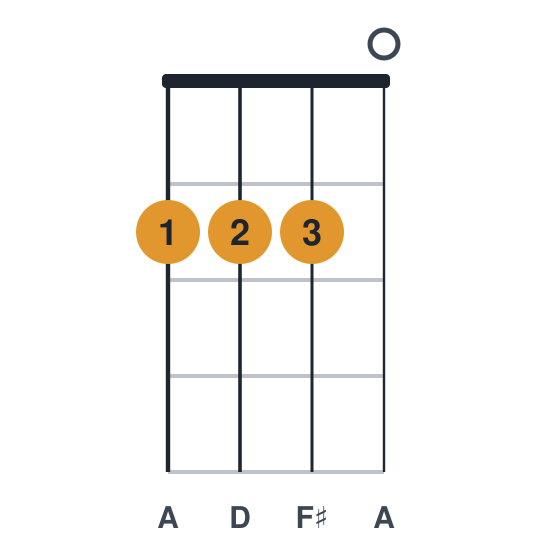
- Dthe plain major, one note apart
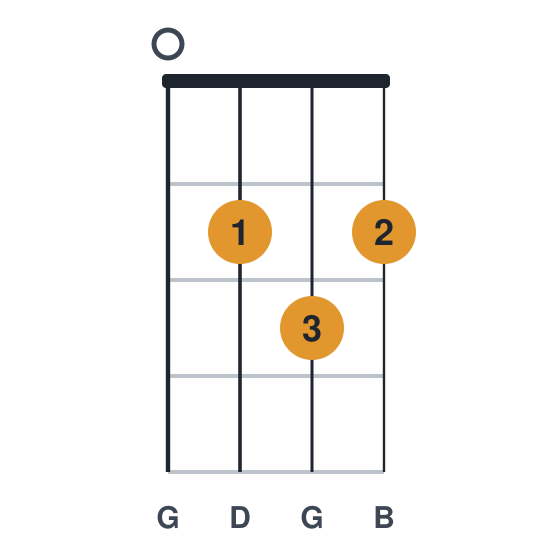
- Gwhere Daug usually resolves
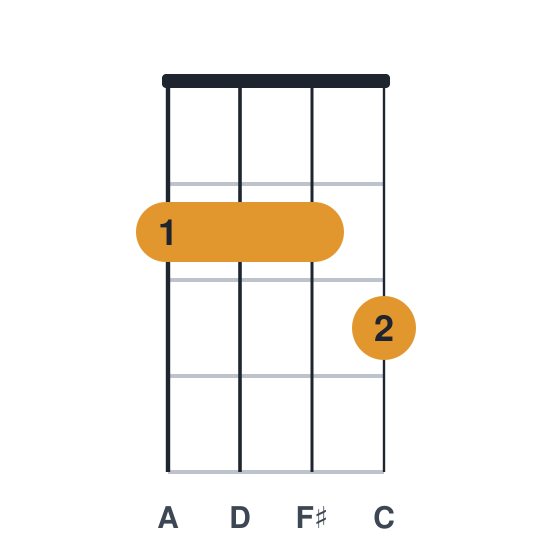
- D7another chord built to push forward
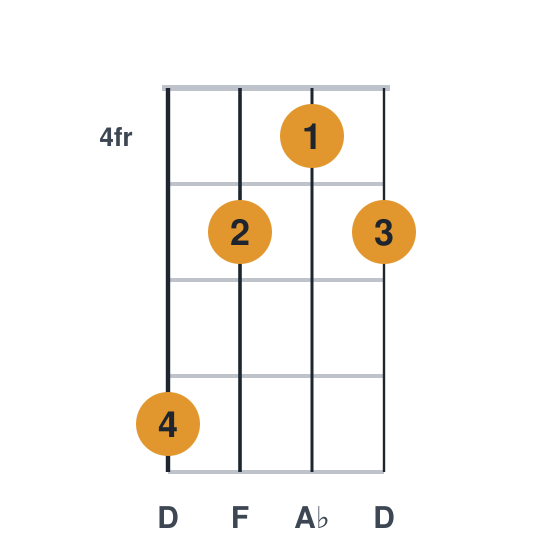
- Ddimthe other chord built out of equal intervals


Other D chords
Daug ukulele chord chart (3221) from melodician.com