A7 Ukulele Chord
A7 is the A dominant seventh chord. It has four notes: A, C sharp, E and G. On the ukulele it takes one finger: the index on the 1st fret of the C string, with the other three strings open, including the open g that supplies the seventh.

Index on the 1st fret of the C string, the other three strings open. The open g carries the seventh, so the one finger only has to add the third.
How to play A7 on ukulele, step by step
- Index finger: 1st fret, C string
- Leave the G, E and A strings open. Strum all four strings.
A7 is plain A with a finger taken away. A frets the g string at the 2nd fret; lift that finger off and the open g string sounds G, the seventh. Few chords get easier as they gain a note.
More ways to play A7
There are 3 common A7 shapes: the standard one at the top of the page, plus these further up the neck. You only ever need one. Tap any card to hear it.

Warmer and more even than the open shape, with the root ringing highest. A good reach target once the one finger version is automatic.

A wide, chiming spread: two high fretted notes against two open strings. Thin on its own, lovely as a colour inside a strummed passage.
If it sounds wrong
- It sounds like plain A
- Habit adds the middle finger back on the 2nd fret of the g string. A7 leaves that string open on purpose: the open g is the seventh.
- The open strings sound dull
- Arch the index so only its tip touches the C string. A finger leaning across the neck brushes the open E or A string and takes the ring out of them.
- The C string buzzes
- Move the fingertip right up behind the 1st fret. On the 1st fret a light touch is enough; pressing hard pulls the note sharp.
What makes it an A7
A · C♯ · E · G 1 3 5 ♭7
A7 is a dominant seventh: an A major triad (A, C sharp, E) plus a minor seventh, G. The seventh is what tips the chord forward: A7 is the V7 of D, and it pulls toward D major and D minor alike.
The shape is one finger because the tuning does the rest. The open E and A strings are the fifth and the root, and the open g string is already G, the seventh. Only the third needs a finger, on the 1st fret of the C string.
A7 vs A
A is two fingers (2100) and A7 is one (0100): keep the index where it is and lift the middle finger off the g string. The note that was a doubled root becomes G, the seventh, and the chord changes character completely.
A settles; A7 leans. Hold A7 and your ear starts asking for D. Songs in D lean on that pull constantly, which is why A7 turns up in so much country, folk and blues played out of D.
A7 chord questions
Is A7 really a one finger chord?
Yes. Index on the 1st fret of the C string, everything else open. Only C7 matches it for ease on the ukulele.
What is the difference between A7 and A?
A7 has one finger fewer. Lifting the middle finger off the g string turns the doubled root into G, the seventh, and plain A into A7.
What does A7 resolve to?
D. A7 is the V7 chord of D major and D minor, and it sits beside D7 and E7 in a blues in D.
Why is the open g string the seventh?
The g string on a ukulele is tuned high, above the C and E strings, and its open note is G. For A7 that note happens to be exactly the seventh the chord needs.
Where is A7 used?
In songs in D, where it is the chord pulling home, and in blues and old time tunes in A, where A7 itself is the home chord.
Chords to learn next
- D7A7 resolves to D
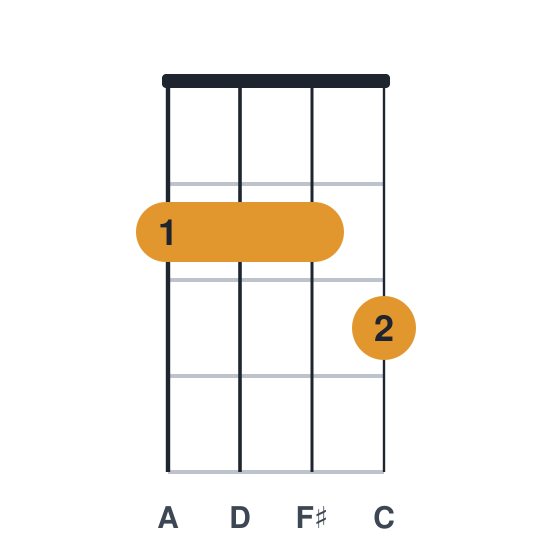
- Athe plain major underneath it
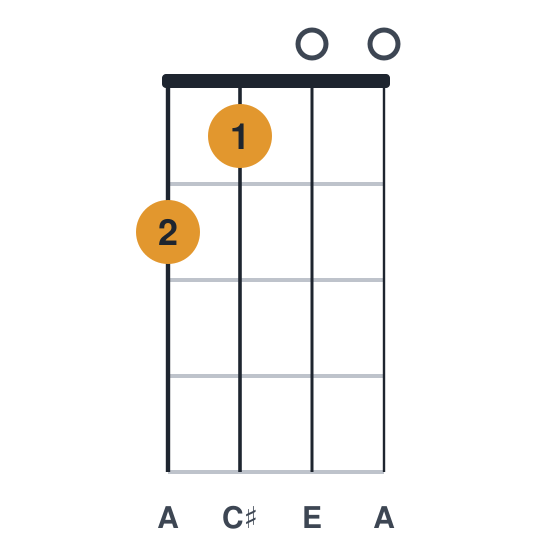
- G7the IV chord next to A7 in blues in D
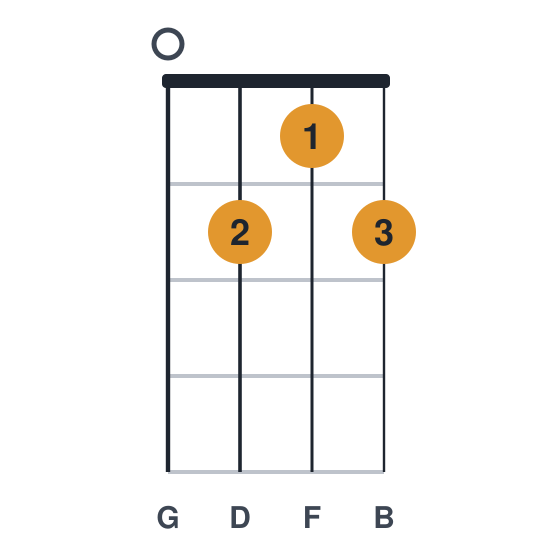
- A9the same seventh with a ninth on top
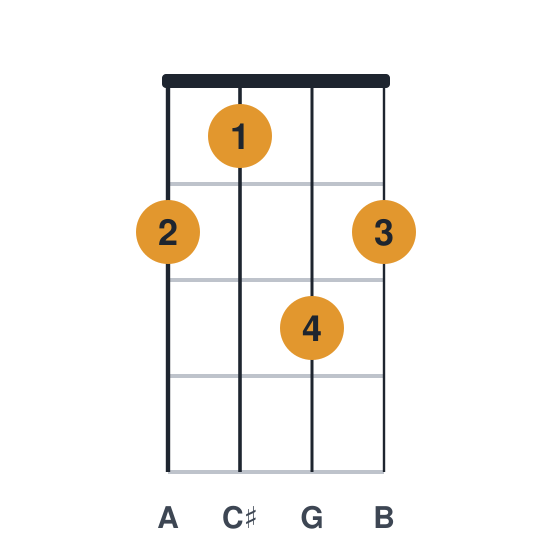


Other A chords
A7 ukulele chord chart (0100) from melodician.com