Chords in the Key of Eb
The key of Eb major contains seven chords: Eb, Fm, Gm, Ab, Bb, Cm and Ddim. Every B, E and A in the key is flattened, and most songs in Eb lean on Eb, Ab, Bb and Cm.
The seven chords on guitar
Each chord below opens its own page, with more shapes up the neck, audio for every voicing and a printable chart. Tap the play button on any card to hear it.


The seven chords on piano
The same seven chords on a keyboard, in root position. Each one opens its own page, with every inversion and the finger numbers for both hands.
IEbE♭ G B♭ 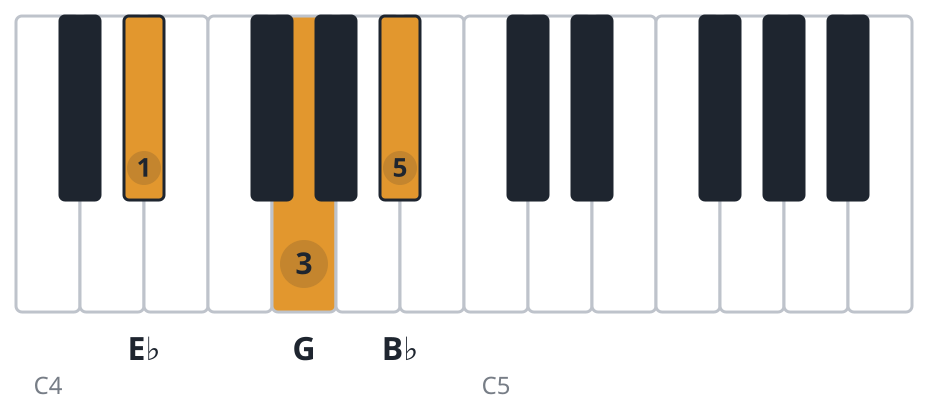
the home chord
iiFmF A♭ C 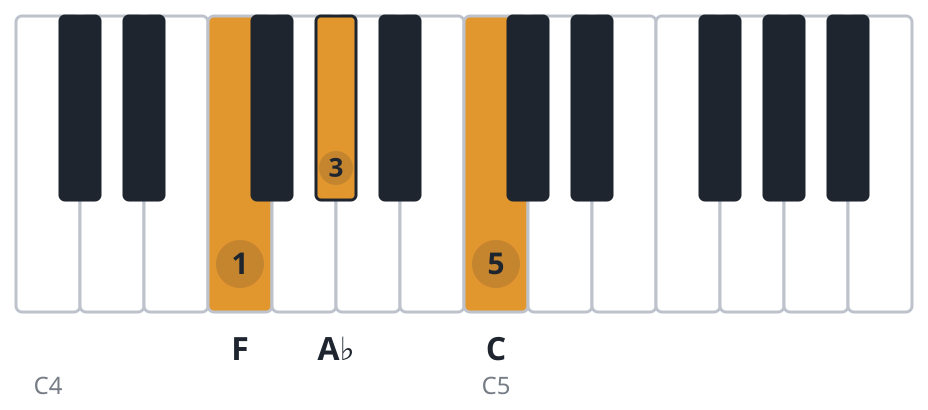
the gentle step up from home
iiiGmG B♭ D 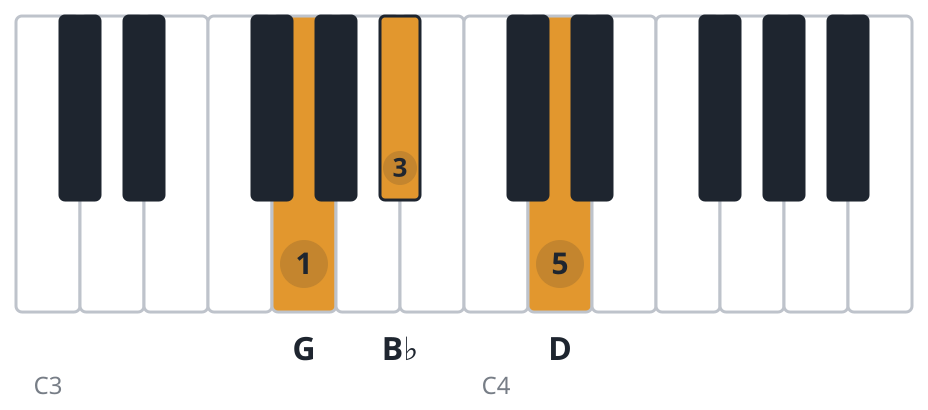
the darkest of the three minors
IVAbA♭ C E♭ 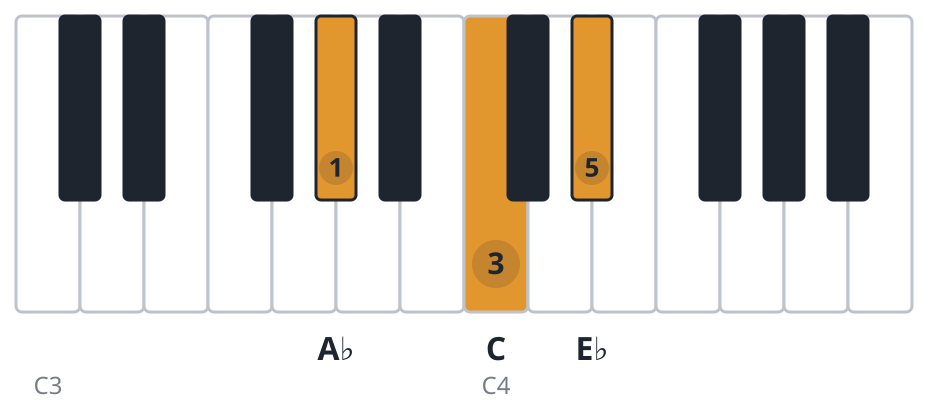
the lift away from home
VBbB♭ D F 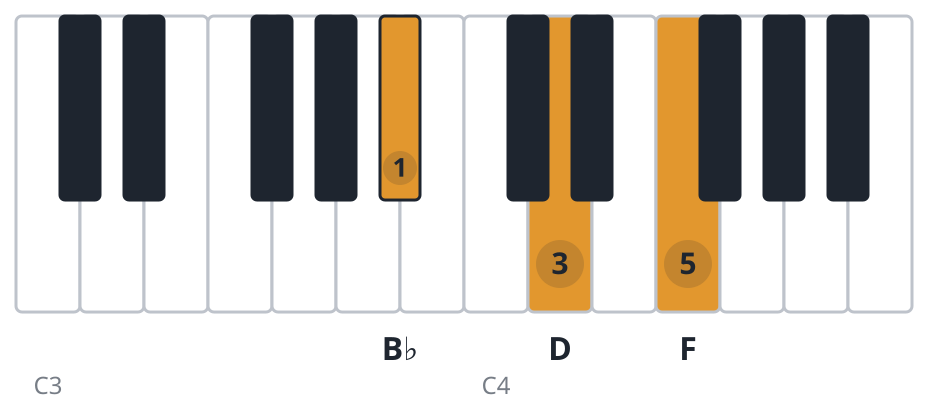
the chord that pulls back home
viCmC E♭ G 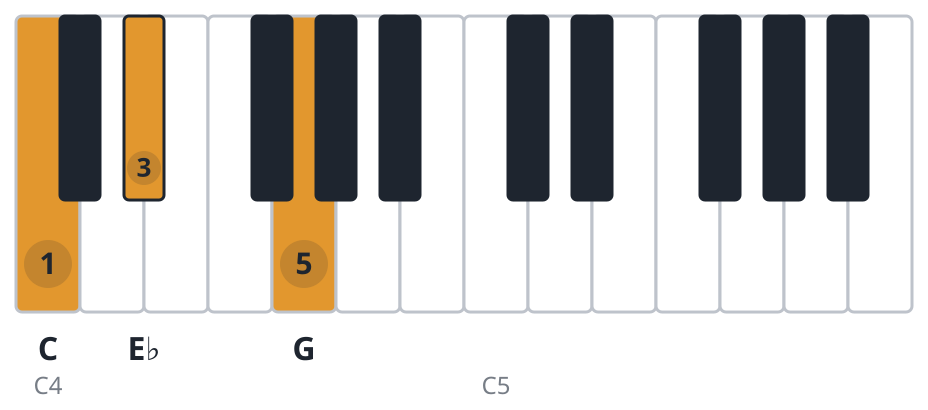
the relative minor
vii°DdimD F A♭ 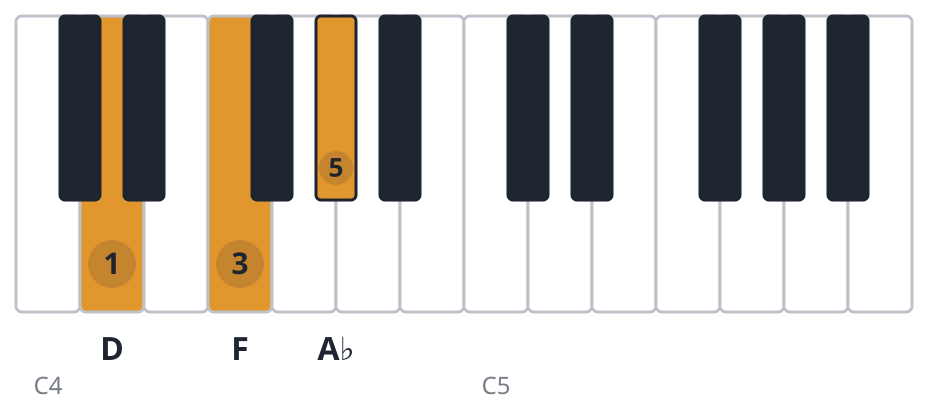
the tense one, used sparingly


The seventh chords in Eb major
Add one more note to each chord and the key gains its seventh chords, which is where most jazz and a good deal of soul begins.
Common progressions in Eb major
- I - IV - V
Eb Ab Bb
The backbone of a great deal of jazz and big band writing.
- I - V - vi - IV
Eb Bb Cm Ab
Capo at the third fret with C, G, Am and F shapes gives this on a guitar with no barres.
- ii - V - I
Fm Bb Eb
With sevenths, Fm7, Bb7 and Ebmaj7, one of the most common cadences in the jazz repertoire.
Why these seven chords
On a stave, Eb major is written with three flats, Bb, Eb and Ab, which is how a reader knows the key before playing a note.
Eb sits three steps anticlockwise from C. It is one of the standard keys for brass instruments, several of which are built in Eb, so a great deal of jazz, marching and orchestral music lives here.
The majors are Eb, Ab and Bb. Cm is the relative minor and does most of the darker work in the key.
On guitar
All seven chords need a barre, so guitar parts in Eb are usually either played with a capo or written for a different key and transposed by the singer.
A capo at the third fret with C major shapes is the common answer. A capo at the first fret with D shapes gets there too.
On piano
Eb major is one of the most comfortable keys on a keyboard. The scale puts three black keys under the middle fingers and the white keys under the thumb, which is a natural hand shape.
The tonic chord Eb is two black keys with G between them, a shape most pianists can place without looking.
Questions about the key of Eb
What are the 7 chords in the key of Eb?
Eb, Fm, Gm, Ab, Bb, Cm and Ddim. Eb, Ab and Bb are major, Fm, Gm and Cm are minor, and Ddim is diminished.
What capo position gives the key of Eb from C shapes?
The third fret. C, F and G shapes played there sound as Eb, Ab and Bb.
Why is Eb so common in jazz?
Several brass and reed instruments are built in Eb or Bb, so those keys are the comfortable ones for the horn players the music was written around.
What do the numbers next to each chord mean?
They are each chord's place in the key, written as Roman numerals. In Eb major the I is Eb, the IV is Ab and the V is Bb. The numbering holds in every key, so the V of C major is G. That is why progressions get written as numerals like I, V, vi, IV: learn one and you have it in all twelve major keys.
Why are some numerals capitals and some lowercase?
The case tells you the chord quality. Capitals are major, which in Eb major means Eb, Ab and Bb. Lowercase are minor: Fm, Gm and Cm. The small circle on vii° means diminished, and here that is Ddim.
What is the relative minor of Eb major?
C minor. It is written with three flats, Bb, Eb and Ab, the same signature as Eb major, and it contains the same seven chords. Only the chord that sounds like home changes, from Eb to Cm.
The relative minor
C minor is written with the same three flats, Bb, Eb and Ab and contains the same seven chords as Eb major. What changes is which one sounds like home, so the same shapes can be played darker without learning anything new. Chords in the key of C Minor