Fm7 Guitar Chord
Fm7 is the F minor seventh chord. It has four notes: F, A flat, C and E flat. It is a full six string barre at the 1st fret, yet only two fingers are involved, which makes it one of the simplest barre chords to remember and a gentler starting point than full F major.

Barre all six strings at fret 1 and add the ring finger at fret 3 on the A string. It is the one finger open Em7 chord shifted up a fret, with the barre standing in for the nut.
How to play Fm7, step by step
- Index finger: press flat across the low E to high E strings at fret 1
- Ring finger: 3rd fret, A string
- Strum all six strings.
This two finger grip is the movable Em7 shape: at fret 3 it becomes Gm7. Many players use it to train the barre itself, since nearly everything depends on the index finger.
More ways to play Fm7
There are 3 common Fm7 shapes in total: the standard one at the top of the page, plus these, easiest first. You only ever need one. Tap any card to hear it.

Cleaner and smaller, with the root an octave above the barre version.

Punchier and more midrange than the fret 1 barre, without the deep low root.
Songs that use the Fm7 chord
- Learn this song(opens a new tab on our partner site)
Why Can't We Be Friends
War
- Learn this song(opens a new tab on our partner site)
Spooky
Atlanta Rhythm Section
Getting all six strings to speak
- Middle strings buzz
- The barre carries five of the six strings here, and the D and G pair sits under its softest part. Roll the index finger onto its edge, keep the elbow close to your body, and pull the neck gently into the finger.
- High E chokes at the edge
- The barre's tip must cover the high E fully at fret 1. Slide the finger so a little of it hangs past the edge of the neck rather than falling short.
- The ring finger drags the A string
- At fret 3 it only needs light pressure. If it pushes the string sideways the chord drifts sharp; place the finger straight down on its tip.
What makes it an Fm7
F · A♭ · C · E♭ 1 ♭3 5 ♭7
Fm7 is a minor seventh chord: an F minor triad (F, Ab, C) plus a minor seventh (Eb). The seventh takes the darkness of F minor and relaxes it. Fm7 does its regular work as the ii chord of Eb major, moving to Bb7, and as the vi chord of Ab major. Those flat keys are the natural home of soul and gospel, so Fm7 comes up often when guitarists play songs from those traditions.
Fm vs Fm7
Fm barres fret 1 and stacks the ring and pinky fingers on the A and D strings at fret 3; Fm7 keeps only the ring finger and lets the barre sound the E flat on the D string. Dropping the pinky turns a fifth into a seventh and the grim minor into something warmer. Fm7 is the easier of the two grips, and in many songs in Ab or Eb it can stand in when the chart says Fm.
Fm7 in major keys
Every note of Fm7 sits inside these keys. See how it works alongside the other chords in each one.
Fm7 chord questions
Is Fm7 easier than F major?
For most learners, yes. Both barre all six strings at fret 1, but F major adds two more fretted fingers in a tight cluster. Fm7 is just the barre plus one ring finger.
Can I play Fm7 without a barre?
Yes. The shape at frets 3 to 5 on this page (x x 3 5 4 4) has no barre and keeps all four notes.
What keys use Fm7?
F minor itself, Eb major, where it is the ii chord heading to Bb7, and Ab major, where it is the vi chord.
Why does Fm7 only need two fingers?
Fm7 is the open Em7 shape moved up one fret. The barre replaces the nut, and the single remaining fretted note falls to the ring finger.
What is the difference between Fm7 and Fmaj7?
Fm7 has a flat third (Ab) and a flat seventh (Eb); Fmaj7 has a natural third (A) and seventh (E). Fmaj7 sounds bright and dreamy, Fm7 dark and mellow. They are not interchangeable.
Chords to learn next
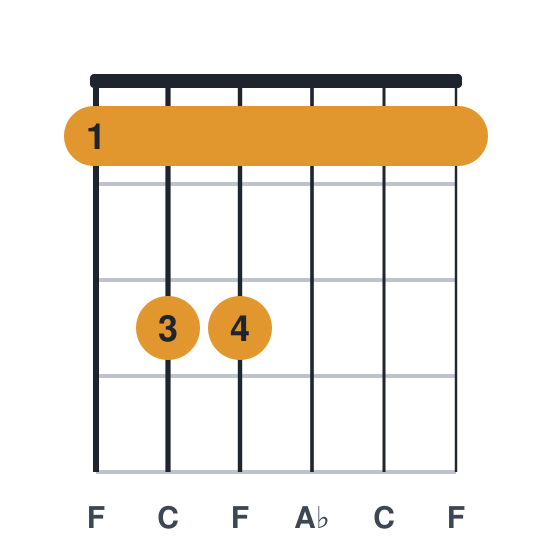
- Fmthe same chord without the seventh
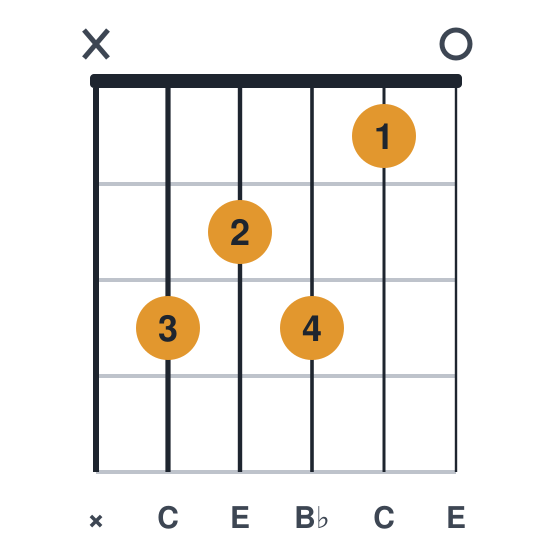
- C7the V chord that resolves to F minor
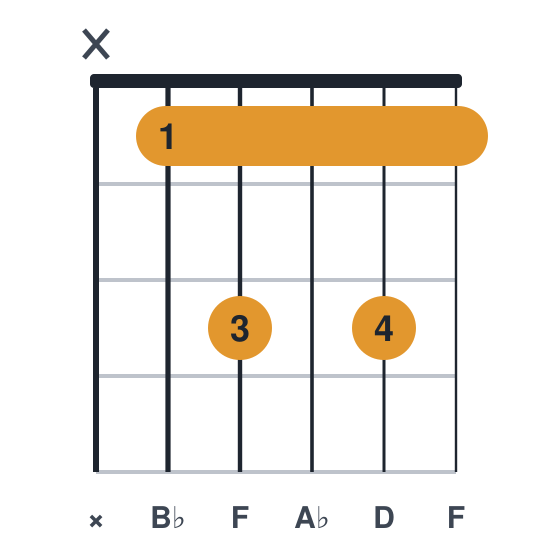
- Bb7partner in the ii V of Eb major
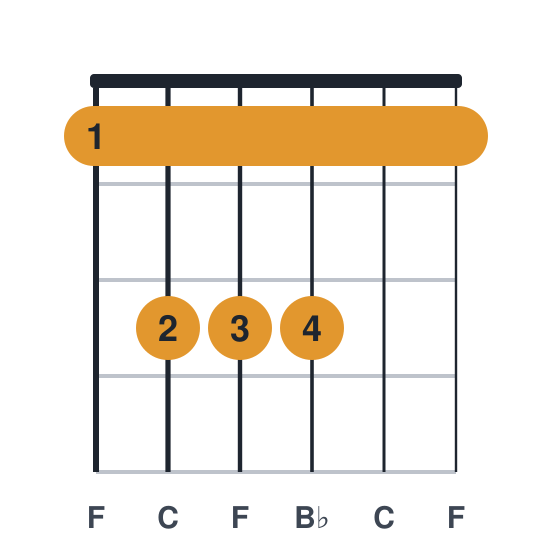
- Fsus4a different color built on the same root


Other F chords
Fm7 guitar chord chart (131111) from melodician.com