Faug Guitar Chord
Faug is the F augmented chord. It has three notes: F, A and C♯. Good news for anyone scarred by F major: neither Faug voicing on this page needs a six string barre. Both are four string grips in the middle of the neck, and both are movable, so they double as your augmented shapes for every other root.

The Daug grip rooted at fret 3: index reaches back for the F, ring and pinky pair up at fret 6, middle takes the high E at 5. No barre, just a stretch.
How to play Faug, step by step
- Index finger: 3rd fret, D string
- Middle finger: 5th fret, high E string
- Ring finger: 6th fret, G string
- Pinky finger: 6th fret, B string
- Strum from the D string down, skipping the two lowest strings.
Once this sits well, test the augmented party trick: slide the whole grip four frets up, to fret 7 on the D string, and listen. Same three notes, same chord, different order.
More ways to play Faug
There are 2 common Faug shapes in total: the standard one at the top of the page, plus these, easiest first. You only ever need one. Tap any card to hear it.

Deeper in the hand and slightly darker, with the root carrying more weight.
If it will not sound clean
- The root on the D string buzzes
- The index is stretched three frets away from the ring and pinky. Turn your wrist so the index reaches back along the neck instead of bending sideways.
- The top note chokes
- The middle finger on the high E sits in the shadow of the ring and pinky pair. Curl it hard so the pair does not lean on it from above.
- Muffled notes on the G or B string
- Ring and pinky share fret 6 on neighboring strings. If they stack on top of each other, both notes suffer. Keep each fingertip on its own string, side by side.
What makes it an Faug
F · A · C♯ 1 3 ♯5
Faug is an augmented triad: F major with the fifth raised a half step, C becoming C♯. Everything tense about the chord comes from that note. C♯ leads by half step up to D and back down to C, so the chord works like a hinge, swinging the harmony toward wherever it goes next.
Its most common address is the key of B flat, where Faug is the V chord with a raised fifth: F to Faug to Bb, the C♯ rising into D, the third of Bb. It resolves the same way into D minor. Faug also splits the octave perfectly evenly, which means Aaug and C♯aug hold exactly the same notes, and any Faug grip repeats every four frets.
F vs Faug
One half step separates them: F major carries C as its fifth, Faug lifts it to C♯. In the hands they are opposites. F major in its full form is the famous six string barre; Faug is a barre free four string grip. But you cannot swap one for the other: F is a chord to build on, Faug is a chord to pass through, usually for a bar on the way to Bb or Dm.
Faug chord questions
Is Faug easier than F major?
Usually yes. The standard Faug is four strings with one finger each, no barre. Full F major needs the six string barre most beginners struggle with.
What does Faug resolve to?
B flat major, most often, because Faug is the V chord of Bb with a raised fifth. D minor is the other natural landing spot.
Is F+ the same chord as Faug?
Yes. F+, Faug and F augmented are three ways of writing one chord: F, A and C♯.
Why does the Faug shape repeat every four frets?
The augmented triad is three equal major thirds, so moving any voicing four frets lands on the same three notes rearranged. Slide the standard shape from fret 3 to fret 7 and you are still playing Faug.
What is the difference between F and Faug?
The fifth. Both chords contain F and A; F major completes the triad with C, while Faug raises that note to C♯. That one fret is the entire difference.
Chords to learn next
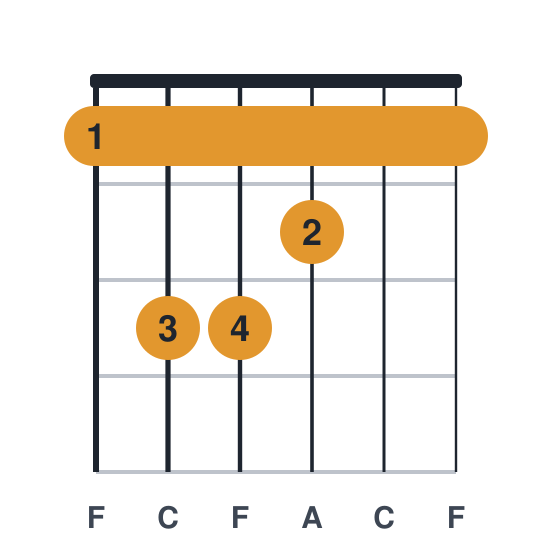
- Fthe plain major, one note apart
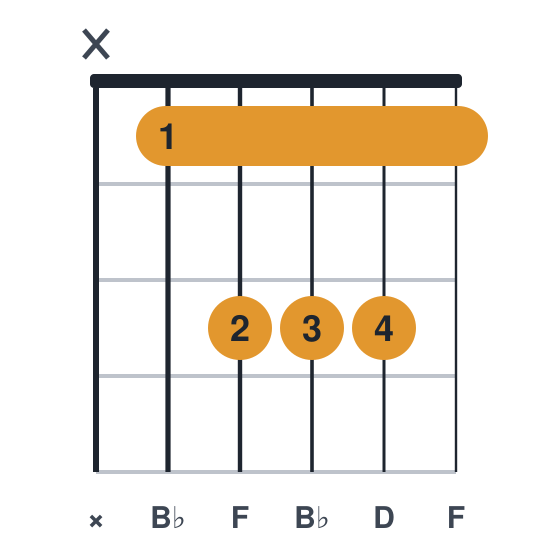
- Bbwhere Faug usually resolves
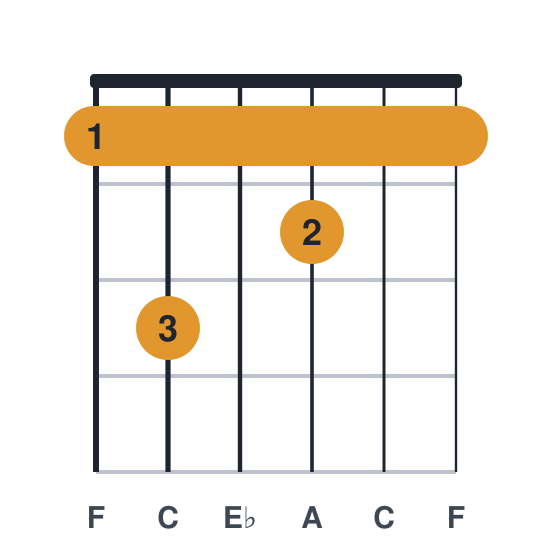
- F7another chord built to push forward
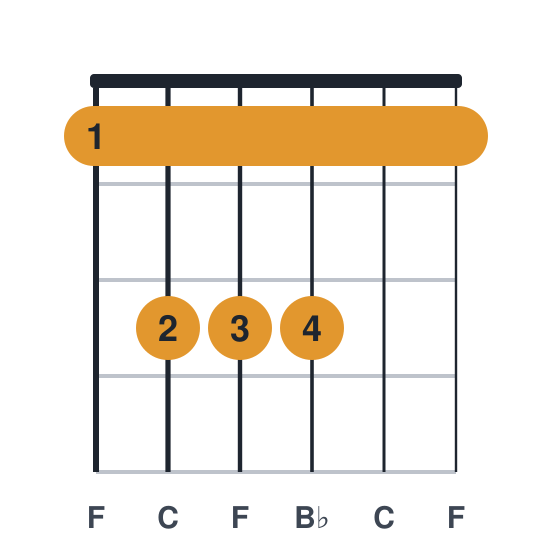
- Fsus4another color built on the same root, pulling elsewhere


Other F chords
Faug guitar chord chart (xx3665) from melodician.com