Fdim Guitar Chord
Fdim is the F diminished chord, a diminished triad. It has three notes: F, A♭ and B. Unlike F major, no version of it needs a barre: the standard shape is four fingers on the top four strings around the 3rd fret. It is a rare visitor in chord charts, so when one names it, the writer wanted this exact tense color.

The Ddim grip at the 3rd fret, root under the index on the D string and the pinky posted two frets higher on the B string. Fully movable.
How to play Fdim, step by step
- Index finger: 3rd fret, D string
- Middle finger: 4th fret, G string
- Ring finger: 4th fret, high E string
- Pinky finger: 6th fret, B string
- Strum from the D string down, skipping the two lowest strings.
The grip is the same one used for Edim one fret lower and F#dim one fret higher. Diminished shapes travel; you are really learning one shape with twelve names.
More ways to play Fdim
There are 2 common Fdim shapes in total: the standard one at the top of the page, plus these, easiest first. You only ever need one. Tap any card to hear it.

Rounder and more grounded, with the low F root adding weight the standard shape lacks.
Fixing buzzes and dead strings
- The stretched pinky buzzes on the B string
- It sits at the 6th fret, two above the rest of the hand. Bring your elbow closer to your body; the pinky swings forward and lands cleanly behind its fret.
- The first string chokes
- The ring finger's note at the 4th fret is easily muted by the overreaching pinky. Arch the pinky and test the top two strings separately before strumming.
- The chord sounds muddy
- Open low strings are ringing under the shape. Begin the strum at the D string and mute the low E with your thumb if it keeps bleeding through.
What makes it an Fdim
F · A♭ · B 1 ♭3 ♭5
Fdim stacks two minor thirds: F up to A♭, then up again to B, which strict spelling would call C♭. Set it against F minor and the only change is the top note, C squeezed down one fret. That squeezed fifth is why the chord never sounds finished.
F is the leading tone of G♭, so the chord's theoretical home is the key of G♭ major, which guitarists rarely visit. In practice Fdim earns its keep as a chromatic connector: a one beat chord while a bass line passes through F on its way between two stable chords one whole step apart.
Fdim vs Fm
Fm is F, A♭, C; Fdim lowers the C to B. On paper that is a tiny edit, but on guitar the practical contrast is big: Fm usually means a full barre at the 1st fret, while Fdim asks for four fingertips and no barre at all. The sounds split the same way the shapes do. Fm is heavy, stable and can anchor a whole progression; Fdim is unstable by design and only ever passes through. If your chart says Fm, the barre is worth the work; if it says F°, this lighter shape is the right tool.
Fdim in major keys
Every note of Fdim sits inside these keys. See how it works alongside the other chords in each one.
Fdim chord questions
Is Fdim easier than F major?
For most hands, yes. Fdim needs no barre, just four fingers on the top four strings, while the standard F major requires a full first fret barre.
What is the difference between Fdim and Fdim7?
Fdim is the three note triad: F, A♭, B. Fdim7 adds a diminished seventh (D) on top. Charts that write Fdim or F° mean the triad; the dim7 is a bigger four note chord with its own pages and shapes.
What does Fdim resolve to?
One half step up, to G♭ major or F♯ minor. Like every diminished triad, it sits a fret below its target and climbs into it.
Why does the chord show B instead of Cb?
The flat fifth of F is strictly C♭, which is the same pitch as B. Diagrams use the name B because it is the one guitarists actually think in.
How often will I actually need Fdim?
Rarely, and that is honest. It appears mostly in jazz influenced progressions and chromatic bass walks. When it does appear, nothing else makes quite the same sound, which is why it is worth having under your fingers.
Chords to learn next
- F#Fdim pulls up a half step to F#
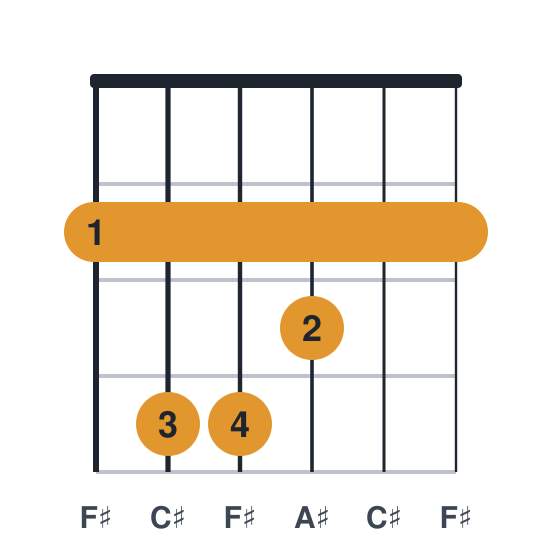
- F#mthe minor resolution one fret up
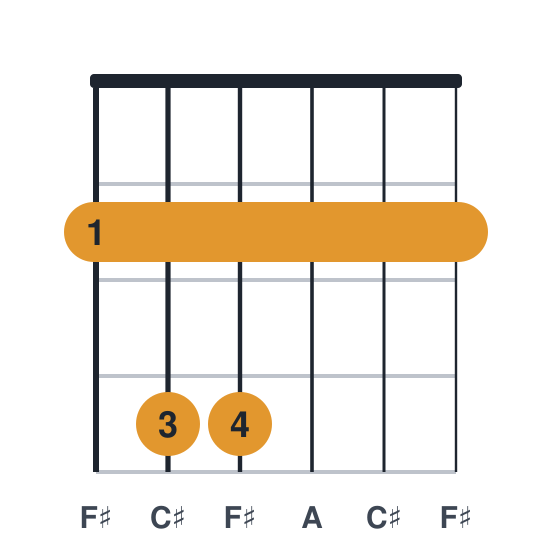
- Fmone note away from F minor
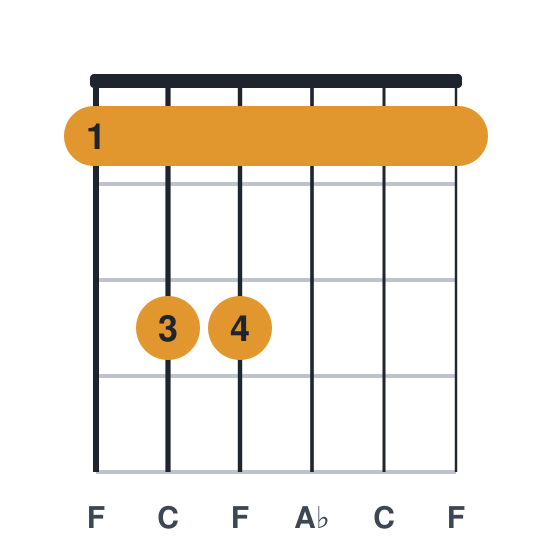
- Fthe plain major chord on the same root
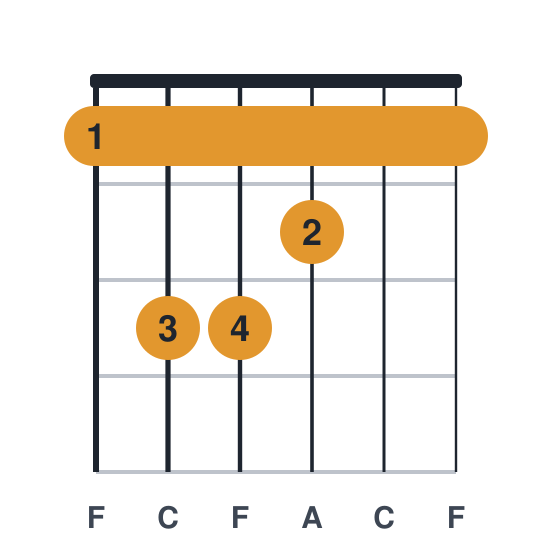


Other F chords
Fdim guitar chord chart (xx3464) from melodician.com