F5 Guitar Chord
F5 is the F power chord. It has two notes: F and C. There is no third, so it is neither F major nor F minor, and it needs none of the barre that makes full F so awkward.

Root on the low E string at the 1st fret, the fifth on the A above it and the root again on the D. Movable: slide this grip anywhere and it is still a power chord.
How to play F5, step by step
- Index finger: 1st fret, low E string
- Ring finger: 3rd fret, A string
- Pinky finger: 3rd fret, D string
- Strum only the low E and A and D strings, and stop the downstroke at the D.
If the F barre chord is holding a song up, this is the shape to use instead. It gives you an F that works in any rock or blues context with two fingers.
More ways to play F5
There are 5 common F5 shapes in total: the standard one at the top of the page, plus these, easiest first. You only ever need one. Tap any card to hear it.

Leaner than the three string version and quicker to move. Under distortion the missing octave is barely noticeable.

Thick and solid, with the doubled root filling it out. This is the sound of a rock rhythm part.

Thick and solid, with the doubled root filling it out. This is the sound of a rock rhythm part.

Leaner than the three string version and quicker to move. Under distortion the missing octave is barely noticeable.
If it buzzes near the nut
- The root at the 1st fret buzzes
- The 1st fret is the stiffest place on the neck and this is the thickest string. Press firmly and keep the finger right behind the fret wire.
- Strings above the chord sound
- F5 uses the bottom three strings. Flatten the fretting fingers just enough to touch the G string and stop the strum at the D.
- The hand feels cramped
- Playing at the 1st fret with a two fret stretch is tight. Move the thumb down behind the neck and let the wrist drop, which opens the hand.
What makes it an F5
F · C 1 5
F5 is F plus its perfect fifth, C. The A of F major and the A flat of F minor are both absent, so the chord commits to neither.
This is the practical case for power chords in a nutshell. Full F needs a barre across six strings; F5 needs two fingers on three strings, and in a distorted rhythm part it sounds better than the barre would.
F5 vs F
F major is the chord that stops most beginners, because it needs a barre. F5 keeps the root and the fifth, drops the third, and needs no barre at all.
They are not interchangeable in every song. In a gentle strummed arrangement the missing third is noticeable; in a rock riff it is an improvement.
F5 in major keys
Every note of F5 sits inside these keys. See how it works alongside the other chords in each one.
F5 chord questions
Can I use F5 instead of the F barre chord?
In rock, blues and anything with distortion, yes. In a quiet strummed song the full F sounds fuller, because the power chord has no third to give it a major colour.
Is F5 major or minor?
Neither. It has only F and C, and the third that would decide is left out.
Where else is F5 on the neck?
At the 8th fret of the A string, using the same movable grip, and a smaller version sits on the D string at the 3rd fret.
Which strings do I strum?
The low E, A and D strings. Stop there and keep the top three quiet.
What chords go with F5?
B flat 5 and C5 complete the key of F. In the key of C, F5 is the IV chord and sits next to C5 and G5.
Chords to learn next
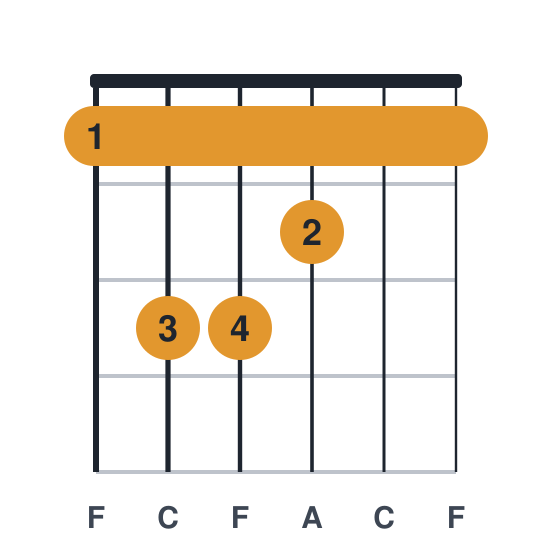
- Fthe full major chord on the same root
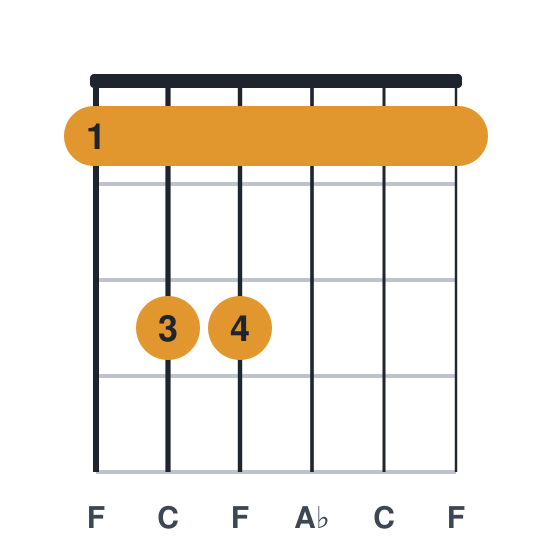
- Fmthe minor a power chord leaves undecided
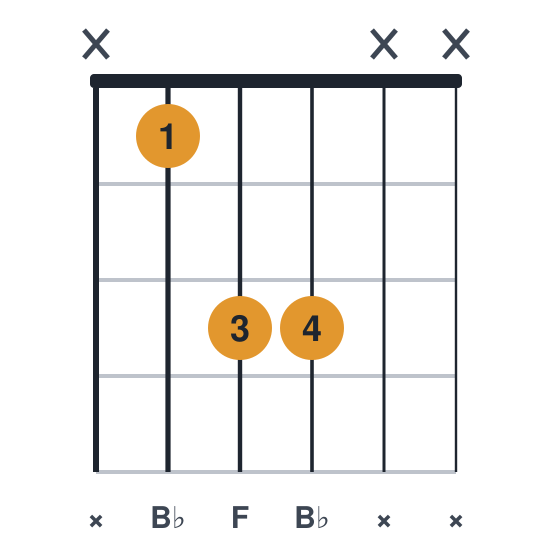
- Bb5the power chord a fourth up, the next move in most riffs
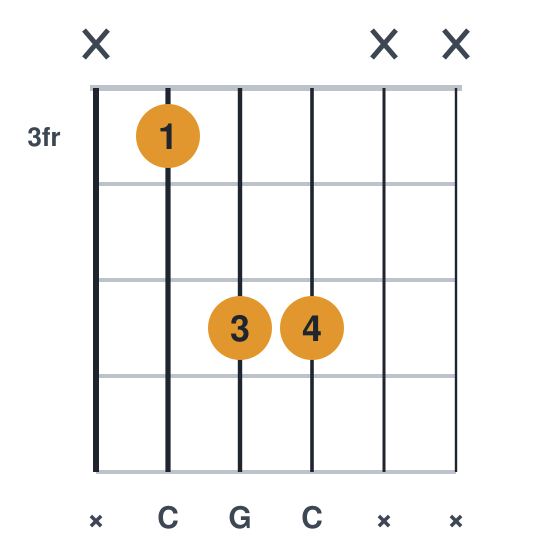
- C5the power chord a fifth up, the other half of most riffs


Other F chords
F5 guitar chord chart (133xxx) from melodician.com