Chords in the Key of C
The key of C major contains seven chords: C, Dm, Em, F, G, Am and Bdim. Nothing in the key is sharpened or flattened, which is why it is the one people learn first, and most songs in C spend their time on C, F, G and Am.
The seven chords on guitar
Each chord below opens its own page, with more shapes up the neck, audio for every voicing and a printable chart. Tap the play button on any card to hear it.


The seven chords on piano
The same seven chords on a keyboard, in root position. Each one opens its own page, with every inversion and the finger numbers for both hands.
ICC E G 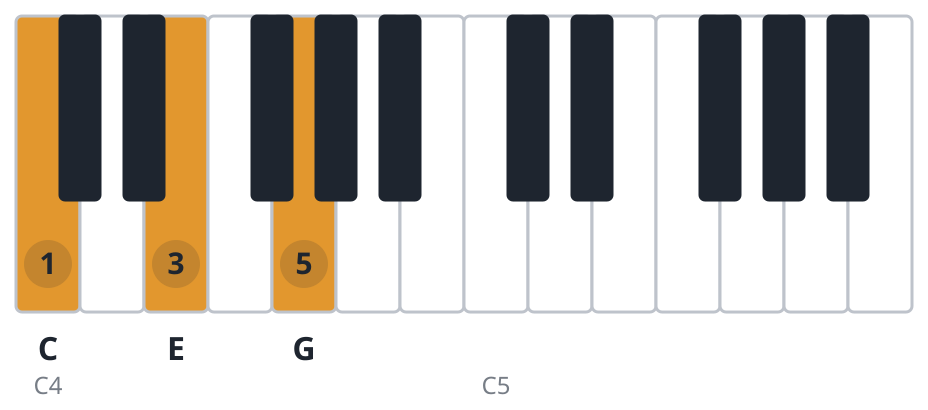
the home chord
iiDmD F A 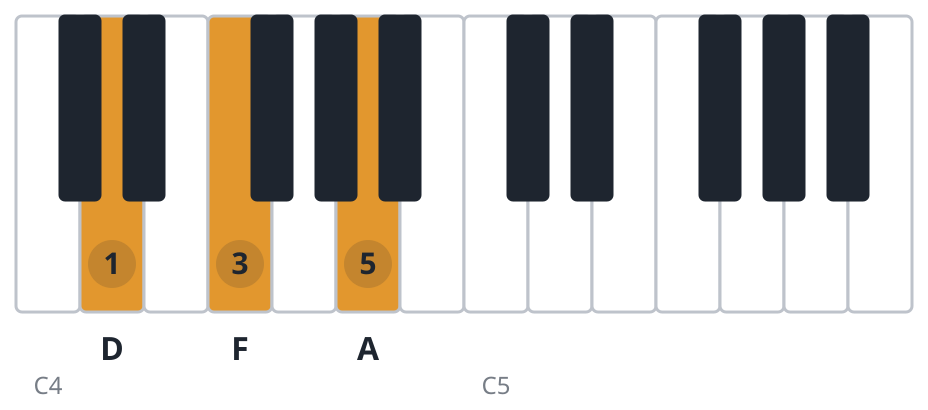
the gentle step up from home
iiiEmE G B 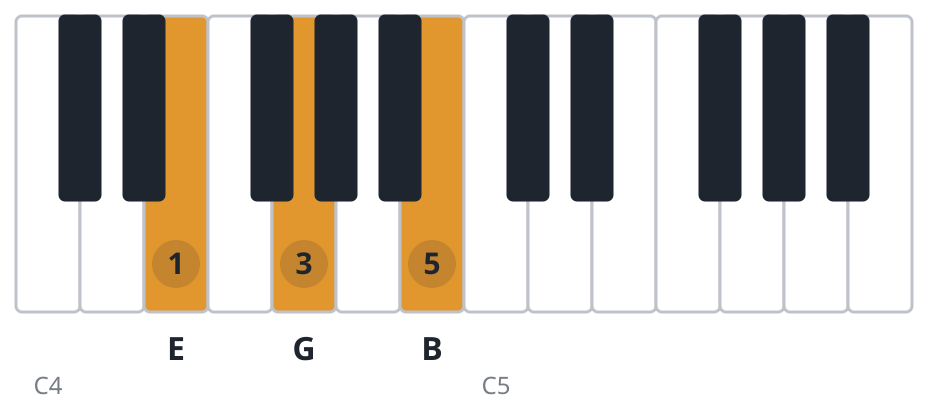
the darkest of the three minors
IVFF A C 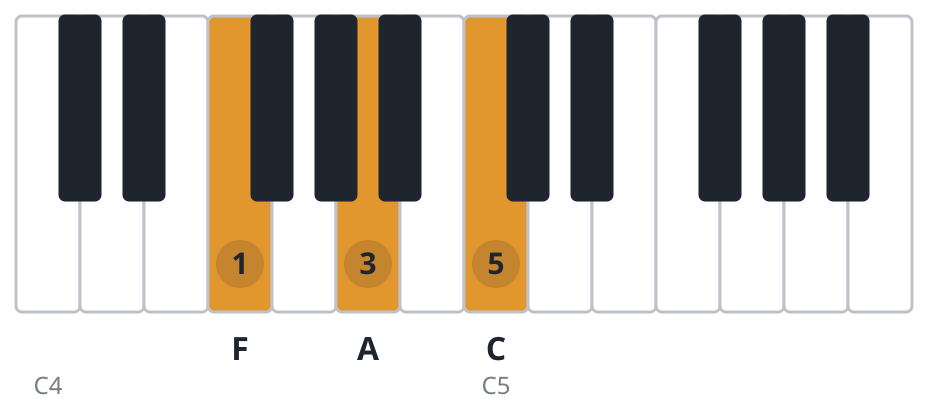
the lift away from home
VGG B D 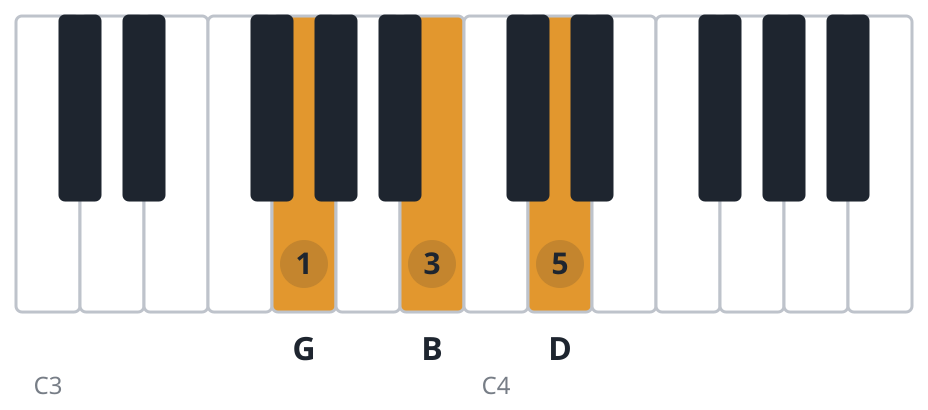
the chord that pulls back home
viAmA C E 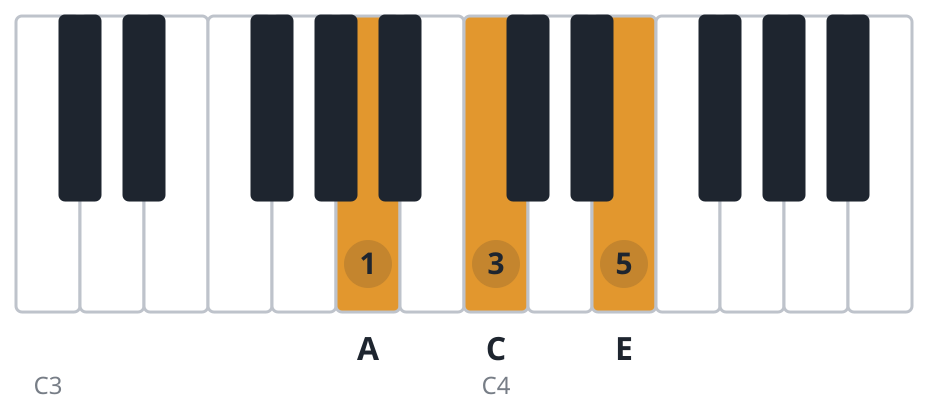
the relative minor
vii°BdimB D F 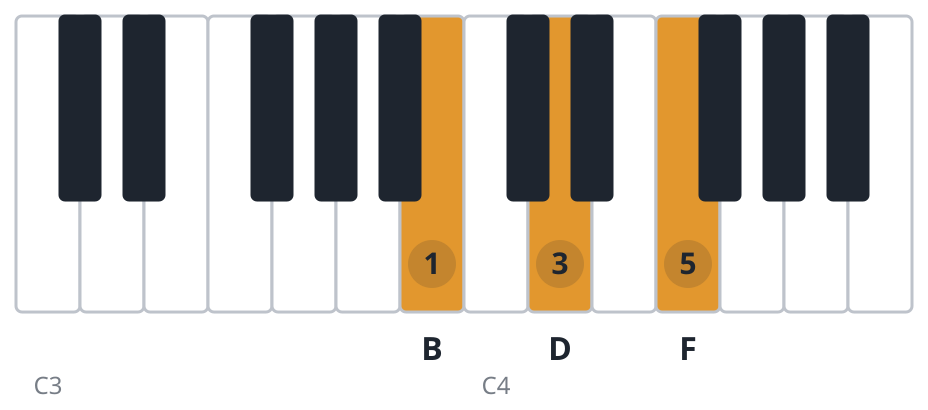
the tense one, used sparingly


The seventh chords in C major
Add one more note to each chord and the key gains its seventh chords, which is where most jazz and a good deal of soul begins.
Common progressions in C major
- I - V - vi - IV
C G Am F
The most used progression in popular music. In C, three chords are familiar open shapes and F is the fretted change, which helps explain why the progression is approachable for beginners.
- I - IV - V
C F G
The three major chords of the key, and the backbone of blues, country and early rock.
- ii - V - I
Dm G C
The standard jazz cadence. Play it with sevenths, as Dm7, G7 and Cmaj7, and it sounds like the genre it comes from.
Why these seven chords
On a stave, C major is written with no sharps and no flats, which is how a reader knows the key before playing a note.
A key is not a list someone decided on. Stack a chord on each note of the scale, using only notes from that scale, and the seven chords fall out on their own. That is why the pattern of qualities is the same in every major key: major, minor, minor, major, major, minor, diminished.
The three majors are the first, fourth and fifth chords, C, F and G. Most songs in C spend most of their time on those three. The three minors, Dm, Em and Am, are what a song reaches for when it wants to sound softer or sadder without leaving the key.
On guitar
C is the friendliest key on a guitar. C, Dm, Em, G and Am have familiar open shapes. F is usually played as a barre or a smaller fretted shape, and Bdim is uncommon, so most beginner changes in C remain manageable.
This is why so much folk and pop sits in C or G. The key is not more musical than the others; the guitar is simply built so that these particular chords fall under an untrained hand.
On piano
C major is the key every piano student starts in, because it uses no black keys at all. The scale is the seven white keys from C to B, and every chord in the key is built from them.
That makes it the easiest key to read and the easiest to find by touch, though not always the easiest to play: with no black keys to anchor the hand, some players find it harder to feel where they are than a key like Db.
Questions about the key of C
What are the 7 chords in the key of C?
C, Dm, Em, F, G, Am and Bdim. The first, fourth and fifth are major, the second, third and sixth are minor, and the seventh is diminished.
Why does the key of C have no sharps or flats?
The pattern of whole and half steps that makes a major scale happens to line up with the white keys when you start on C. Every other major key needs at least one black key to keep that pattern.
What is the relative minor of C major?
A minor. It uses the same seven notes and the same seven chords, but treats Am as home instead of C.
What do the numbers next to each chord mean?
They are each chord's place in the key, written as Roman numerals. In C major the I is C, the IV is F and the V is G. The numbering holds in every key, so the V of G major is D. That is why progressions get written as numerals like I, V, vi, IV: learn one and you have it in all twelve major keys.
Why are some numerals capitals and some lowercase?
The case tells you the chord quality. Capitals are major, which in C major means C, F and G. Lowercase are minor: Dm, Em and Am. The small circle on vii° means diminished, and here that is Bdim.
What is the relative minor of C major?
A minor. It is written with no sharps and no flats, the same signature as C major, and it contains the same seven chords. Only the chord that sounds like home changes, from C to Am.
The relative minor
A minor is written with the same no sharps and no flats and contains the same seven chords as C major. What changes is which one sounds like home, so the same shapes can be played darker without learning anything new. Chords in the key of A Minor