Dm Piano Chord
D minor is the Dm piano chord. It has three notes: D, F and A. All three are white keys, and it is one of the three all white minor chords along with A minor and E minor.

D at the bottom, then F and A. Right hand 1-3-5, left hand 5-3-1. Every key here is white.
How to play Dm on piano, step by step
- Start on the D above middle C. That is the lowest note of the chord.
- Thumb (1): D
- Middle finger (3): F
- Little finger (5): A
- Press them together with the right hand. The left hand plays the same notes with fingers 5, 3, 1 an octave lower, or just D on its own as a bass note.
D minor and F major share F and A. Moving between them means shifting one note, which is why the two so often sit side by side in a progression.
Inversions of Dm
The same 3 notes with a different one at the bottom. All of them are Dm; which you play depends on what the hand is coming from. Tap any card to hear it.


If it sounds wrong
- It sounds bright instead of sad
- The middle note is F, a white key. If it sounds major you are on F sharp, the black key beside it, which gives D major.
- The chord sounds thin
- Check all three notes are down. With no black keys to guide the hand, it is easy to let one finger rest without pressing.
- The thumb dominates
- The thumb is heavier than the other fingers. Play with the side of its tip and let the hand carry the weight evenly across all three.
What makes it a Dm
D · F · A 1 ♭3 5
D minor is the first, flat third and fifth of the D scale: D, F and A. The three half steps from D to F make it minor, where four would make it major.
It is the relative minor of F major, and the ii chord of C, which is its most common job: in the key of C, D minor is the chord that leads into G on the way home.
Dm vs D
One note. D minor has F; D major has F sharp, the black key just above it. Because one is white and one is black, the two chords feel quite different under the hand.
It is worth practising the change as a single movement, holding the outer fingers still and rocking the middle one on and off the black key.
Dm in major keys
Every note of Dm sits inside these keys. See how it works alongside the other chords in each one.
Questions about Dm
Which notes are in a Dm chord on piano?
D, F and A. All three are white keys.
What fingers do you use for Dm?
Right hand: thumb on D, middle finger on F, little finger on A. Left hand: little finger on D, middle on F, thumb on A.
What is the difference between Dm and D?
The middle note. D minor uses F, D major uses F sharp. One white key, one black key, and the whole mood of the chord changes.
Is Dm easy to play?
Yes. Three white keys with a gap between each, no black notes and nothing wider than a fifth.
Where is the Dm chord used?
As the ii chord in C, the vi in F and the iii in B flat. In the key of C it is the usual step before G.
Chords to learn next
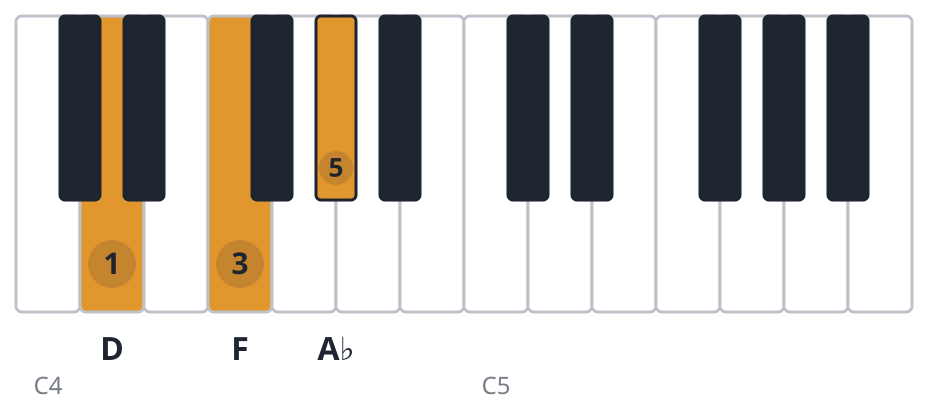
- Dthe major version of Dm
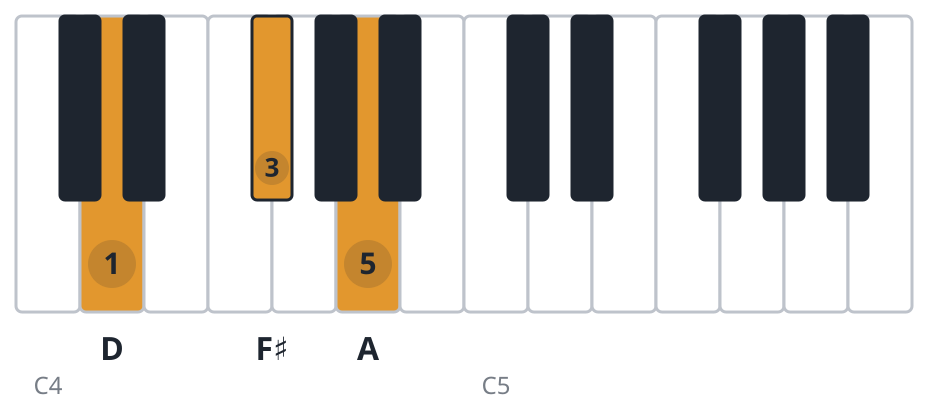
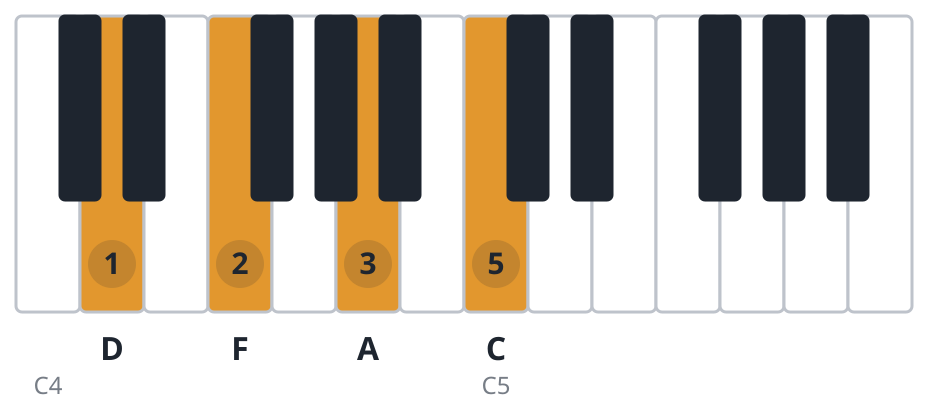
- Dm7a seventh added, which softens the minor
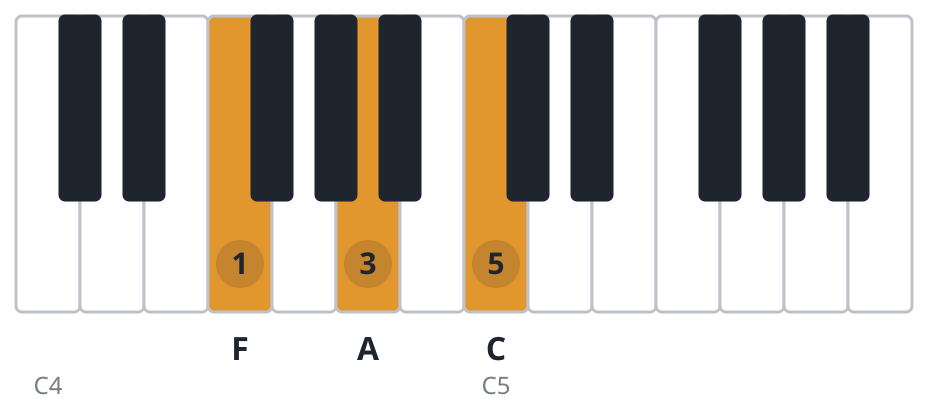
- Fthe relative major of Dm
- Ddimthe fifth lowered as well as the third