D9 Piano Chord
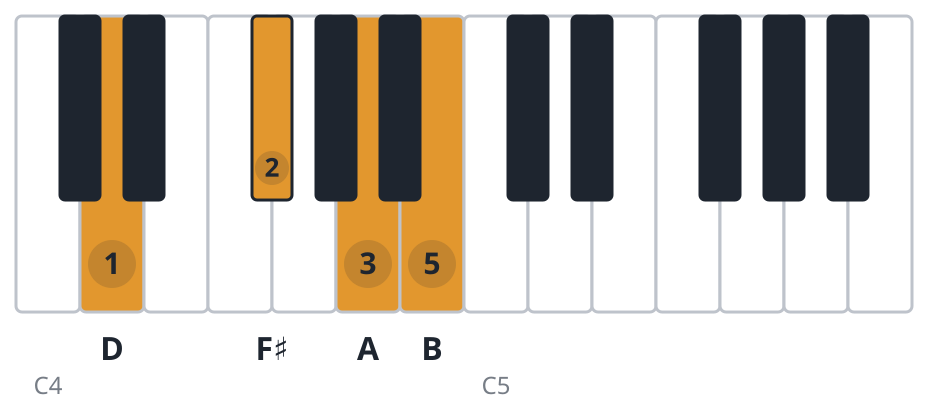
D9 is the D dominant ninth chord. It has five notes: D, F sharp, A, C and E. The stack is wider than an octave, so most players put D in the left hand and the other four notes in the right.

D at the bottom, then F♯, A, C and E. Right hand 1-2-3-4-5 if your hand spans a ninth; otherwise D in the left hand and the other four notes in the right.
How to play D9 on piano, step by step
- Start on the D above middle C. That is the lowest note of the chord.
- Thumb (1): D
- Index finger (2): F♯
- Middle finger (3): A
- Ring finger (4): C
- Little finger (5): E
- That reach is wider than an octave, so most players split it: play D with the left hand and the other notes with the right. If you keep it in one hand, use the two-hand split shown on this page. Leaving out the fifth (A) can thin the sound, but it does not shorten the span from the root to the ninth.
Play D7 first, then add the E on top with the little finger. The ninth is the only new note, and hearing it arrive tells you exactly what it does.
If it sounds wrong
- The reach is too wide
- D to E is a ninth. Split the chord: D alone in the left hand, F sharp, A, C and E in the right. That is the normal way to play it.
- It sounds soft instead of bluesy
- The seventh must be C natural. C sharp turns the chord into Dmaj9, the dreamy version with a different job.
- Five notes come out uneven
- Drop the hand as one shape instead of pressing five fingers one by one. The middle of the hand carries A and C; keep those two as firm as the outside notes.
What makes it a D9
D · F♯ · A · C · E 1 3 5 ♭7 9
D9 is a D7 chord with an E added: D, F sharp, A and C make the seventh, and the E a ninth above the root rounds it into D9.
D9 is the V9 of G, the seventh chord blues, soul and funk actually play instead of the plain D7. G is everywhere in popular music, which makes its V chord one of the most useful ninths to know.
D9 vs D7
D9 is D7 with an E on top. Both pull toward G; the ninth simply softens the edge without losing the push.
Play D7, add E with the little finger, and resolve to G. The move is the same, the arrival is the same, and the chord on the way sounds fuller.
D9 in major keys
Every note of D9 sits inside these keys. See how it works alongside the other chords in each one.
Questions about D9
Which notes are in a D9 chord on piano?
D, F sharp, A, C and E. F sharp is the only black key, and the E on top is the ninth.
What is the difference between D9 and Dadd9?
The seventh. D9 contains C; Dadd9 is the plain D major chord with an E added and no seventh, so it rests where D9 leans.
Why does this page show no inversions?
This page teaches one practical root-position voicing because a ninth spans more than an octave. Ninth chords can still be inverted: an inversion changes the bass note, and players often reorder or omit notes to fit the hand. The diagrams here keep the beginner-friendly voicing visible.
Can I leave a note out of D9?
The fifth (A) can be omitted when another part supplies the root; this thins the voicing without changing the chord quality.
Where is the D9 chord used?
As the V chord of G and through a blues in D. Funk and soul parts use it wherever D7 would appear.
Chords to learn next
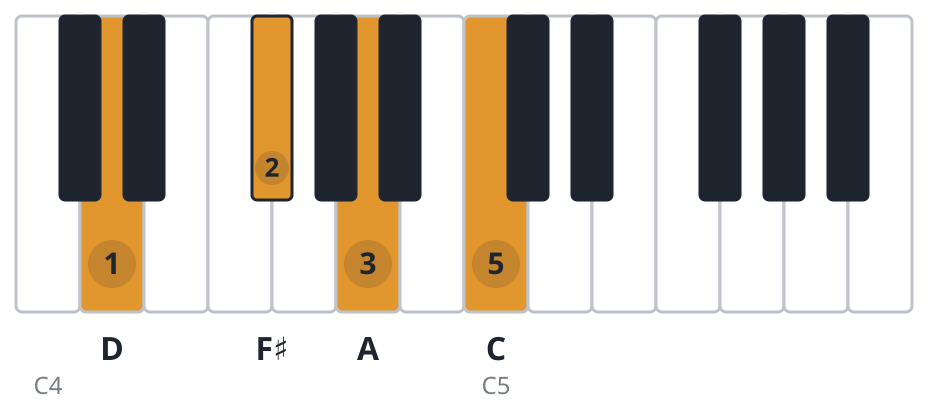
- D7the same chord without the ninth
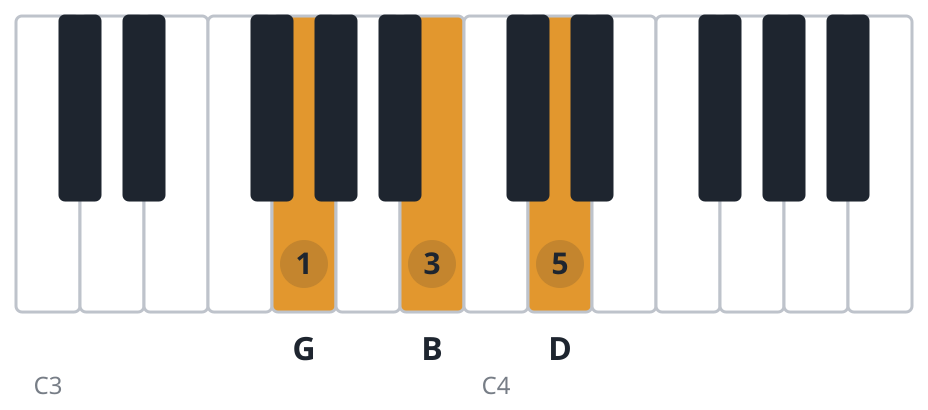
- Gwhere D9 wants to resolve
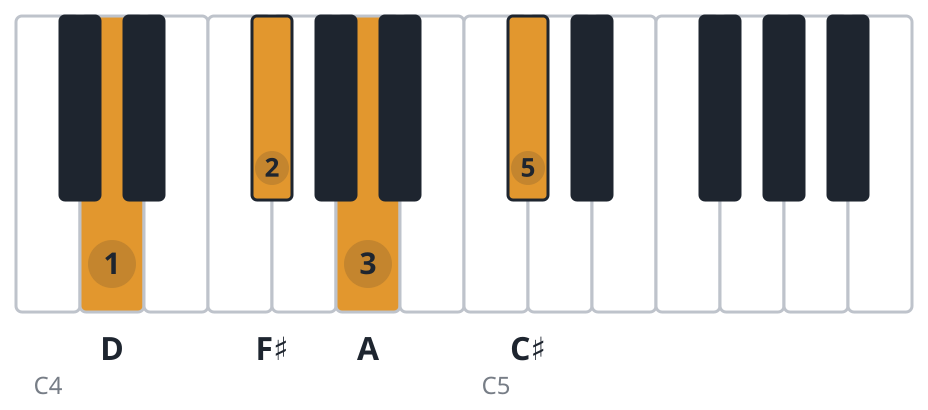
- Dmaj7the other seventh built on this root
- D6the same root with a sixth instead of a seventh