F7 Guitar Chord
F7 is the F dominant seventh chord. It has four notes: F, A, C and E♭. The standard shape is a full six string barre at the 1st fret, the toughest spot on the neck to barre, so this page also gives you a four string version with no barre at all.

The full F barre with the pinky left off: index across all six strings at fret 1, middle and ring above it. Movable up the neck for any dominant seventh.
How to play F7, step by step
- Index finger: press flat across the low E to high E strings at fret 1
- Middle finger: 2nd fret, G string
- Ring finger: 3rd fret, A string
- Strum all six strings.
If the full barre is new to you, get the no barre shape below working first. The barre comes faster once your ear already knows how the chord should sound.
More ways to play F7
There are 3 common F7 shapes in total: the standard one at the top of the page, plus these, easiest first. You only ever need one. Tap any card to hear it.

Lighter and cleaner than the barre, trading bass weight for clarity.

Smoother and higher than the standard shape, sitting comfortably in the mid range.
Songs that use the F7 chord
- Learn this song(opens a new tab on our partner site)
Hey Jude
The Beatles
- Learn this song(opens a new tab on our partner site)
The Sky Is Crying
Stevie Ray Vaughan
When the barre buzzes and thuds
- The thin strings buzz under the barre
- String tension is stiffest at the 1st fret. Roll the index onto its bony outer edge and place it tight against the fret wire, not in the middle of the fret.
- D string sounds dead
- The barre alone frets the D string here, and the tip of the middle finger on the G string often overhangs and kills it. Pull the middle finger back onto its tip.
- Your hand cramps after a few bars
- You are squeezing instead of leaning. Let the weight of your arm pull the neck into the barre and keep the thumb low on the back of the neck.
What makes it an F7
F · A · C · E♭ 1 3 5 ♭7
F7 is an F major triad (F, A, C) plus a minor seventh (E♭). The E♭ tilts the chord toward B flat, making F7 the V7 of B flat major and B flat minor. Guitarists meet it at least as often in a different role: in blues in C, F7 is the IV chord that answers the home chord in bar five. Same tension both times; one job aims it at a new key, the other keeps it circling inside the twelve bars.
F vs F7
If you can play the full F barre chord, F7 is one finger easier: lift the pinky, and the D string falls back to the barre and sounds an E♭ instead of an F. That one semitone drop is the entire difference between the two chords. Use F major when the music rests on F; use F7 when it is moving to B flat or grinding through a blues.
F7 in major keys
Every note of F7 sits inside these keys. See how it works alongside the other chords in each one.
F7 chord questions
Why is F7 so hard to play?
The standard shape needs a six string barre at the 1st fret, where string tension is highest. The no barre shape at frets 3 to 5 gives you the same four notes without the fight.
Can I play F7 without a barre?
Yes. The compact shape at frets 3 to 5 uses one finger per string on the middle four strings and contains every note F7 needs.
What is the difference between F and F7?
F7 adds an E♭. In the barre shapes, that means lifting the pinky so the barre sounds the D string, making F7 physically simpler than F.
What does F7 resolve to?
B flat. F7 is the dominant (V) chord of B flat major and B flat minor, and it also serves as the IV chord in blues in C.
What songs use F7?
Hound Dog leans on F7 as the IV chord of its blues in C, and Mustang Sally does the same over a slower groove.
Chords to learn next
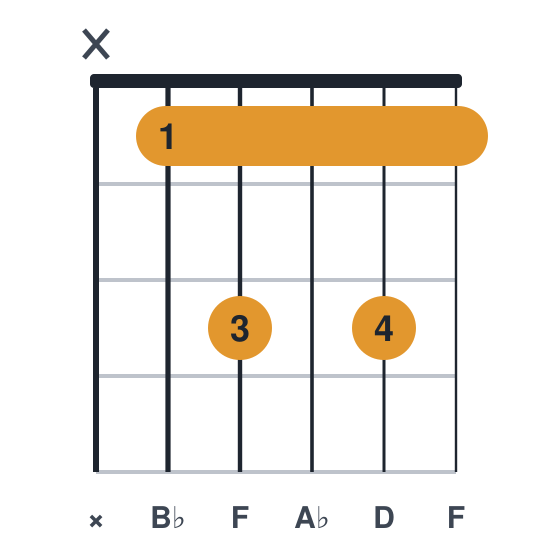
- Bb7F7 resolves to Bb
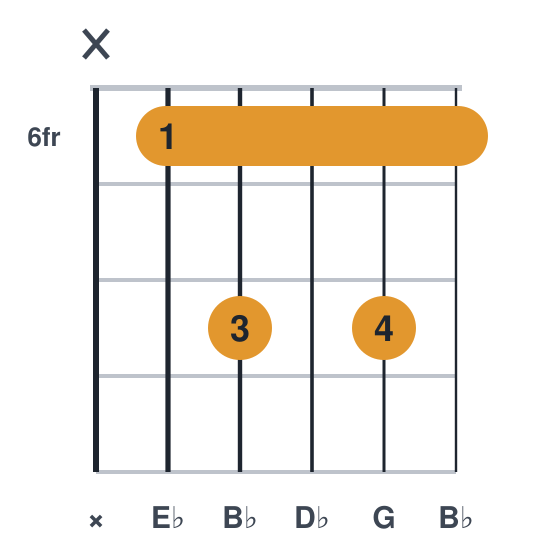
- Eb7the IV chord next to F7 in blues in Bb
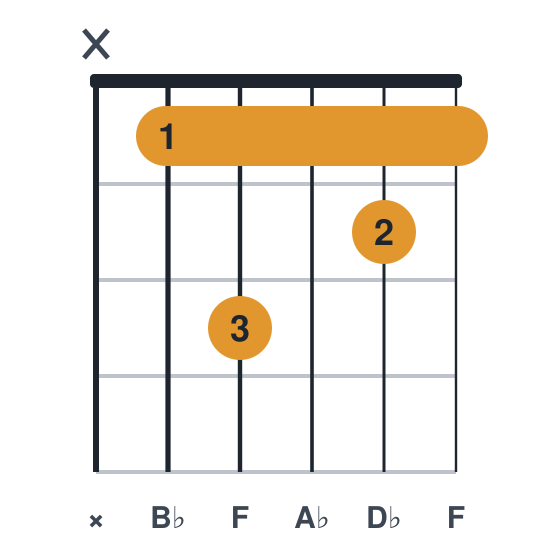
- Bbm7F7 is the V chord of Bb minor
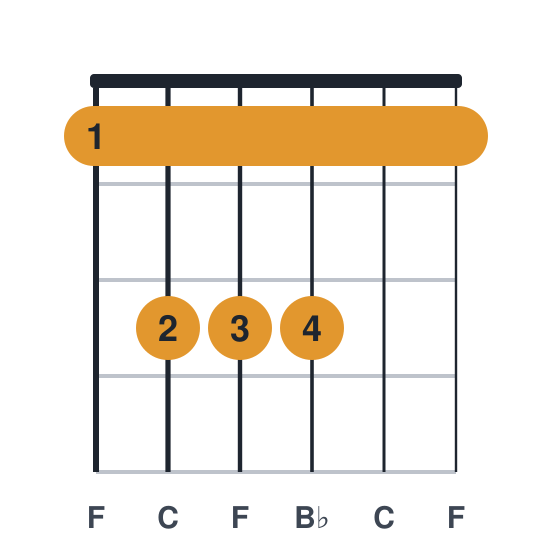
- Fsus4the suspended color players hang on before resolving


Other F chords
F7 guitar chord chart (131211) from melodician.com