F# Guitar Chord
F♯ is the F sharp major chord, also written G♭. It has three notes: F♯, A♯ and C♯. The standard shape is the same six string barre as F, moved up to the 2nd fret. That one fret of distance from the nut makes a real difference: the strings give more easily, so many players find F♯ the gentler of the two.

The standard F♯: a full E shape barre at fret 2. Movable: it is the F grip one fret higher, and G is one fret higher again.
How to play F#, step by step
- Index finger: press flat across the low E to high E strings at fret 2
- Middle finger: 3rd fret, G string
- Ring finger: 4th fret, A string
- Pinky finger: 4th fret, D string
- Strum all six strings.
Easy F# for beginners (no full barre)
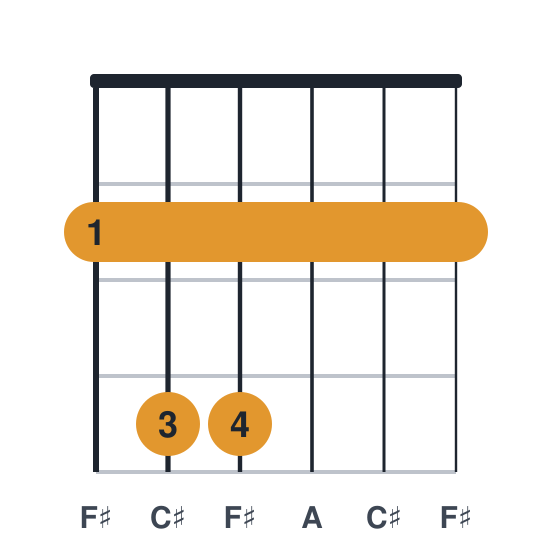
Use the four string version: ring finger on the D string at fret 4, middle on the G at 3, and the index laid over just the B and high E strings at fret 2. Pressing two strings with the index is a fraction of the work of pressing six.
This is the top half of the full barre, unchanged. Whenever the six string version becomes available to you, your upper fingers already know their places.
Nothing essential is missing either. F♯, A♯ and C♯, the root, third and fifth, all sound in the small shape; the big barre mostly adds octave doublings underneath.
More ways to play F#
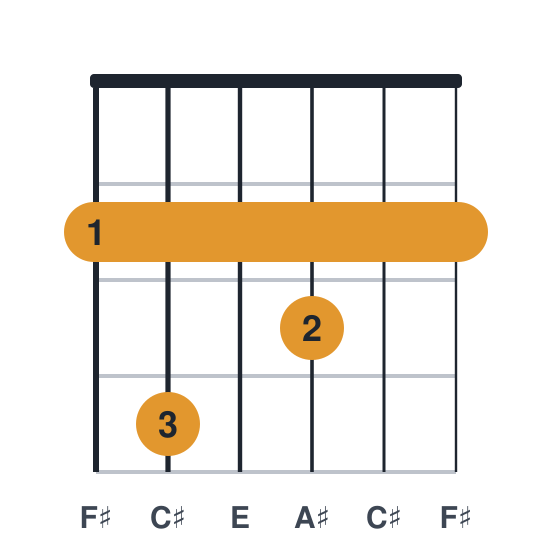
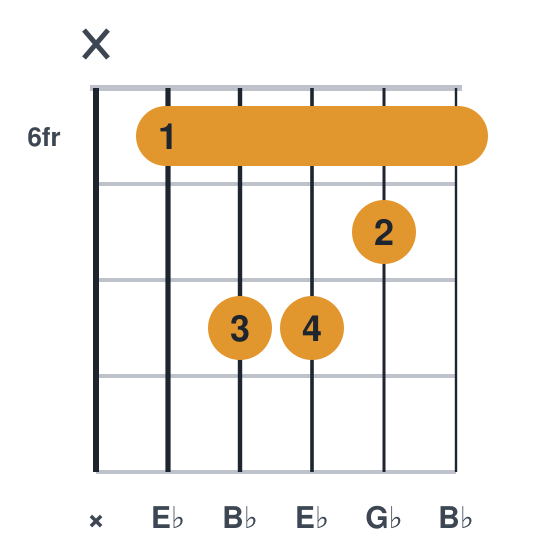
There are 4 common F# shapes in total: the standard one at the top of the page, plus these, easiest first. You only ever need one. Tap any card to hear it.

Cleaner and lighter, keeping the upper voice of the barre.

Chiming and compact, an octave above the barre's bass.

Punchy and high, the uppermost F♯ voicing on this page.
Songs that use the F# chord
- Learn this song(opens a new tab on our partner site)
Day Tripper
The Beatles
- Learn this song(opens a new tab on our partner site)
She's So High
Tal Bachman
Big River
Johnny Cash
Capo 1
Learn this song(opens a new tab on our partner site)Mayberry
Rascal Flatts
Capo 2
Learn this song(opens a new tab on our partner site)- Learn this song(opens a new tab on our partner site)
Fast As You
Dwight Yoakam
- Learn this song(opens a new tab on our partner site)
Living After Midnight
Judas Priest
If F# buzzes under the barre
- The B string chokes mid chord
- A crease of the index is swallowing it. Slide the barre a few millimeters along its length until firm flesh, not a fold, sits on every string it has to sound.
- The bass end thuds instead of ringing
- The tip end of the index loses pressure first. Angle the elbow in toward your ribs so the barre tilts its weight toward the low E and A strings.
- Everything works for ten seconds, then collapses
- Grip fatigue. Release the thumb squeeze, let the arm's pull supply the force, and give the hand short breaks; stamina arrives gradually.
What makes it an F#
F♯ · A♯ · C♯ 1 3 5
F♯ major is the root F♯, the major third A♯ and the fifth C♯. It functions as the I chord in the key of F♯, the IV chord in C♯, and the V chord in B. The V of B is its everyday job on guitar: in the Pinball Wizard run on this page, the chords walk down from B and settle on F♯, the chord that pulls the music back toward B. Spell it G♭ and nothing changes but the ink.
F# vs F#m
A♯ against A is the entire difference. On the six string barre the swap could not be simpler: lift the middle finger, let the barre sound the G string at fret 2, and F♯ becomes F♯m. Guitarists reach for F♯m far more often, thanks to countless songs in the keys of A and E; the major belongs mainly to the key of B.
F# in major keys
Every note of F# sits inside these keys. See how it works alongside the other chords in each one.
F# chord questions
Are F# and Gb the same chord?
Yes, one chord with two spellings. Guitar tab and songbooks almost always write F#.
Can I play F# without barring all six strings?
Yes. The four string shape on this page needs the index on only two strings and still contains the whole chord.
Is F# easier than F?
Slightly, for most hands. The shape is identical, but at the 2nd fret the strings press down more easily than right beside the nut.
What is the difference between F# and F#m?
One note: A♯ versus A. On the barre shape you lift the middle finger to get the minor.
What songs use the F# chord?
On this page, Pinball Wizard, where F# closes the descending chord run. More broadly, songs in the key of B rely on it.
Chords to learn next
- F#mthe minor version of F#
- F#7F# with the seventh that pushes to B
- Ebmthe relative minor of F#
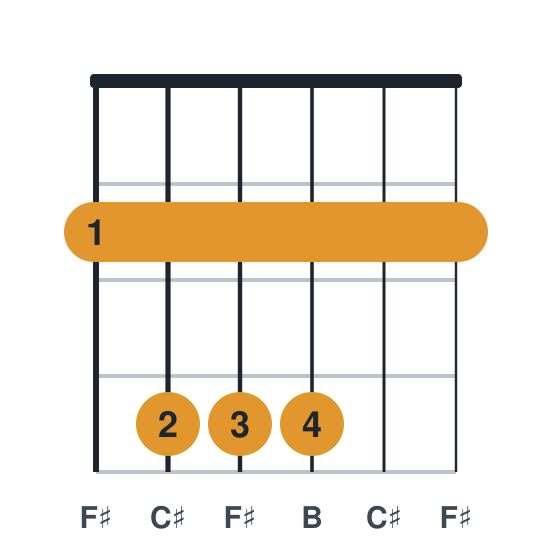
- F#sus4the suspended color that resolves back to this chord


Other F# chords
F# guitar chord chart (244322) from melodician.com