F#m7 Guitar Chord
F#m7 is the F sharp minor seventh chord. It has four notes: F sharp, A, C sharp and E. On guitar it is a six string barre at the 2nd fret using just two fingers, and because it belongs to the keys of E and A, guitar music keeps it very busy.

A full barre at fret 2 plus one ring finger on the A string. Everything else is the index finger's job, which makes this a favourite grip for barre practice.
How to play F#m7, step by step
- Index finger: press flat across the low E to high E strings at fret 2
- Ring finger: 4th fret, A string
- Strum all six strings.
The grip is movable: it is Fm7 one fret lower and Gm7 one fret higher. If the full barre will not ring yet, start with the no barre shape at fret 4 further down the page.
More ways to play F#m7
There are 4 common F#m7 shapes in total: the standard one at the top of the page, plus these, easiest first. You only ever need one. Tap any card to hear it.

Lighter and neater than the barre, with the bass left out.

Firmer and more focused in the midrange, good for cutting through other instruments.

Smaller and darker than the barre, four strings instead of six, but it holds the minor seventh colour.
Songs that use the F#m7 chord
If F#m7 comes out half muted
- The D and G strings die
- They sound under the middle of the barre, its softest part. Keep the index finger straight, roll it slightly toward the nut, and squeeze from the arm rather than pinching with the thumb.
- Ring finger flattens onto the D string
- It belongs on the A string at fret 4, standing on its tip. If it tips over, the D string loses the E note, and that E is the seventh that defines the chord.
- The whole chord rattles
- At fret 2 the strings are still fairly stiff. Set the barre right behind the fret wire; even a few millimetres too far back costs real pressure.
What makes it an F#m7
F♯ · A · C♯ · E 1 ♭3 5 ♭7
F#m7 is a minor seventh chord: an F sharp minor triad (F#, A, C#) plus a minor seventh (E). The E takes the tension out of the minor and lets the chord sit quietly. Guitar keys keep it employed: F#m7 is the ii chord in E major, moving toward B7, and the vi chord in A major. Almost any strummed song in E or A will reach for it sooner or later.
F#m vs F#m7
Both chords barre all six strings at fret 2. F#m frets the D string at fret 4 with the pinky; F#m7 lets that string ring at the barre, where it becomes the seventh. The m7 needs one finger fewer and sounds smoother, less brooding. If a song in A calls for F#m and the pinky will not cooperate, F#m7 nearly always fits.
F#m7 in major keys
Every note of F#m7 sits inside these keys. See how it works alongside the other chords in each one.
F#m7 chord questions
Is F#m7 the same as Gbm7?
Yes, the same notes under a different spelling. F#m7 is the standard name because the chord lives in sharp keys like E and A.
Can I play F#m7 without a barre?
Yes. The four string shape at frets 4 to 6 on this page (x x 4 6 5 5) keeps all four notes with no barre.
What keys use F#m7?
E major, where it is the ii chord, A major, where it is the vi chord, and its own key of F# minor.
Is F#m7 a hard chord?
It is a barre chord, but a forgiving one: the index finger does almost all the work and only one other finger is needed. Expect some weeks of buzz, not months.
What is the difference between F#m and F#m7?
One note: F#m7 adds an E. On the fretboard, lift the pinky off the D string and the barre supplies the E. The sound relaxes noticeably.
Chords to learn next
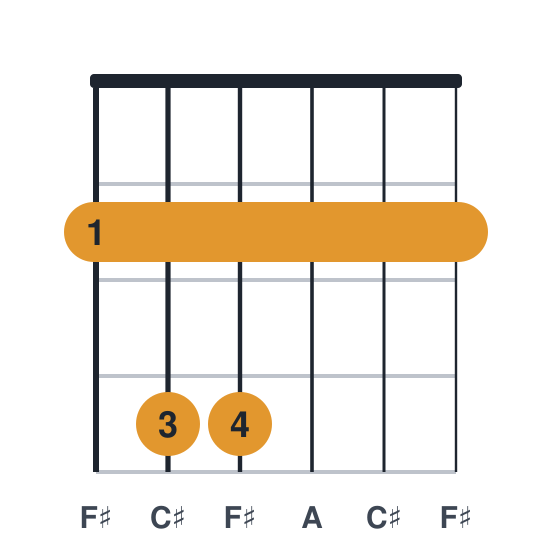
- F#mthe same chord without the seventh
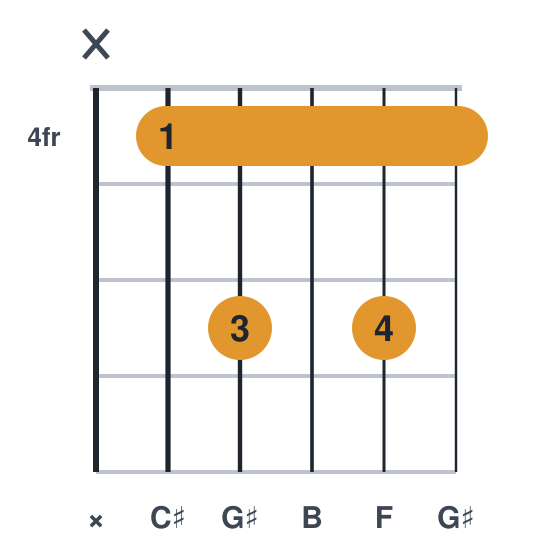
- C#7the V chord that resolves to F# minor
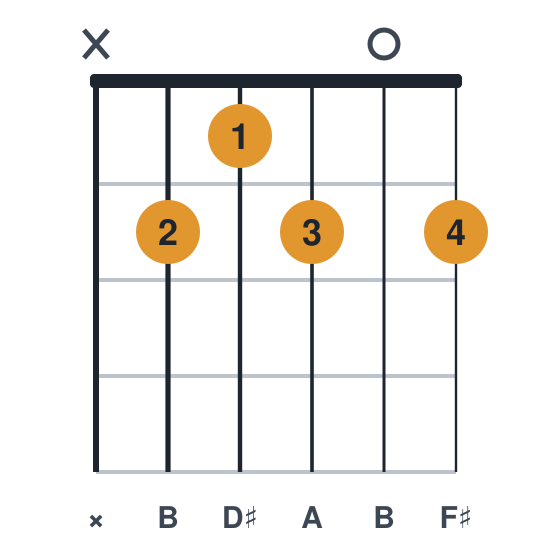
- B7partner in the ii V of E major
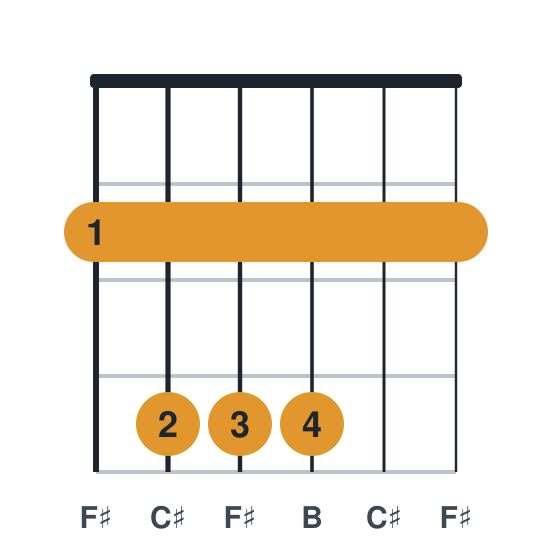
- F#sus4a different color built on the same root


Other F# chords
F#m7 guitar chord chart (242222) from melodician.com