F#maj7 Guitar Chord
F#maj7 is the F sharp major seventh chord, also written Gbmaj7. It has four notes: F♯, A♯, C♯ and F, the last properly spelled E♯. There is no open shape; the standard grip roots the chord on the low E string at the 2nd fret and needs four fingers but no barre.

Root on the low E at the 2nd fret, seventh and third on the D and G strings, fifth on the B. The index frets the bass note and mutes the A string at the same time.
How to play F#maj7, step by step
- Index finger: 2nd fret, low E string
- Middle finger: 2nd fret, B string
- Ring finger: 3rd fret, D string
- Pinky finger: 3rd fret, G string
- Strum all six strings. The index mutes the A string and the middle finger's edge keeps the high E silent.
More ways to play F#maj7
There are 3 common F#maj7 shapes in total: the standard one at the top of the page, plus these, easiest first. You only ever need one. Tap any card to hear it.

Brighter and lighter than the main shape, all four notes close together on the upper strings.

High and clear. Well above the standard shape, so it cuts through rather than filling in underneath.
Songs that use the F#maj7 chord
- Learn this song(opens a new tab on our partner site)
Cry
Godley & Creme
If strings buzz or go silent
- The A string rings and muddies everything
- It has to be muted, not avoided: let the underside of the index, which is fretting the low E, rest against the A string as you strum through.
- D and G notes buzz
- Ring finger and pinky share the 3rd fret. Arch them both and place them as a pair, tips down, just behind the fret.
- High E chimes in uninvited
- The middle finger on the B string can lean a little to touch the high E, or you can stop the strum one string early.
What makes it an F#maj7
F♯ · A♯ · C♯ · F 1 3 5 7
F#maj7 is a major seventh chord: an F sharp major triad (F♯, A♯, C♯) plus a major seventh, E♯, the same pitch as F. That seventh a half step under the root is what floats. F#maj7 is the I chord of F sharp major and the IV chord of C sharp major, remote keys on paper that turn up more than you would expect in R&B, neo soul and dream pop, where this exact soft color is the point.
F# vs F#maj7
F sharp major has three notes; F#maj7 adds the seventh. The plain F# is normally a full barre chord, while the standard F#maj7 here is four fingertips with two muted strings, no barre. Choose the plain major when the song wants a solid, bright F#; choose the maj7 when it should hang in the air instead of landing.
F#maj7 in major keys
Every note of F#maj7 sits inside these keys. See how it works alongside the other chords in each one.
F#maj7 chord questions
Are F#maj7 and Gbmaj7 the same?
Yes, one chord with two spellings. Flat side charts write Gbmaj7, sharp side charts write F#maj7. Nothing changes on the fretboard.
Is F#maj7 hard to play?
Moderate. No barre is required, but two strings must stay muted while four fingers work close together, which takes some coordination.
Why is the seventh sometimes written E#?
In the key of F sharp, every letter name is used once, so the seventh is spelled E♯ rather than F. E♯ and F are the same pitch; only the spelling differs.
What is the difference between F#maj7 and F#7?
F#7 carries an E natural and pulls toward B, full of tension. F#maj7 carries an E♯ and sits still. One is a push, the other is a rest.
What keys use F#maj7?
It is the I chord of F sharp major and the IV chord of C sharp major. It also appears written as Gbmaj7 in flat key charts.
Chords to learn next
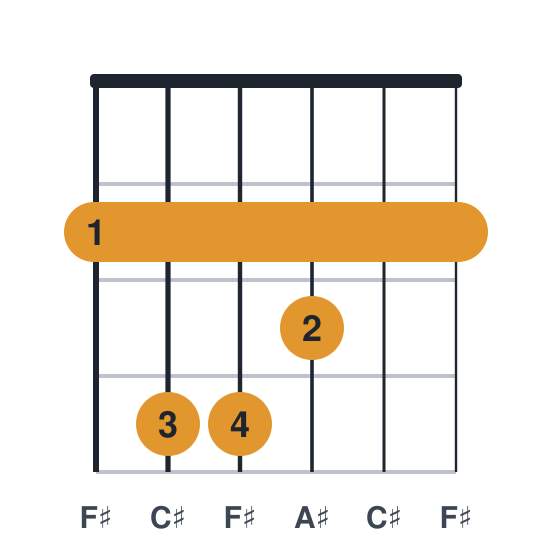
- F#the plain major
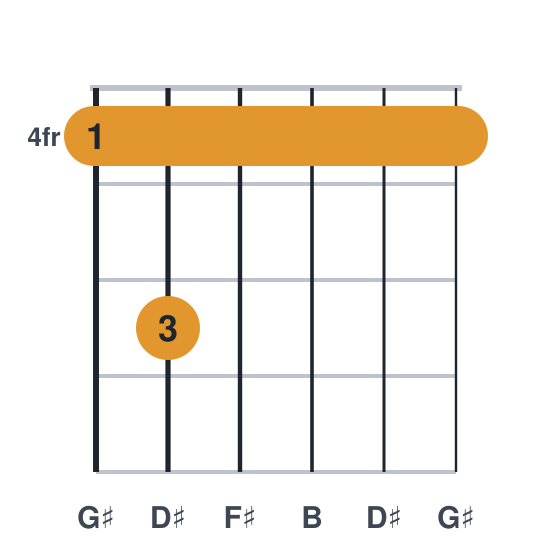
- G#m7the ii chord beside F#maj7 in the key of F#
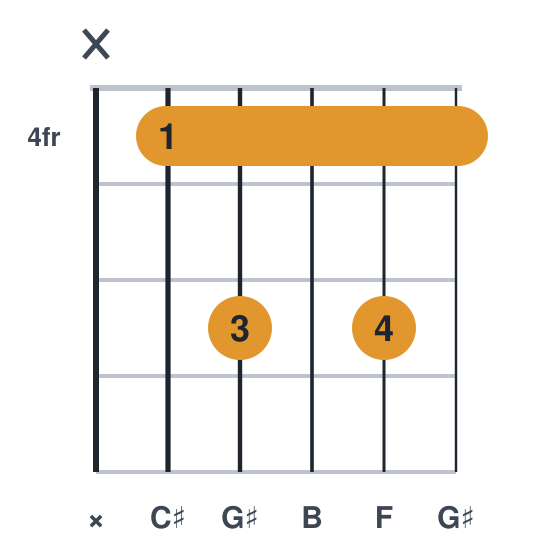
- C#7the V chord of F#
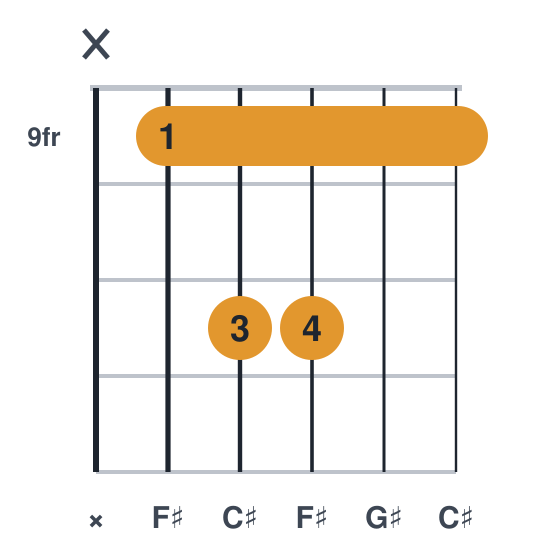
- F#sus2a lighter, more open color on the same root


Other F# chords
F#maj7 guitar chord chart (2x332x) from melodician.com