G#m7 Guitar Chord
G#m7 is the G sharp minor seventh chord. It has four notes: G sharp, B, D sharp and F sharp. On guitar it is a barre at the 4th fret using two fingers, the same grip as Gm7 one fret lower, and songs in the keys of E and B are where you will usually need it.

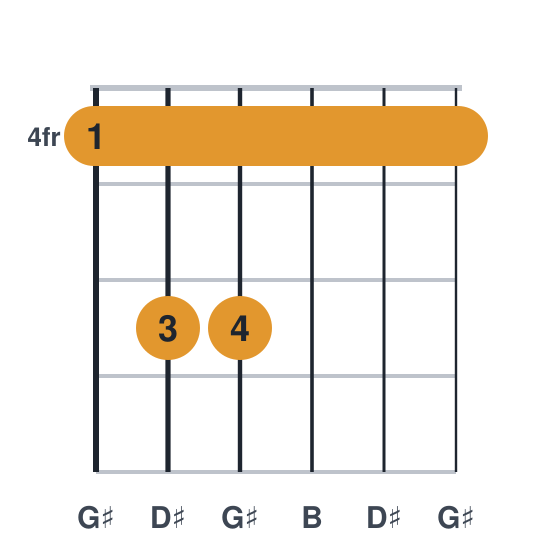
Index across all six strings at fret 4, ring finger on the A string at fret 6. The movable two finger minor seventh barre.
How to play G#m7, step by step
- Index finger: press flat across the low E to high E strings at fret 4
- Ring finger: 6th fret, A string
- Strum all six strings.
The shape travels: one fret down it is Gm7, one fret up it is Am7. If the barre is still a struggle, the fret 6 shape further down this page skips it entirely.
More ways to play G#m7
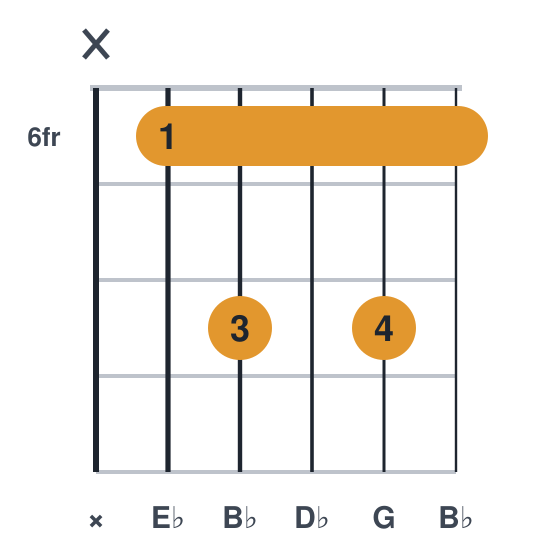
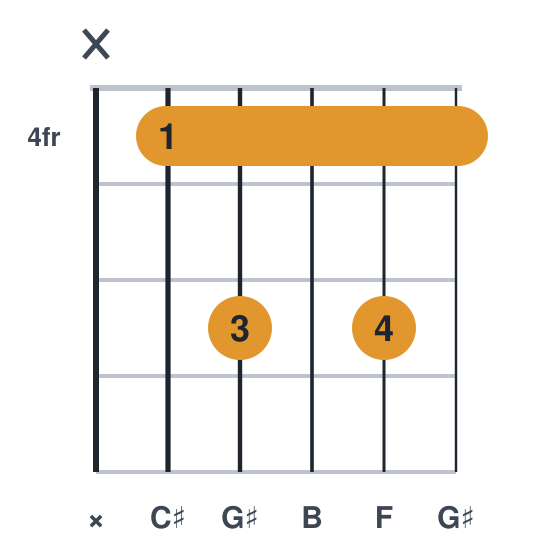
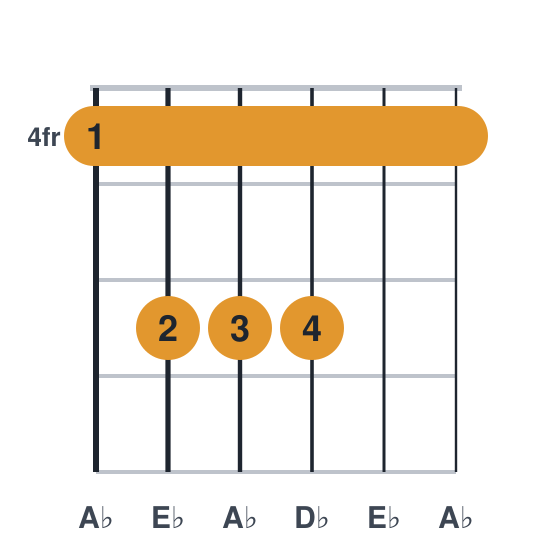
There are 3 common G#m7 shapes in total: the standard one at the top of the page, plus these, easiest first. You only ever need one. Tap any card to hear it.

Smaller and clearer, sitting an octave above the six string barre.

Compressed and bright, the treble end of this chord's range.
When strings drop out of G#m7
- The middle of the barre sags
- Five notes depend on the index finger here. Straighten it, set the thumb behind the neck roughly opposite the barre, and let the forearm supply the squeeze.
- Ring finger mutes its neighbour
- It presses the A string at fret 6; if it leans, the D string below stops ringing and takes the seventh with it. Keep it curled and on its tip.
- The chord is clean but dull
- Barres this far up can sound choked when the finger sits on the fret wire. Shift the hand so the barre lands just behind fret 4, not on top of it.
What makes it a G#m7
G♯ · B · D♯ · F♯ 1 ♭3 5 ♭7
G#m7 is a minor seventh chord: a G sharp minor triad (G#, B, D#) plus a minor seventh (F#). The added seventh loosens the minor sound. In everyday use, G#m7 is the ii chord of F sharp major and the vi chord of B major; it also serves as the iii chord in E major, a key guitarists visit constantly. That iii chord job, drifting between E and A, is where many players meet G#m7 first.
G#m vs G#m7
Both live at the 4th fret barre. G#m needs three fingers, with the pinky holding the D string at fret 6; G#m7 retires the pinky and lets the barre sound an F sharp on that string instead. The result is mellower and one finger cheaper. Barres this far from the nut are kinder to the hand than their 1st fret cousins, and the m7 version is the easiest way in.
G#m7 in major keys
Every note of G#m7 sits inside these keys. See how it works alongside the other chords in each one.
G#m7 chord questions
Is G#m7 the same as Abm7?
Yes, one chord with two spellings. G#m7 is far more common because the chord belongs to sharp keys like E, B and F sharp; Abm7 appears mainly in flat key sheet music.
How do I play G#m7 without a barre?
Use the four string shape at frets 6 to 8 on this page: x x 6 8 7 7, one finger per string.
What keys use G#m7?
B major, where it is the vi chord, F sharp major, where it is the ii, and E major, where it is the iii. Its own key is G sharp minor.
Is G#m7 hard for beginners?
It needs a barre, so it is not a first month chord. But the grip is only two fingers, and at fret 4 the strings give in more easily than near the nut.
What is the difference between G#m and G#m7?
G#m7 adds an F sharp. On the fretboard you simply leave out the pinky and the barre provides the note. The sound softens from tense to settled.
Chords to learn next
- G#mthe same chord without the seventh
- Eb7the V chord that resolves to G# minor
- C#7partner in the ii V of F# major
- Absus4a different color built on the same root


Other G# chords
G#m7 guitar chord chart (464444) from melodician.com