F#6 Guitar Chord
F#6 is the F sharp sixth chord. It has four notes: F sharp, A sharp, C sharp and D sharp. The shape here uses the top four strings with the root on the D string, which keeps it out of barre chord territory.

Four strings, root on the D at the 4th fret. The index covers the D and B strings while the ring and pinky take the G and high E. Movable, and it needs no barre across the whole neck.
How to play F#6, step by step
- Index finger: press flat across the D to B strings at fret 4
- Ring finger: 6th fret, G string
- Pinky finger: 6th fret, high E string
- Strum from the D string down, skipping the two lowest strings.
The same four string grip covers every sixth chord: slide it down two frets for E6, up one for G6. Only the fret changes.
More ways to play F#6
There are 2 common F#6 shapes in total: the standard one at the top of the page, plus these, easiest first. You only ever need one. Tap any card to hear it.

Even and close packed, the four notes almost touching. Less bass weight than an open shape, which makes it easy to sit under a singer.
If notes are missing
- The index is not covering both its strings
- It holds the D and B strings at the 4th fret while the G string is pressed at the 6th between them. Lay the index flat and let the G string pass under the joint.
- The stretch to the 6th fret feels long
- Ring and pinky take the 6th fret. Bring the elbow slightly forward and keep the thumb behind the middle of the neck so the hand can open.
- The bass strings ring
- This chord starts on the D string. Keep the low E and A quiet with the fretting hand, or begin the strum at the D.
What makes it an F#6
F♯ · A♯ · C♯ · D♯ 1 3 5 6
F#6 is an F sharp major triad (F sharp, A sharp, C sharp) with a D sharp added, the sixth of the scale. The triad stays whole in every shape on this page.
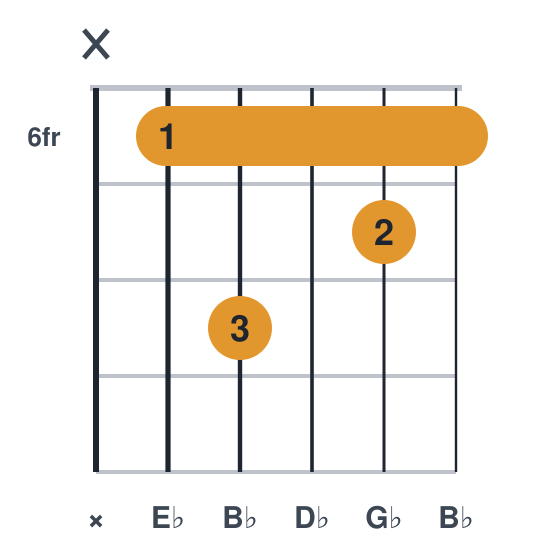
Read from D sharp, those notes spell a minor seventh chord, written Ebm7 in flat keys. F#6 and Ebm7 hold the same pitches and differ only in what sits in the bass.
F#6 vs F#maj7
F#6 adds a D sharp to the triad; F#maj7 adds an E sharp, which charts print as F. The sixth is a whole step below the root and sounds finished; the seventh is a half step below and sounds like it wants to move.
Guitarists usually meet F sharp chords as barres, so the four string sixth on this page is a useful alternative: it gives you an F sharp chord with no barre and no thumb wrapped over the neck.
F#6 in major keys
Every note of F#6 sits inside these keys. See how it works alongside the other chords in each one.
F#6 chord questions
Is F#6 the same as Gb6?
Yes, the same chord spelled two ways. Guitar charts use F#6 far more often, so that is the name here.
Can I play F#6 without a barre?
Yes. The top four string shape at the 4th fret needs no barre. The larger shape further up the page uses one finger laid across four strings, which is easier than a full six string barre.
Is F#6 the same as Ebm7?
They contain the same four notes. F sharp in the bass makes it F#6; the D sharp, written E flat, in the bass makes it a minor seventh.
What is the difference between F#6 and F#7?
F#6 adds a D sharp and rests. F#7 adds an E and pulls toward B. In blues in B, F#7 is the chord you want; F#6 is the softer landing.
Which strings do I strum?
The top four, starting at the D string. Leave the bottom two out.
Chords to learn next
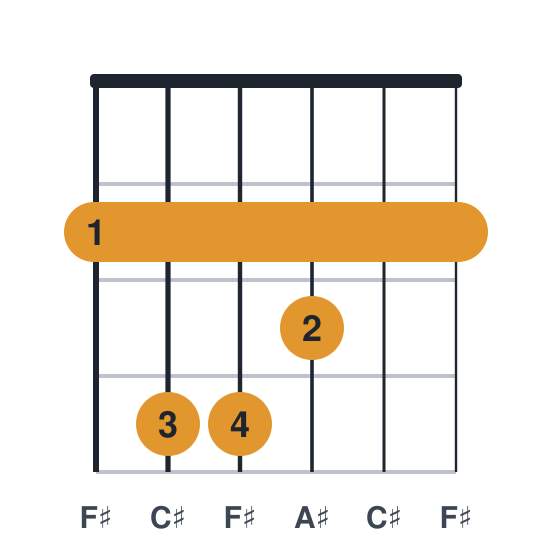
- F#the plain major underneath it
- Ebm7the same four notes counted from Eb
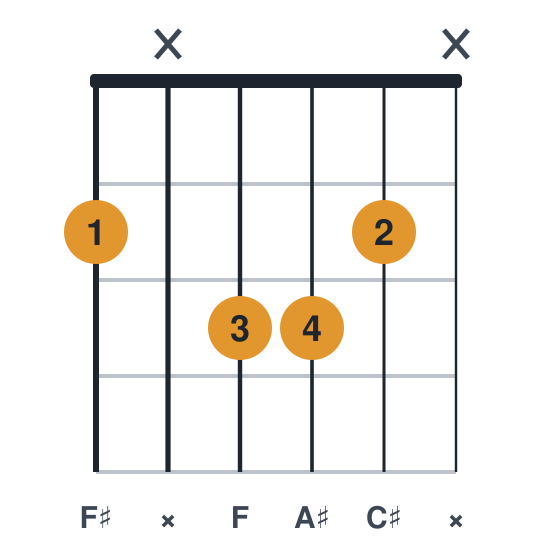
- F#maj7the other note people add to a major chord
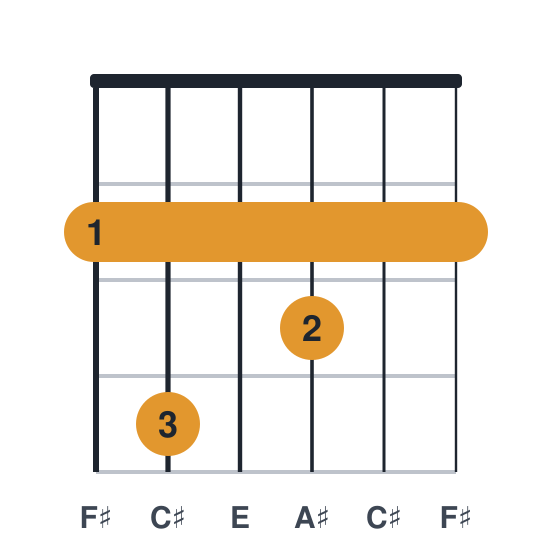
- F#7a seventh on the same root instead of a sixth


Other F# chords
F#6 guitar chord chart (xx4646) from melodician.com