F#add9 Guitar Chord
F#add9 is the F sharp added ninth chord. It has four notes: F♯, A♯, C♯ and G♯. The standard shape is the four string Fadd9 grip moved up one fret, sitting between the 2nd and 4th frets with no barre.

Four fingers on the top four strings between the 2nd and 4th frets, root on the D string. It is the Fadd9 chart shape one fret up, with no barre anywhere.
How to play F#add9, step by step
- Index finger: 2nd fret, B string
- Middle finger: 3rd fret, G string
- Ring finger: 4th fret, D string
- Pinky finger: 4th fret, high E string
- Strum from the D string down, skipping the two lowest strings.
The shape is movable and the fingering never changes: one fret down it plays Fadd9, two frets up it plays Abadd9.
More ways to play F#add9
There are 2 common F#add9 shapes in total: the standard one at the top of the page, plus these, easiest first. You only ever need one. Tap any card to hear it.

Rounder and deeper, with the ninth in the middle of the voicing. It pairs well with a band when the top strings are taken.
If it buzzes or sounds wrong
- The low strings rumble into the chord
- The low E and A strings are not part of the shape. Start the strum at the D string, and let the ring finger's tip lean back to keep the A string quiet.
- The G sharp on top does not ring
- The pinky shares the 4th fret with the ring finger and tends to land flat. Come down on its tip, right behind the fret, so the ninth speaks.
- The index note chokes
- The index on the 2nd fret of the B string sits under the other fingers. Keep it upright and pressing straight down so the fifth of the chord stays in.
What makes it an F#add9
F♯ · A♯ · C♯ · G♯ 1 3 5 9
F#add9 is an F sharp major triad (F♯, A♯, C♯) with a G sharp added, the ninth. The ninth is the second note of the F sharp scale an octave up, and with the third (A♯) still present, the chord keeps its major character and simply gains air.
It does the jobs plain F sharp does: the I chord in F sharp, the IV chord in C sharp, the V chord in B. The V of B is where most guitarists meet it, since B major sits comfortably on the instrument.
F#add9 vs F#sus2
Both chords add a G sharp to F sharp, but F#sus2 removes the third (A♯) to make room for it, while F#add9 keeps the third and stacks the G sharp on top. F#add9 stays clearly major with extra shimmer; F#sus2 floats and waits to resolve.
F#sus2 needs a barre, and most F sharp chords do. The standard F#add9 here needs none, which makes it something of an exception on this root.
F#add9 in major keys
Every note of F#add9 sits inside these keys. See how it works alongside the other chords in each one.
F#add9 chord questions
Is F#add9 the same as Gbadd9?
Yes, one chord with two names. Sharp key charts write F#add9 and flat key charts write Gbadd9; the shape and sound are identical.
Is there an F#add9 without a barre?
Yes, and it is the standard shape on this page: four fingers on the top four strings between the 2nd and 4th frets. Almost every other F sharp chord needs a barre, this one does not.
What is the difference between F#add9 and F#9?
F#9 also contains an E, the flat seventh, which makes it a dominant chord. F#add9 adds only the G sharp and stays a bright major chord.
What is the difference between F#add9 and F#sus2?
Both contain a G sharp, but F#sus2 removes the third (A♯) and floats, while F#add9 keeps the third and still sounds fully major.
Where is F#add9 used?
As a brighter F sharp in the keys of F sharp, B and C sharp. Songs in B that want the V chord to shimmer are the most common spot.
Chords to learn next
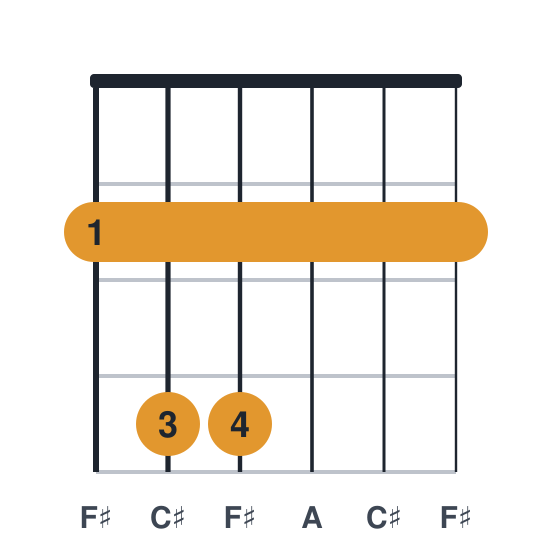
- F#the plain major
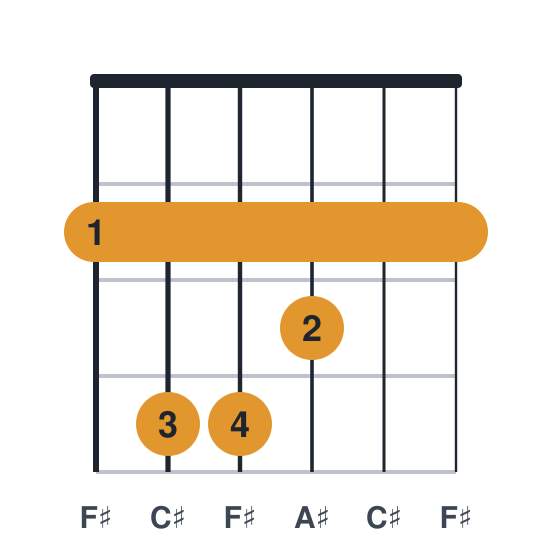
- F#sus2the 9 without the 3
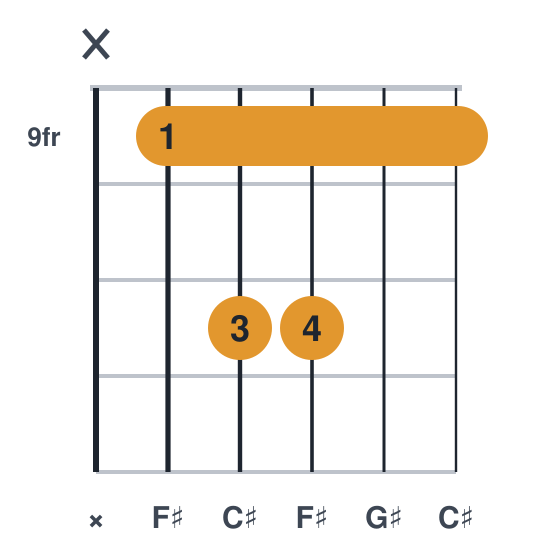
- F#maj7another colour on the same major
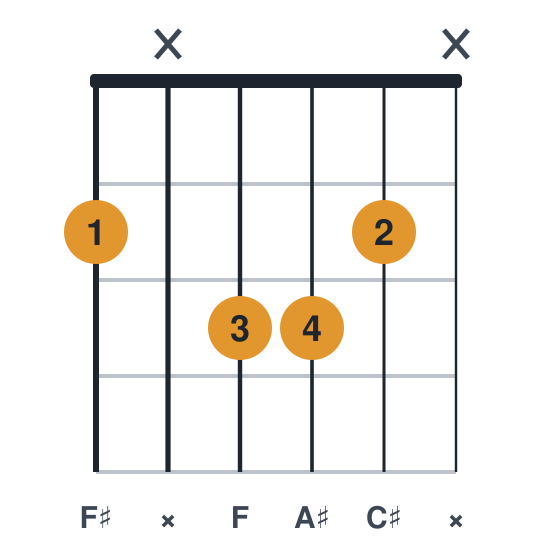
- F#mthe minor chord on the same root, a darker place to go next


Other F# chords
F#add9 guitar chord chart (xx4324) from melodician.com