F#dim Guitar Chord
F#dim is the F sharp diminished chord, a diminished triad. It has three notes: F♯, A and C. Because it is the diminished chord that belongs to the key of G major, it turns up more often than most of its cousins, usually walking the harmony up into G. The standard shape sits at the 4th fret on the top four strings with no barre.

The Ddim grip at the 4th fret: root on the D string, middle and ring at fret 5, pinky posted at fret 7 on the B string. Movable everywhere.
How to play F#dim, step by step
- Index finger: 4th fret, D string
- Middle finger: 5th fret, G string
- Ring finger: 5th fret, high E string
- Pinky finger: 7th fret, B string
- Strum from the D string down, skipping the two lowest strings.
After this, Edim and Gdim are free: identical grip, two frets down or one fret up.
More ways to play F#dim
There are 2 common F#dim shapes in total: the standard one at the top of the page, plus these, easiest first. You only ever need one. Tap any card to hear it.

Thicker and warmer, the A string root putting a floor under the tension.
Songs that use the F#dim chord
If it sounds muffled or buzzy
- The pinky note rattles
- The 7th fret on the B string is a long reach from a hand parked at fret 4. Shift the hand's weight toward the pinky side and let the index stretch back instead.
- The top string goes silent
- The pinky, crossing above the high E to reach the B string, lies down on it. Stand the pinky up on its tip; the ring finger note underneath needs the space.
- Low open strings ring through
- The bottom two strings are not part of the shape. Aim the pick at the D string to start the strum, and let your thumb hang over the low E as a mute.
What makes it an F#dim
F♯ · A · C 1 ♭3 ♭5
F#dim is two minor thirds stacked: F♯ to A, A to C. It is F♯ minor with its fifth pulled down from C♯ to C, and that one fret strips out the chord's stability. All that remains is direction: F♯ is the leading tone of G, so the chord aims straight at G major.
Build a chord on each note of the G major scale and the one on F♯ comes out diminished; the same three notes also form the ii chord of E minor. And since D7 spells D, F♯, A, C, playing F#dim is playing D7 without its root, which is exactly why both chords resolve to G.
F#dim vs F#m
F♯m is F♯, A, C♯; F#dim trades the C♯ for C, one fret lower. F♯m is a workhorse chord in keys like A and D and can hold a groove indefinitely. F#dim cannot hold anything: it tips forward into G, which is precisely its value in G major songs. On the fretboard they do not resemble each other, since F♯m is usually a 2nd fret barre while F#dim is a barre free cluster at fret 4. Read the chart symbol carefully: F♯m and F♯° are one character and one world apart.
F#dim in major keys
Every note of F#dim sits inside these keys. See how it works alongside the other chords in each one.
F#dim chord questions
What key uses F#dim?
G major, where it is the chord built on the scale's seventh note, and E minor, where it acts as the ii chord. In both it usually resolves up to G or leads into a B7 or Em.
What is the difference between F#dim and F#dim7?
F#dim is the triad: F♯, A, C. F#dim7 adds E♭ on top for four notes and a denser sound. A chart writing F#dim or F#° wants the triad shown on this page.
Is F#dim the same as Gbdim?
Yes. F♯ and G♭ name the same pitch, so the chords are identical. The sharp spelling is far more common because the chord lives in the key of G.
Is F#dim hard to play?
No barre, but the pinky reaches two frets beyond the other fingers, which takes a few sessions to feel natural. The compact shape at fret 9 avoids the stretch entirely.
Can I play D7 instead of F#dim?
Often, yes. F#dim is D7 minus the D, so in a G major song the two are close substitutes. D7 sounds fuller; F#dim sounds lighter and lets the bass line walk F♯ to G.
Chords to learn next
- GF#dim pulls up a half step to G
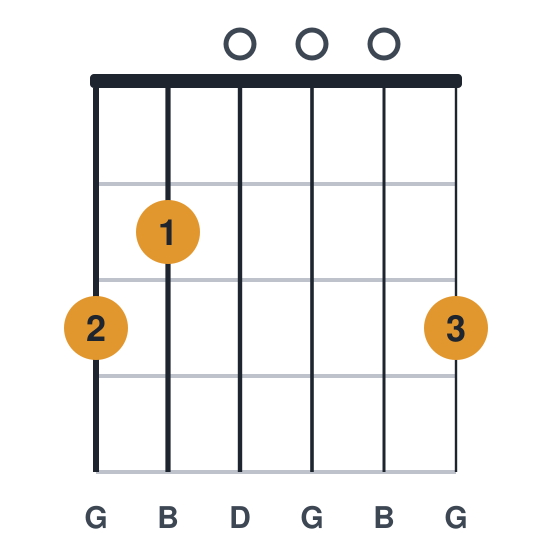
- Gmthe minor resolution one fret up
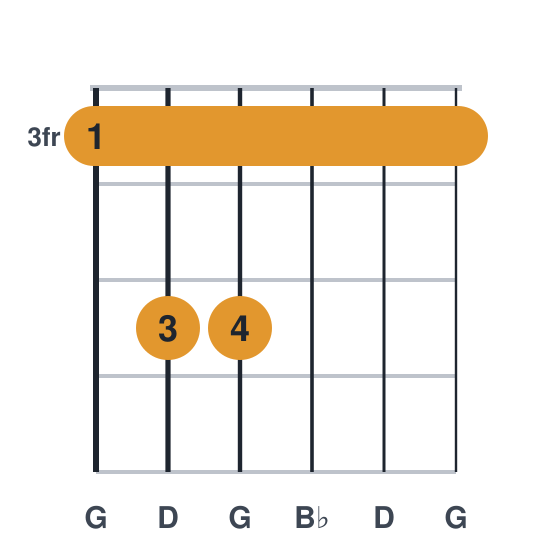
- F#mone note away from F# minor
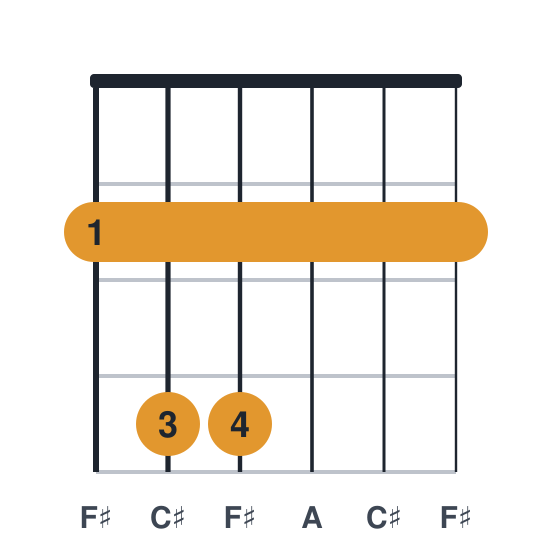
- F#the plain major chord on the same root
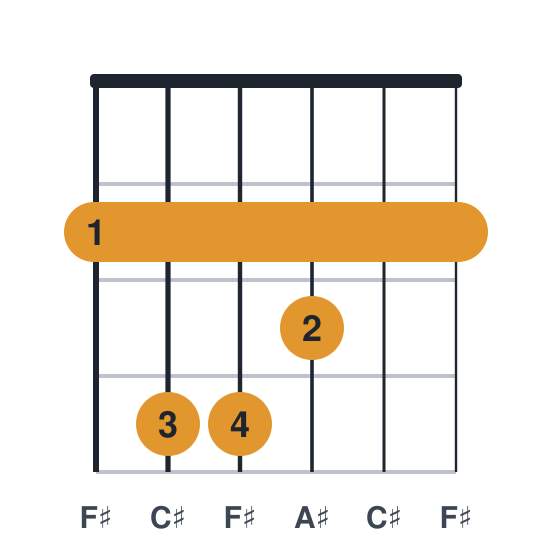


Other F# chords
F#dim guitar chord chart (xx4575) from melodician.com