F#maj9 Guitar Chord
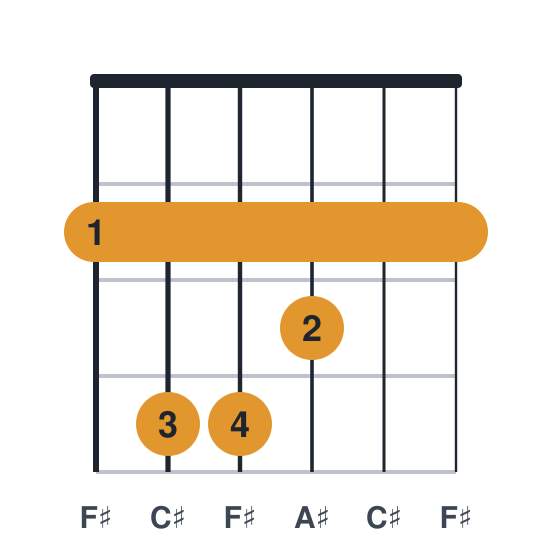
F#maj9 is the F sharp major ninth chord. It has five notes: F sharp, A sharp, C sharp, F and G sharp. The main shape is a barre at the 2nd fret with the root on the low E string, the Emaj9 grip moved up two frets.

The movable Emaj9 shape barred at the 2nd fret, root on the low E string, with the middle finger laid across the D and G strings one fret above the barre.
How to play F#maj9, step by step
- Index finger: press flat across the low E to B strings at fret 2
- Middle finger: lay across the D and G strings at fret 3
- Ring finger: 4th fret, A string
- Pinky finger: 4th fret, high E string
- Strum all six strings.
Two frets are all that separate this from Emaj9: the open strings become barred ones and the same stack sits on top. Slide it up two more and it is Abmaj9.
More ways to play F#maj9
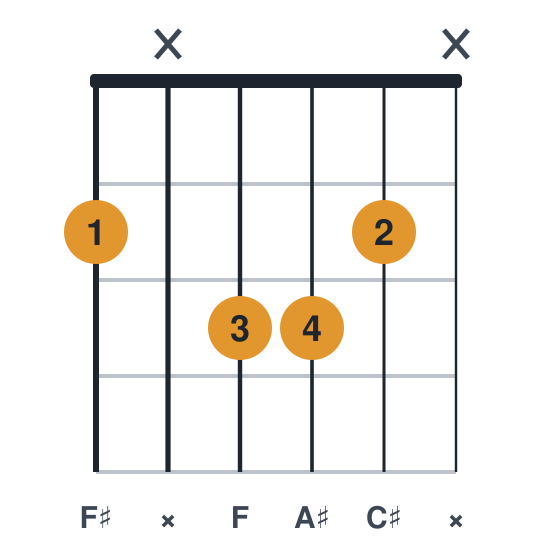
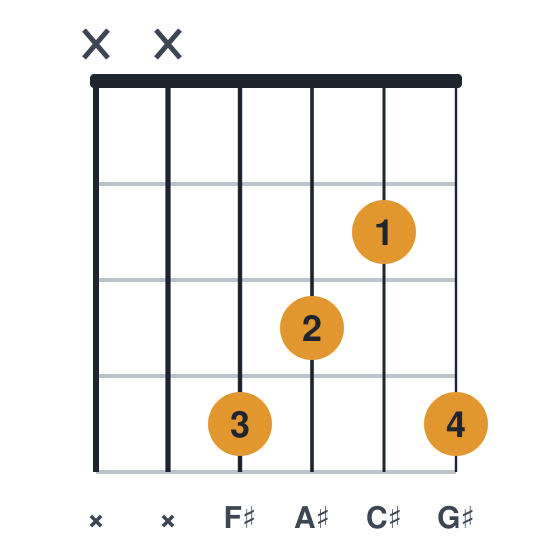
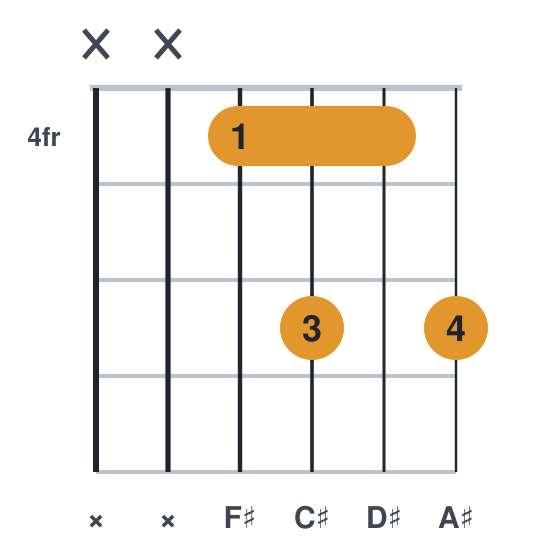
There are 2 common F#maj9 shapes in total: the standard one at the top of the page, plus these, easiest first. You only ever need one. Tap any card to hear it.

Tighter and quicker than the big barre, sitting where lead lines live. Handy when F#maj9 passes inside a progression rather than ending it.
If the barre fights back
- Notes under the index drop
- The index holds five strings at the 2nd fret, close to the nut where the strings are stiffest. Roll it onto its outer edge so the bone takes the pressure.
- The middle finger mutes one of its two strings
- It lays across the D and G strings at the 3rd fret. Keep the last joint flat so both strings sit under the same firm surface.
- The chord sounds thick
- Five notes across six strings is a lot of sound this low on the neck. Strum lightly, or start the strum on the A string.
What makes it an F#maj9
F♯ · A♯ · C♯ · F · G♯ 1 3 5 7 9
F#maj9 is an F#maj7 chord with a ninth added: F sharp, A sharp, C sharp and F make the seventh chord, and the G sharp on top makes it a ninth. The F is strictly an E sharp, the same key, printed the way the fretboard names it.
It is the I chord of F sharp major at its softest. Six sharps keep the key rare on guitar, so the chord more often appears written as Gbmaj9 in piano charts, one sound with two names.
F#maj9 vs F#maj7
F#maj9 is F#maj7 with a G sharp added on top. The seventh chord rests; the ninth version rests wider, with the top of the chord shimmering instead of settling.
The maj9 also asks more of the hand: a five string barre with the middle finger laid across two more. Save it for bars long enough for the extra note to be heard.
F#maj9 in major keys
Every note of F#maj9 sits inside these keys. See how it works alongside the other chords in each one.
F#maj9 chord questions
Is F#maj9 the same as Gbmaj9?
Yes, one chord with two names. Piano charts usually write G flat; guitarists tend to think in sharps, so F sharp is the spelling here.
Is the F in F#maj9 a mistake?
No. Strictly the seventh of F sharp is E sharp, which is the same key as F. Charts print F because that is the name on the fretboard; the sound is identical.
What is the difference between F#maj9 and F#9?
F#9 has an E natural, the flat seventh, and pulls toward B. F#maj9 has an E sharp, written F, and stays put.
Is there an F#maj9 without a full barre?
Yes: the five string shape at the 9th fret. Its only barre is one finger across the top two strings, and every other finger has one job.
Where is F#maj9 used?
As the I chord of F sharp or G flat major in jazz, soul and bossa nova, usually met through a piano chart.
Chords to learn next
- F#maj7the same chord without the ninth
- F#add9the ninth without the seventh
- F#the plain major
- F#6the other soft colour on the same major


Other F# chords
F#maj9 guitar chord chart (243324) from melodician.com