F#aug Guitar Chord
F#aug is the F sharp augmented chord, also written Gbaug. It has three notes: F♯, A♯ and D. There is no open shape; you play it as a four string grip in the middle of the neck. Like all augmented chords it is symmetric, so the shape you learn here also serves you every four frets up or down.

The Daug grip at fret 4: index anchors the root, ring and pinky sit together at fret 7, middle drops onto the high E at 6. Slide it to fret 8 and it is still F#aug.
How to play F#aug, step by step
- Index finger: 4th fret, D string
- Middle finger: 6th fret, high E string
- Ring finger: 7th fret, G string
- Pinky finger: 7th fret, B string
- Strum from the D string down, skipping the two lowest strings.
This grip is the workhorse augmented shape. Learn where its root lives, under the index on the D string, and you can spell any augmented chord from it by sliding.
More ways to play F#aug
There are 2 common F#aug shapes in total: the standard one at the top of the page, plus these, easiest first. You only ever need one. Tap any card to hear it.

Thicker and lower centered than the standard shape, with the root right under your hand.
If it buzzes or goes quiet
- Root note buzzes under the index
- Three frets separate the index from the ring and pinky, and the index pays for it. Keep the thumb low on the back of the neck so the hand can open without the index going flat.
- The high E note gets smothered
- The middle finger works in the gap below the ring and pinky pair. Arch it steeply; if its neighbors touch it, the top note dies.
- Low strings ring through
- Only four strings belong in this chord. Start the strum at the D string and let the tip of the index rest lightly against the A string above it.
What makes it an F#aug
F♯ · A♯ · D 1 3 ♯5
F#aug is an augmented triad: F♯ major with the fifth raised a half step, C♯ becoming D. That raised note refuses to settle. It pulls upward toward D♯ and leans back toward C♯, so the chord functions as motion, a bridge between two stable places rather than a place itself.
In practice F#aug turns up as the V chord of B with a raised fifth: F♯ to F#aug to B, the D note climbing to D♯ inside the B chord. It resolves into B minor even more smoothly, since D is already Bm's third. And because the triad divides the octave into three equal thirds, F#aug shares every note with A#aug and Daug.
F# vs F#aug
One note tells them apart: the fifth is C♯ in F♯ major and D in F#aug. As grips they are different animals. F♯ major is usually a six string barre; F#aug is a four string stretch with no barre at all. Musically the major chord is home base, while the augmented one is a passing color, worth a beat or two on the way to B or Bm.
F#aug chord questions
Are F#aug and Gbaug the same chord?
Yes. F♯ and G♭ name the same pitch, so the two chords are identical. Which spelling a chart uses depends on the key it is written in.
What does F#aug resolve to?
B major or B minor. F#aug is the V chord of B with a raised fifth, and its D note either climbs to D♯ in B major or holds still as the third of Bm.
Is there an open F#aug shape?
No practical one. F♯, A♯ and D avoid the open strings in useful positions, so the chord is played as a movable fretted grip. The two shapes here cover it.
Is F#aug hard to play?
It needs a three fret stretch but no barre. Most players find it easier than the F♯ major barre chord, just less familiar.
Which chords contain the same notes as F#aug?
Daug and A#aug (Bbaug). The augmented triad's equal spacing means its three notes can each serve as the root of the same chord.
Chords to learn next
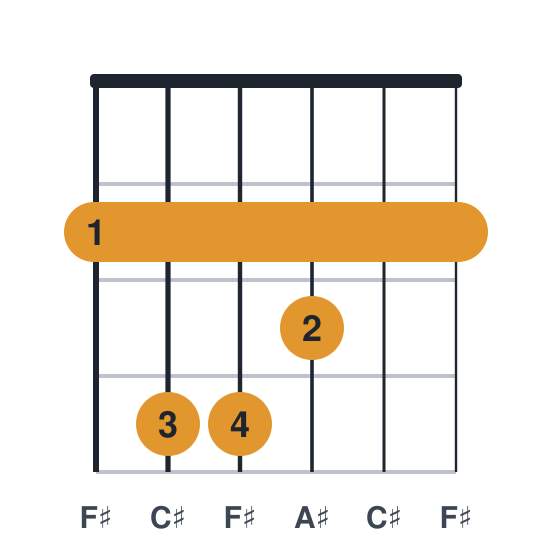
- F#the plain major, one note apart
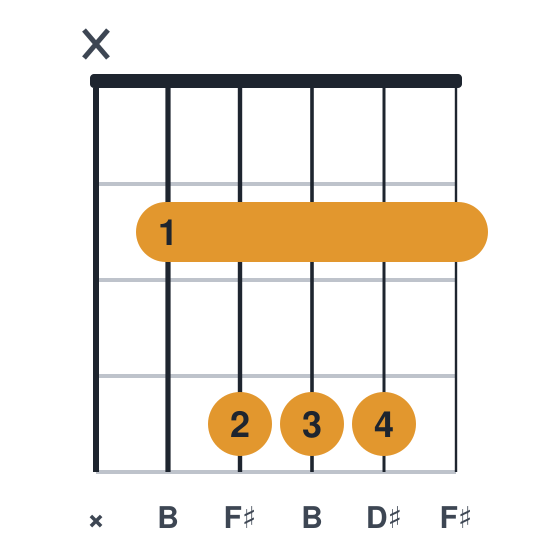
- Bwhere F#aug usually resolves
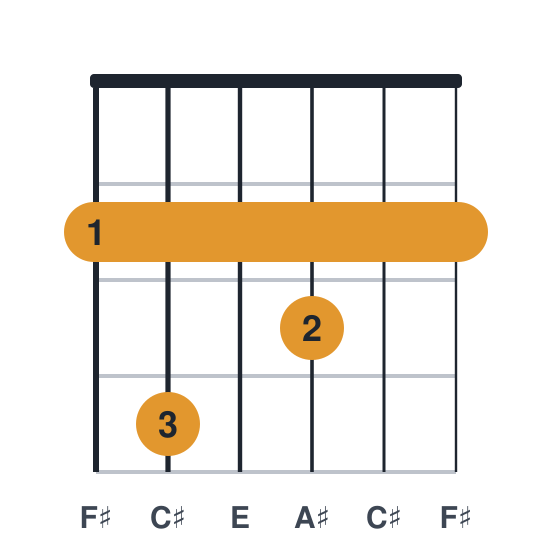
- F#7another chord built to push forward
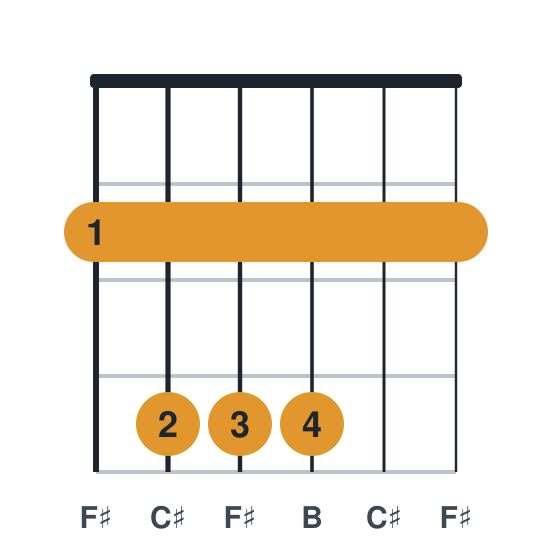
- F#sus4another color built on the same root, pulling elsewhere


Other F# chords
F#aug guitar chord chart (xx4776) from melodician.com